Sep 2026· IEEE Transactions on Mobile Computing· Vol 25, pp. 13523-13542· 8 citations· 46 references
Computer Science
Abstract
This paper investigates a dynamic heterogeneous mobile edge computing network (HMECN), where mobile devices (MDs) could offload their full tasks to a small base station (SBS) directly or the macro base station (MBS) in direct or relay mode. As age of information (AoI) is a comprehensive and accurate metric to capture the freshness of computation results, we formulate a long-term weighted sum AoI (LWSA) minimization problem in the HMECN by jointly optimizing the offloading decisions of MDs as well as the bandwidth and computation resource allocation of all base stations, subject to energy, delay and peak AoI constraints. To address the formulated non-convex mixed integer nonlinear programming problem, we decompose it into the offloading decision optimization (ODO) top-problem and the resource allocation optimization (RAO) sub-problem. Based on the decomposition, we propose a federated learning (FL)-assisted hybrid DRL and convex approach that is comprised of a safe multi-agent DRL algorithm, convex optimization and FL. The ODO top-problem is solved by the safe multi-agent DRL algorithm, which strictly ensures that the actions of each agent do not exceed its energy constraint and then paves the way for using convex optimization to solve the RAO sub-problem. FL is used to alleviate the training instability problem aggravated by multi-agent settings via breaking the limitation of partial knowledge for each individual agent. Simulation results demonstrate the superiority of the proposed approach in terms of the LWSA, convergence, scalability and robustness in dynamic environments.

A Prioritized Adaptive Weighting based on Deep Deterministic Policy Gradient (PAW-DDPG) as an enhanced Deep Deterministic Policy Gradient (DDPG) algorithm to minimize both processing delay and energy consumption by jointly optimizing user scheduling, partial-task offloading, and UAV trajectory is proposed.
W. Saber, Hanan Algamil, Fifi Farouk et al.· Future Internet· 0 citations
HALO, a hierarchical auction-assisted learning framework that combines auction-based task association with hierarchical Proximal Policy Optimization for resource allocation, is proposed, highlighting HALO's ability to maintain stable and efficient performance under varying traffic conditions, making it well-suited for...
Xuli Cai, P. Lohan, S. Trankatwar et al.· arXiv.org· 0 citations
Findings validate the efficacy of incorporating swarm intelligence into the 5G architectures as a viable and self-optimizing solution for the promotion of connectivity and signal power performance in the next-generation high-density wireless networks.
H. Lasisi, H. B. Omodeni, B. Aderinkola et al.· 0 citations
The flexible deployment of uncrewed aerial vehicles (UAVs) and the wide-area coverage of low Earth orbit (LEO) satellites make their integration in space–air–ground integrated networks (SAGINs) a promising solution for communication in resource-constrained remote areas. This paper proposes a SAGIN framework supporting...
Haosheng Chen, Haixia Cui, Peng Cao et al.· IEEE Transactions on Wireles...· 0 citations
Integrated Terrestrial–Non-Terrestrial Networks (ITNTN), which combine terrestrial base stations (BSs), High-Altitude Platform Stations (HAPS), and Low-Earth Orbit (LEO) satellites, are key enablers of 6G communication and edge computing (EC) services. However, energy-limited BSs, particularly HAPS and satellites, pose...
Insaf Rzig, W. Jaafar, Safwan Alfattani· International Conference on...· 0 citations
Related blog posts
MIT News · Artificial Intelligence· news.mit.eduOct 2, 2026
A weeklong summer workshop brought higher education faculty to campus to explore how AI and machine learning materials can be adapted for their classrooms.
MIT News · Artificial Intelligence· news.mit.eduAug 27, 2026
A new machine-learning framework aims to improve the success rate of computational protein design while moving away from results that reproduce sequences found in nature.
Microsoft Research Blog· microsoft.comAug 20, 2026
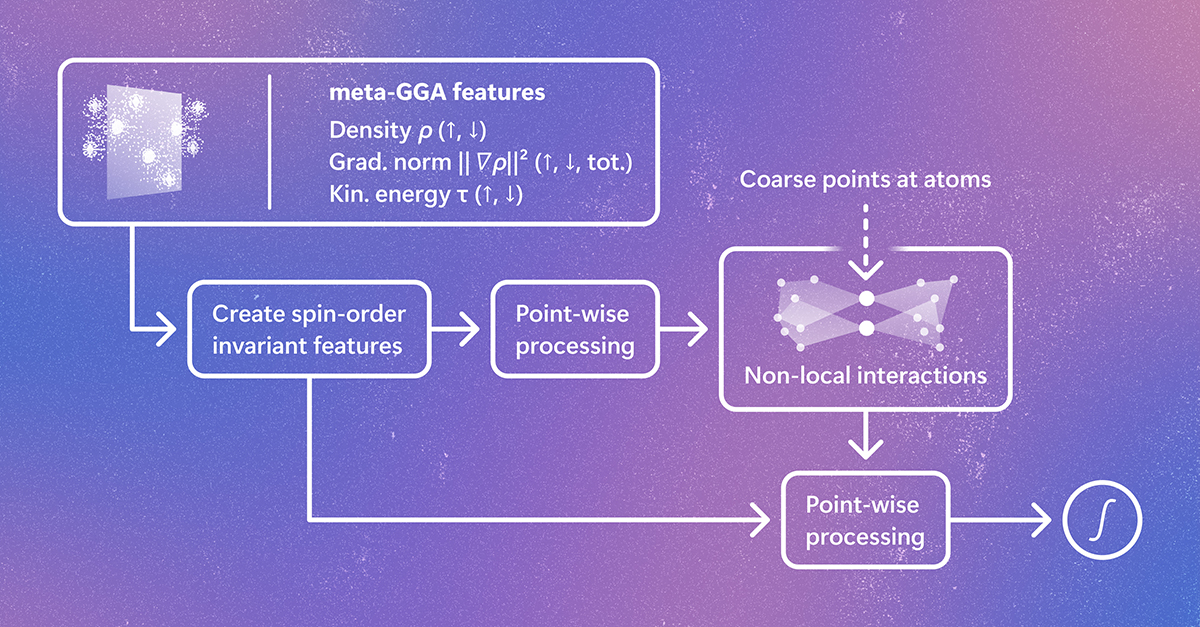
Skala 1.1, the updated deep-learning exchange-correlation functional from Microsoft Research, provides greater accuracy, expanded accessibility across the computational chemistry ecosystem, and a living benchmark to track computational performance. The post Broadening access to Skala creates a faster path to predictive DFT appeared first on Microsoft Research.
We use cookies to run the site and, with your consent, for analytics and to show ads.
See our Cookie Policy.