Backtests covering 2014-2024 across seven equity indices show that the model achieves higher Sharpe ratios than the baselines while maintaining near-zero benchmark correlations and competitive drawdowns.
Abstract
Market-neutral portfolios aim to generate consistent returns while offsetting systematic market risk. Traditional approaches based on factor models or convex optimization often underperform during market regime shifts or when structural assumptions break down. We propose AlphaZeroBeta, a deep reinforcement learning framework designed to deliver benchmark-relative alpha (excess returns) with near-zero beta (market neutrality). AlphaZeroBeta combines a composite reward function that balances risk-adjusted excess return, benchmark correlation, and transaction costs with a CNN-GRU policy trained end-to-end via Recurrent PPO and evaluated through a rolling walk-forward protocol. Backtests covering 2014-2024 across seven equity indices show that the model achieves higher Sharpe ratios than the baselines while maintaining near-zero benchmark correlations and competitive drawdowns.
When economic structures and market dynamics shift, classic portfolio rebalancing algorithms often suffer from unstable and degraded performance. To improve the return and robustness of portfolio management, we explore reinforcement learning (RL) and propose Scenario-Context Rollout (SCR), a macroeconomics-guided feedb...
Vanya Priscillia Bendatu, Yao Lu· Proceedings of the 32nd ACM...· 0 citations
Algorithmic trading now represents a market exceeding $20 billion, where even marginal gains in signal robustness can translate into economically significant returns. Existing evaluations of equity prediction models do not explicitly target regime robustness during hyperparameter selection. Five model classes are train...
A key puzzle in finance is why algorithmic traders with advanced neural models sometimes fail to beat simple traditional strategies, while in other cases they clearly outperform them. This study argues that such variation depends on how information is reflected in market prices. When markets are highly efficient, price...
H. Sahu, Avishek Bhandari· Discover Artificial Intellig...· 0 citations
Portfolio optimization is a fundamental problem in finance which has normally been addressed by mean-variance frameworks and their extensions. However, these methods rely on assumptions such as normally distributed returns and covariance estimates which often fail to capture the dynamics of real markets. Advances in ma...
Steven Itti Leon, Rishi V. N., Venkatakrishnan K. V. et al.· International Conference on...· 0 citations
This work offers a highly adaptable framework that successfully aligns multi-objective algorithmic trading with diverse, real-world human sustainability preferences and integrates a Preference Elicitation framework using Gaussian Processes.
Giovanni Dispoto, Marcello Restelli, Carmine Ventre· 0 citations
Financial markets are challenging to navigate due to changing regimes, high volatility, and unpredictable investor behavior, often leading to model misspecification in classical stationary frameworks like Moving Average (MA) and Autoregressive (AR) models. To address this, we propose an uncertainty-aware framework that...
A. Verma, Arti M. K., Surjeet Kumar· International Conference Com...· 0 citations
Related blog posts
MIT News · Artificial Intelligence· news.mit.eduOct 2, 2026
Martin Trust Center Managing Director Bill Aulet introduces Dear Dreamer, a free platform for middle and high school students who want to learn about entrepreneurship.
Microsoft Research Blog· microsoft.comSep 30, 2026
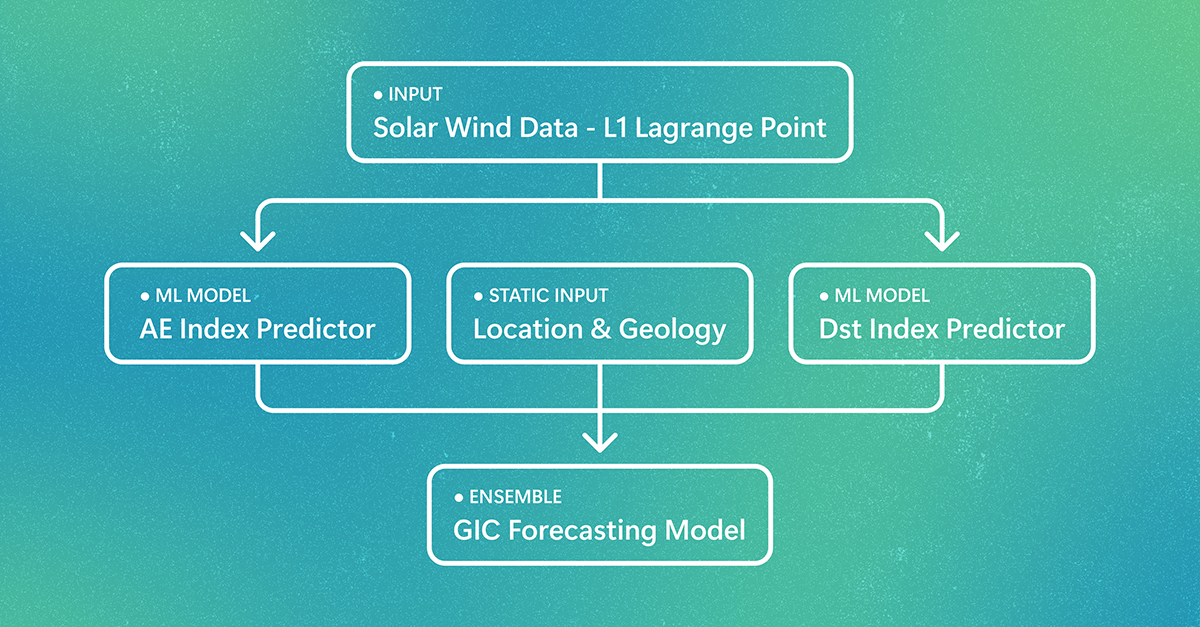
Extreme space-weather events can damage power systems on Earth and degrade GPS accuracy and satellite operations. A new machine learning system can predict where damage is likely to occur 30-60 minutes before a storm arrives. The post Forecasting space weather risks on power grids appeared first on Microsoft Research.
We use cookies to run the site and, with your consent, for analytics and to show ads.
See our Cookie Policy.