Nov 2026· International Journal of Intelligent Engineering and Systems· 0 citations
Network Security and Intrusion Detection
Abstract
Distributed denial-of-service (DDoS) traffic dominates the attack taxonomy of current Internet of Medical Things (IoMT) testbeds, and federated learning (FL) has become the accepted way of training detectors without moving patient-adjacent traffic off hospital premises.Existing federated IoMT detectors nevertheless combine conventional averaging with an off-the-shelf classifier and report results on independent and identically distributed partitions, so their published accuracy reveals little about the conditions a deployed hospital federation meets: attack variants absent from the training distribution, gradual drift in traffic composition, compromised gateways that poison the aggregate, and devices too constrained to host the full model.This paper presents FedHEAL-IoMT, a three-tier framework treating those conditions as one coupled problem.An evidential head emits Dirichlet concentration parameters whose total uncertainty acts as an open-set alarm and, through an exponentially weighted shift statistic, as a label-free drift trigger; a trust-weighted rule gates outlying updates by geometric-median deviation, evaluated inside a two-server secure-computation protocol that reveals no individual update, distance or trust score, before a differentially private secure sum; and a normalized-cost rule places the split-learning cut layer per device class.Validation spans CICIoMT2024, WUSTL-EHMS-2020, ECU-IoHT and CICIoT2023.On CICIoMT2024 FedHEAL-IoMT attains 99.41% accuracy under homogeneous partitions against 99.35% for the strongest baseline, a difference of 0.06 points lying inside the seed spread, while raising macro-F1 by 4.57 points at Dirichlet α = 0.1, open-set area under the receiver operating characteristic curve by 4.31 points over the strongest zero-day baseline, and accuracy under 30% non-adaptive malicious gateways by 5.34 points over the strongest robust comparator, FedMADE, and 8.01 over Krum, at 71.9% lower peak resident memory measured on the Raspberry Pi 4B gateway platform.Code, configurations, seeds and per-seed results are released publicly.

The results indicate that software engineering work practices are chosen opportunistically, adapted and configured to provide value under the constrains imposed by the startup context.
Nicolò Paternoster, Carmine Giardino, M. Unterkalmsteiner et al.· Information and Software Tec...· 394 citations· ⚡54
This state-of-practice investigation was performed using a literature review followed by a multiple-case study approach and presents how inconsistency between managerial strategies and execution can lead to failure by means of a behavioral framework.
Carmine Giardino, Xiaofeng Wang, P. Abrahamsson· International Conference on...· 175 citations· ⚡19
This study conducts a case survey study based on the secondary data of the major pivots happened in 49 software startups, and demonstrates that customer need pivot is the most common among all pivot types.
Sohaib Shahid Bajwa, Xiaofeng Wang, Anh Nguyen-Duc et al.· Empirical Software Engineeri...· 127 citations· ⚡15
It is found that roles of MVPs in startups were not fully aware by entrepreneurs, and entrepreneurs should consider a systematic approach to fully explore the value of MVP, as a multiple facet product (MFP).
Anh Nguyen-Duc, P. Abrahamsson· International Conference on...· 93 citations· ⚡9
It is found that what perceived as biggest challenges by software startups do vary across different life cycle stages, even though its significance decreases when the learning focuses of the startups move from problem to solution and their products mature.
Xiaofeng Wang, Henry Edison, Sohaib Shahid Bajwa et al.· International Conference on...· 62 citations· ⚡6
A comprehensive overview of how enhanced sampling methods are reshaping the field, with a particular focus on the data-driven construction of collective variables, is provided.
Kai Zhu, Enrico Trizio, Jintu Zhang et al.· Chemical Reviews· 58 citations
Related blog posts
MIT News · Artificial Intelligence· news.mit.eduNov 17, 2026
By studying the computational foundations of language learning, Associate Professor Jacob Andreas builds intelligent systems that can communicate effectively with humans.
MIT News · Artificial Intelligence· news.mit.eduNov 17, 2026
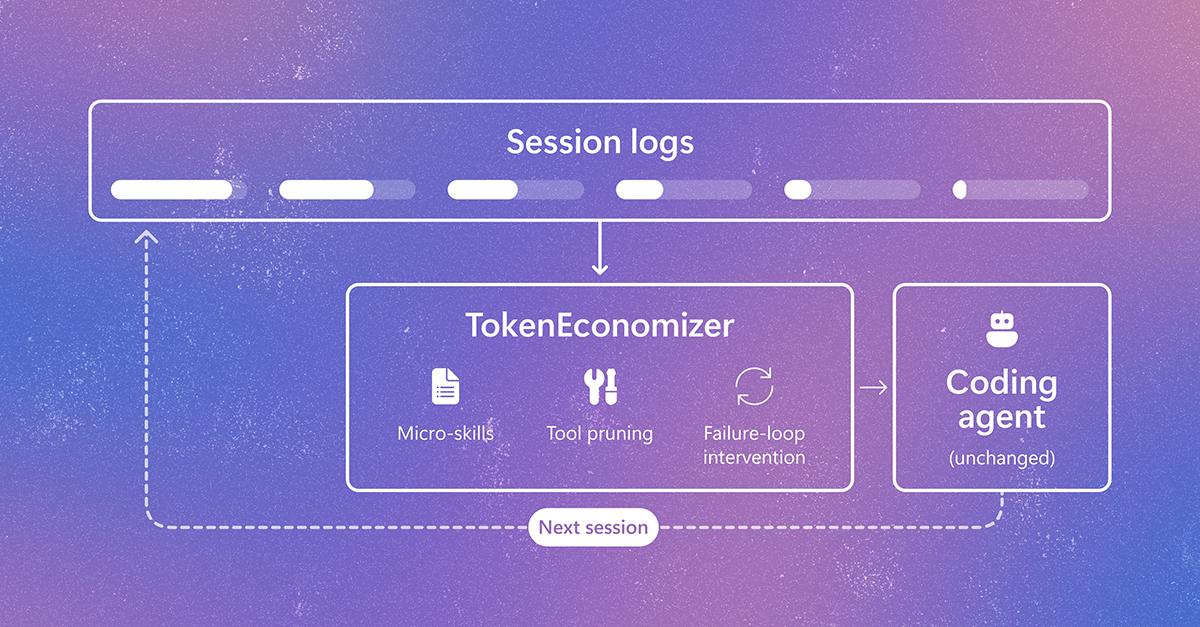
AI coding agents are increasingly help developers fix bugs and build features largely on their own, but every interaction with their models consumes tokens. In each session, an agent sends instructions, tool descriptions, and session history to its model. Most efforts to reduce this cost focus on individual tasks. Yet developers return to the same […] The post TokenEconomizer: Learning from Experience to Make AI Coding Agents More Efficient appeared first on Microsoft Research.
MIT News · Artificial Intelligence· news.mit.eduNov 9, 2026