
Q&A: Why building math muscles remains important in the AI era
Assistant Professor John Urschel explains why learning the fundamental skills of mathematics is still essential despite the evolution of AI tools.
More from the blog
Can AI help build a healthier future?
What can AI enable in medicine, and how do we get there? Microsoft Research lead Doug Burger, Microsoft Principal Research Manager Ava Amini, Microsoft Chief Scientific Officer Eric Horvitz, and physician-scientist Eric Topol of Scripps Research explore these questions and more. The post Can AI help build a healthier future? appeared first on Microsoft Research.
Learning the language of machine learning
By studying the computational foundations of language learning, Associate Professor Jacob Andreas builds intelligent systems that can communicate effectively with humans.
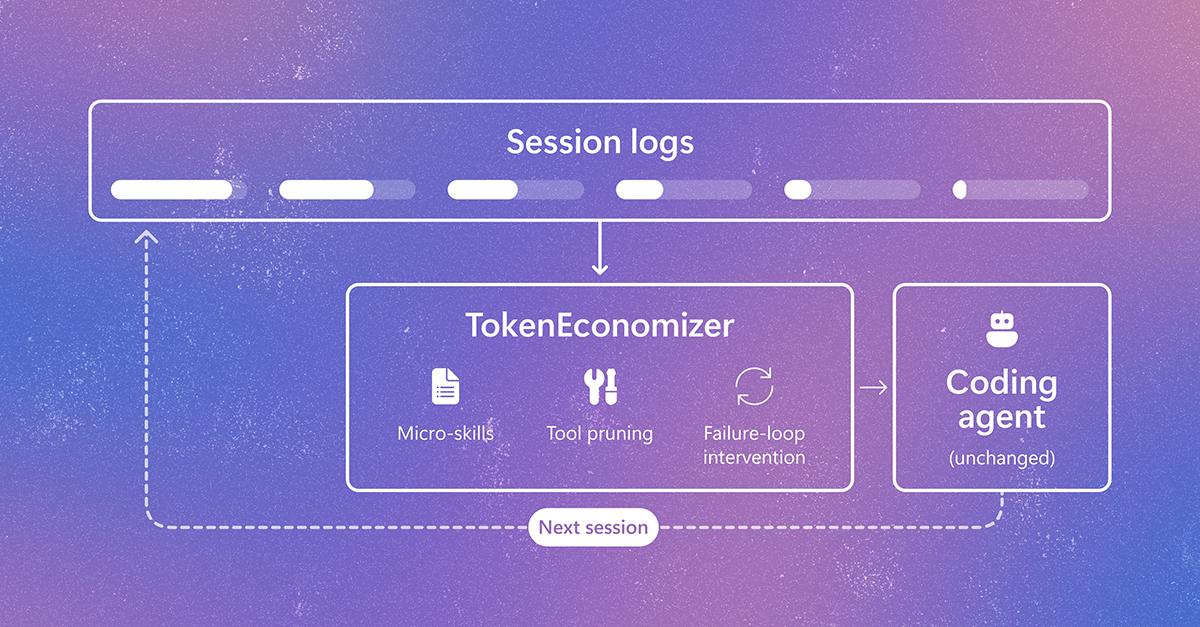
TokenEconomizer: Learning from Experience to Make AI Coding Agents More Efficient
AI coding agents are increasingly help developers fix bugs and build features largely on their own, but every interaction with their models consumes tokens. In each session, an agent sends instructions, tool descriptions, and session history to its model. Most efforts to reduce this cost focus on individual tasks. Yet developers return to the same […] The post TokenEconomizer: Learning from Experience to Make AI Coding Agents More Efficient appeared first on Microsoft Research.
Build a Robot Pick-and-Place Simulation with SimReady Assets
A Blog post by NVIDIA on Hugging Face
Related papers
Token-Mol 1.0: tokenized drug design with large language models
Token-Mol is presented, a token-only 3D drug design model that encodes both 2D and 3D structural information, along with molecular properties, into discrete tokens, which introduces a Gaussian cross-entropy loss function tailored for regression tasks, enabling superior performance across multiple downstream application...
mRNABERT: advancing mRNA sequence design with a universal language model and comprehensive dataset
The authors develop mRNABERT, a foundational AI model that designs entire mRNA sequences and demonstrates superior performance across comprehensive benchmarks, which signifies a substantial leap forward in mRNA research and therapeutic development.
Time for AI (Ethics) Maturity Model Is Now
It is argued that AI software is still software and needs to be approached from the software development perspective, and whether the focus should be on AI ethics or the quality of an AI system, called a maturity model for the development of AI systems is discussed.
Unified and explainable molecular representation learning for imperfectly annotated data from the hypergraph view
OmniMol is presented, a framework using hypergraphs to improve predictions of molecular properties, addressing challenges of imperfect data annotation and enhancing model explainability, and achieves state-of-the-art performance in properties prediction.