Progress-Aware Distillation (ProD) is proposed, which explicitly detects and penalizes stagnation in student-generated trajectories and encodes the stagnation gap between student and teacher into an adaptive margin for dynamically penalizing possible stagnation.
Abstract
While LLM-based agent systems have demonstrated remarkable proficiency in reasoning and solving complex real-world tasks, they also come with substantial token consumption and inference latency, limiting their practical deployment. To enhance the efficiency of agent systems, recent efforts have focused on transferring agentic capabilities from large-scale models to small language models (SLMs) via supervised fine-tuning-based distillation. Nevertheless, as interaction trajectories grow longer, involving extended reasoning-action chains and extensive environmental feedback, distilled student agents tend to experience progress stagnation: becoming trapped in unproductive loops characterized by persistent failed strategies and difficulty making meaningful progress. Our systematic analysis shows that this phenomenon consistently occurs across diverse SLMs and task domains. To address this issue, we propose Progress-Aware Distillation (ProD), which explicitly detects and penalizes stagnation in student-generated trajectories. ProD encodes the stagnation gap between student and teacher into an adaptive margin for dynamically penalizing possible stagnation. By iteratively applying this procedure, ProD enables student agents to progressively approximate teacher behavior. Extensive experiments involving 8 SLMs, ranging from 0.6B to 8B parameters, on both in-domain and out-of-domain benchmarks, demonstrate that ProD substantially mitigates progress stagnation while enhancing both the success rates and task-completion efficiency of distilled SLM agents.

CAST, a critique-aware training framework that converts sparse task outcomes into action-level supervision for critique learning and policy optimization, is presented, demonstrating that critique-aware training improves the robustness of LLM agents in realistic dynamic environments.
Amir Saeidi, Zeng Zhang, Rishi Singh et al.· 2 citations
Experimental results show that CataOPD outperforms current baselines, extends independent student reasoning to still-unrecovered problems, and improves out-of-distribution generalization under catalyst-free inference.
Wen-Jin Liu, Chen-Xi Wang, Jia-Pu Wang et al.· 0 citations
River, a simple training recipe that improves reward quality by filtering low-quality environments and augmenting outcome rewards with process-level behavior regularization is proposed, which achieves the best performance among evaluated open-source RL-trained 8B models across four terminal-agent benchmarks.
Yi-Fan Yao, Bo Pang, Xuan-Phi Nguyen et al.· 2 citations
Recently, coding agents have emerged as a dominant paradigm for real-world software engineering (SWE) scenarios, which solve complex tasks through multi-turn interactions with development environments. However, frequent interactions with environments would inevitably introduce substantial token overhead, leading to hig...
Hao-Bin Li, Liang Jiang, Zhen-Yu Huang et al.· 0 citations
Multi-agent discussion produces reasoning collaboratively, while deployment still relies on a smaller student that must answer alone. Full-graph distillation transfers such discussions by treating each correct solution as a separate training target, but what teachers provide need not match what the student learns. This...
Men-Tao Zhou, Jian-Xiao Wang, Xiu-Peng Chen et al.· 0 citations
Explicit intermediate reasoning gives large language models (LLMs) a stronger problem-solving mode. We study learning from this think-mode advantage via on-policy distillation (OPD). OPD preserves student-generated trajectories and provides dense token-level teacher targets at student-visited prefixes. Privileged reaso...
Wan-Qi Ren, Jian-Xiang Wang, Dan-Xuan Liu et al.· 0 citations
Learn how Google DeepMind and GovTech Singapore uses lightweight on-device Gemma models to intercept conversational scams in private chats with zero cloud data egress.
Microsoft Research Blog· microsoft.comOct 12, 2026
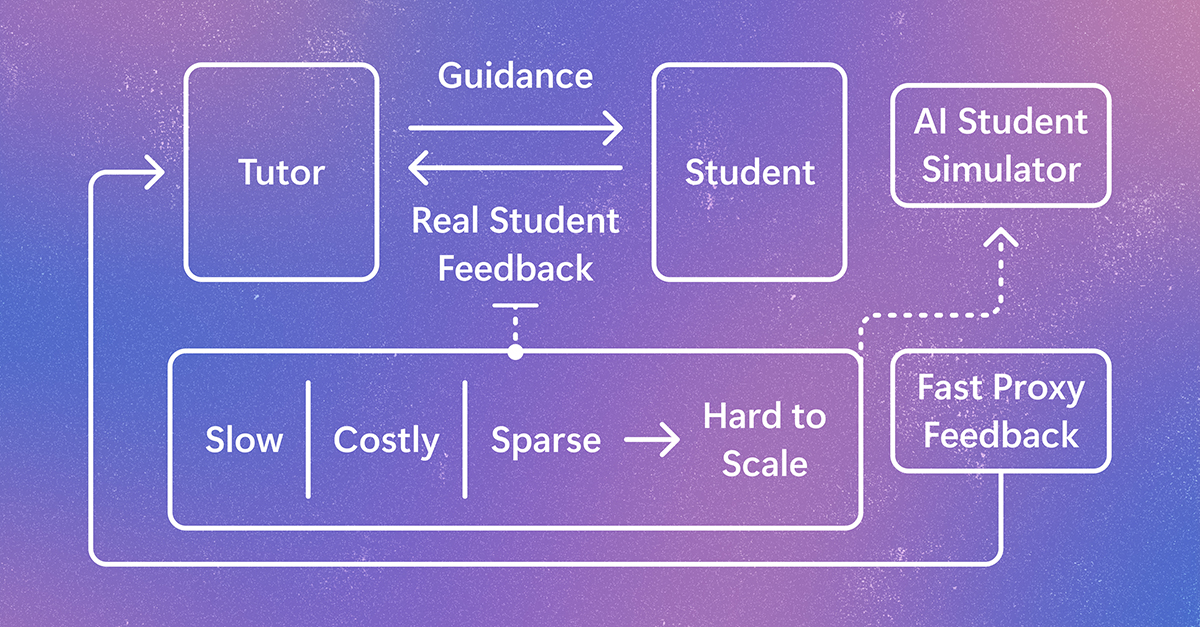
StudentSim is a research system for evaluating and improving AI tutoring tools before they are tested with learners. It models how individuals may engage with tutors, giving feedback to improve tutor performance across subjects like chess, writing, and mathematics. The post Simulating student learning for better AI tutoring appeared first on Microsoft Research.
Adaptive AI agents can help make BIM data more machine-readable by navigating IFC models, interpreting inconsistent information, and mapping it to defined standards. In this blog, Alok Rawat shares findings from a real-world pilot in construction workflows. The post Adaptive AI Agents in Construction Workflows appeared first on GPT-Lab.
We use cookies to run the site and, with your consent, for analytics and to show ads.
See our Cookie Policy.