The distance of a quantum code is a fundamental metric that dictates its error-correction capability. While quantum low-density parity-check (qLDPC) families such as Bivariate Bicycle (BB) codes offer a promising pathway to low-overhead fault-tolerant quantum computing, computing their distance is challenging. Current exact solvers and even search heuristics that provide a distance upper bound suffer from severe computational bottlenecks, restricting the discovery of optimal codes. In this paper, we construct a dataset of BB codes with corresponding distance upper bounds obtained through high-budget heuristic searches. We introduce BB-Net, an attention-based neural network architecture for predicting the distance of BB codes. It achieves 96.39% accuracy on the reference distances in the test set, compared with 94.86% for state-of-the-art heuristics with a budget of up to $10^{4}$ times more computational runtime. On a subset with certified exact distances, BB-Net achieves 98.94%. By relieving the distance-calculation bottleneck, BB-Net enables faster screening of large code spaces, particularly in ML-driven search pipelines, and thereby can accelerate the discovery of novel quantum error-correcting codes, an important capability for advancing scalable fault-tolerant quantum computing. Our code is publicly available: https://github.com/NadavSc/BBNet

It is found that Llama 3 delivers comparable quality to leading language models such as GPT-4 on a plethora of tasks, and performs competitively with the state-of-the-art on image, video, and speech recognition tasks.
This paper investigates developing real-world perception for active agents, proposes Gibson Environment for this purpose, and showcases a set of perceptual tasks learned therein.
F. Xia, Amir Zamir, Zhi-Yang He et al.· 2018 IEEE/CVF Conference on...· 1,069 citations· ⚡112
This publication proposes a definition and a classification of agile software development approaches and analyses ten software development methods that can be characterized as being "agile" against the defined criterion.
P. Abrahamsson, O. Salo, Jussi Ronkainen et al.· arXiv.org· 727 citations· ⚡54
The study shows that agile practices improve both informal and formal communication, but indicates that, in larger development situations involving multiple external stakeholders, a mismatch of adequate communication mechanisms can sometimes even hinder the communication.
M. Pikkarainen, Jukka Haikara, O. Salo et al.· Empirical Software Engineeri...· 401 citations· ⚡48
The results indicate that software engineering work practices are chosen opportunistically, adapted and configured to provide value under the constrains imposed by the startup context.
Nicolò Paternoster, Carmine Giardino, M. Unterkalmsteiner et al.· Information and Software Tec...· 394 citations· ⚡54
Related blog posts
MIT News · Artificial Intelligence· news.mit.eduOct 28, 2026
Professor Paris Smaragdis develops computers with superhuman hearing for applications like speech recognition, music understanding, and environmental monitoring.
MIT News · Artificial Intelligence· news.mit.eduOct 2, 2026
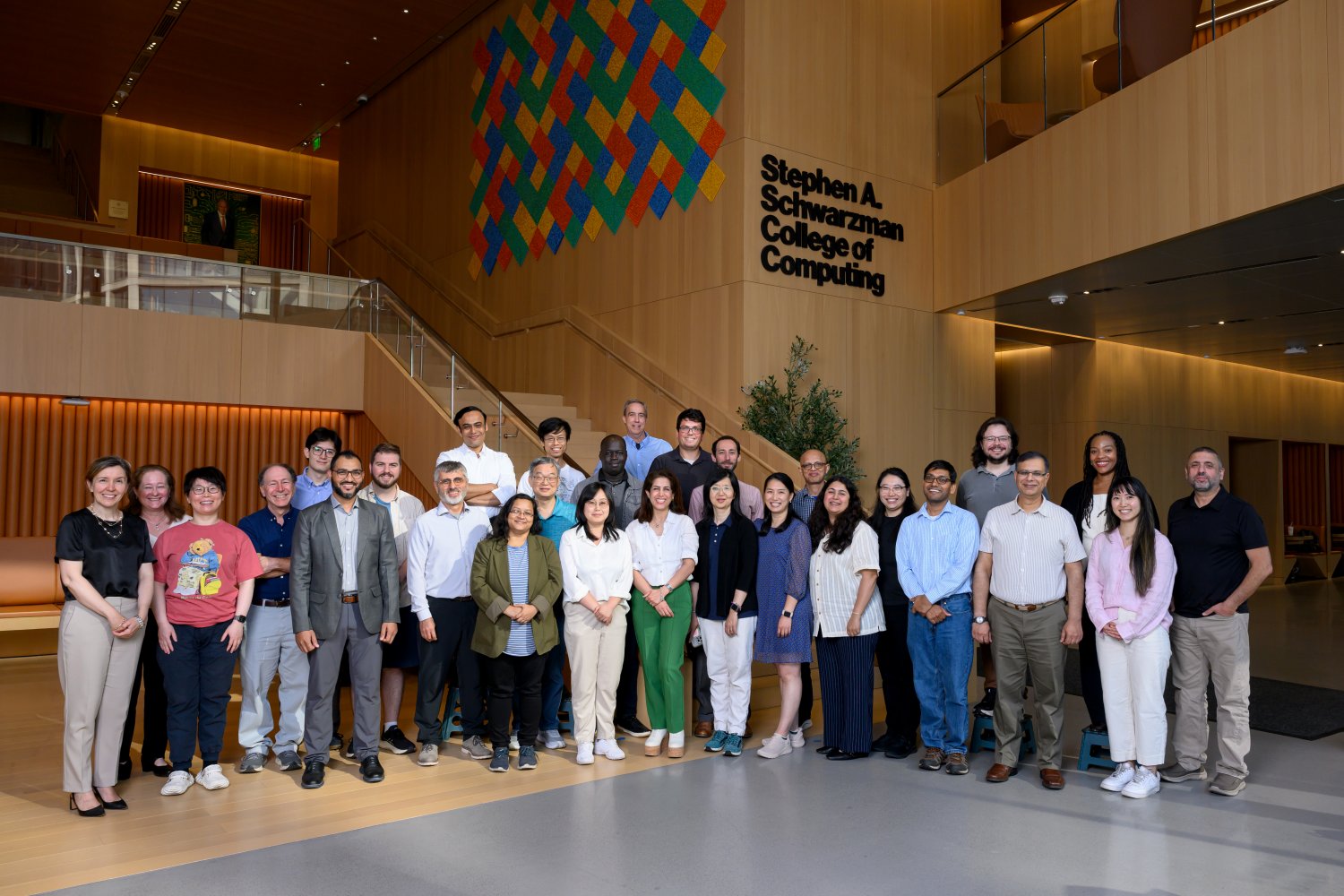
A weeklong summer workshop brought higher education faculty to campus to explore how AI and machine learning materials can be adapted for their classrooms.
MIT News · Artificial Intelligence· news.mit.eduAug 27, 2026
A new machine-learning framework aims to improve the success rate of computational protein design while moving away from results that reproduce sequences found in nature.
We use cookies to run the site and, with your consent, for analytics and to show ads.
See our Cookie Policy.