Exact Symmetry as Algebra: Group-Structured Tensors that Enforce Physical Selection Rules
Paulina HoyosShashanka UbaruDongsung HuhVasileios KalantzisKenneth L. ClarksonMisha KilmerHaim AvronLior Horesh
Oct 2026
Artificial IntelligenceMachine Learning
Abstract
Symmetry determines which physical responses of molecules and crystals are allowed and underlies many models used throughout the physical sciences. Yet several widely used machine-learned models learn symmetry only approximately from data, raising the question of whether approximate symmetry is sufficient for scientific prediction. Using the Orb-v3 force field, we show that it is often not: the relaxed space group of a crystal depends on the orientation of the input for $47\%$ of a $150$-crystal subsample, and relaxation lowers the space group for half of all $399$ crystals studied. To characterize, quantify, and correct such failures, we introduce a tensor algebra, $\star_G$, defined by convolution over a finite symmetry group and applicable to tensors with noncommuting entries. We prove that the symmetry group determines the algebra's block-diagonal transform and use this structure to analyze model errors on symmetric targets. The resulting projections decompose the average squared error into orthogonal components arising from selection-rule violations, inconsistencies across symmetry-related inputs, and residual error. The removable components reveal how much error arises from broken symmetry, provide reference-free lower bounds on prediction error, and can be eliminated without sacrificing accuracy. For operators, projection followed by blockwise truncation yields the optimal symmetric low-rank approximation. Applying these projections to force predictions reduces both rates of space-group change to at most $2\%$. Exact selection rules, reference-free error bounds, and symmetry-preserving corrections are therefore available for any trained model without retraining.

This paper investigates developing real-world perception for active agents, proposes Gibson Environment for this purpose, and showcases a set of perceptual tasks learned therein.
F. Xia, Amir Zamir, Zhi-Yang He et al.· 2018 IEEE/CVF Conference on...· 1,069 citations· ⚡112
The results indicate that software engineering work practices are chosen opportunistically, adapted and configured to provide value under the constrains imposed by the startup context.
Nicolò Paternoster, Carmine Giardino, M. Unterkalmsteiner et al.· Information and Software Tec...· 394 citations· ⚡54
The possibility of inferring high-dimensional data inference in a model that consists of a prior and an auxiliary differentiable constraint given some additional information is considered, thereby allowing a range of potential applications in adapting models to new domains and tasks.
Alexandros Graikos, Esmeralda S. Whitammer, N. Jojic et al.· Neural Information Processin...· 316 citations· ⚡15
It is proved that any global minimizer of the trajectory balance objective can define a policy that samples exactly from the target distribution, and empirically demonstrate the benefits of the trajectories balance objective for GFlowNet convergence, diversity of generated samples, and robustness to long action sequenc...
Esmeralda S. Whitammer, Moksh Jain, Emmanuel Bengio et al.· Neural Information Processin...· 302 citations· ⚡60
GAOKAO-Bench is introduced, an intuitive benchmark that employs questions from the Chinese GAOKAO examination as test samples, including both subjective and objective questions that contribute a robust evaluation benchmark for future large language models and offers valuable insights into the advantages and limitations...
Xiaotian Zhang, Chun-yan Li, Yi Zong et al.· arXiv.org· 216 citations· ⚡17
An algorithm is proposed which leverages disentangled semantic factors to generate adversarial perturbation by altering controlled semantic attributes to fool the learner towards various "adversarial" targets.
Haonan Qiu, Chaowei Xiao, Lei Yang et al.· arXiv.org· 208 citations· ⚡17
Related blog posts
MIT News · Artificial Intelligence· news.mit.eduOct 13, 2026
Machine-learning networks can learn without detailed instructions from a designer. Those that do may offer insight into how the brain reorganizes itself during learning.
MIT News · Artificial Intelligence· news.mit.eduSep 29, 2026
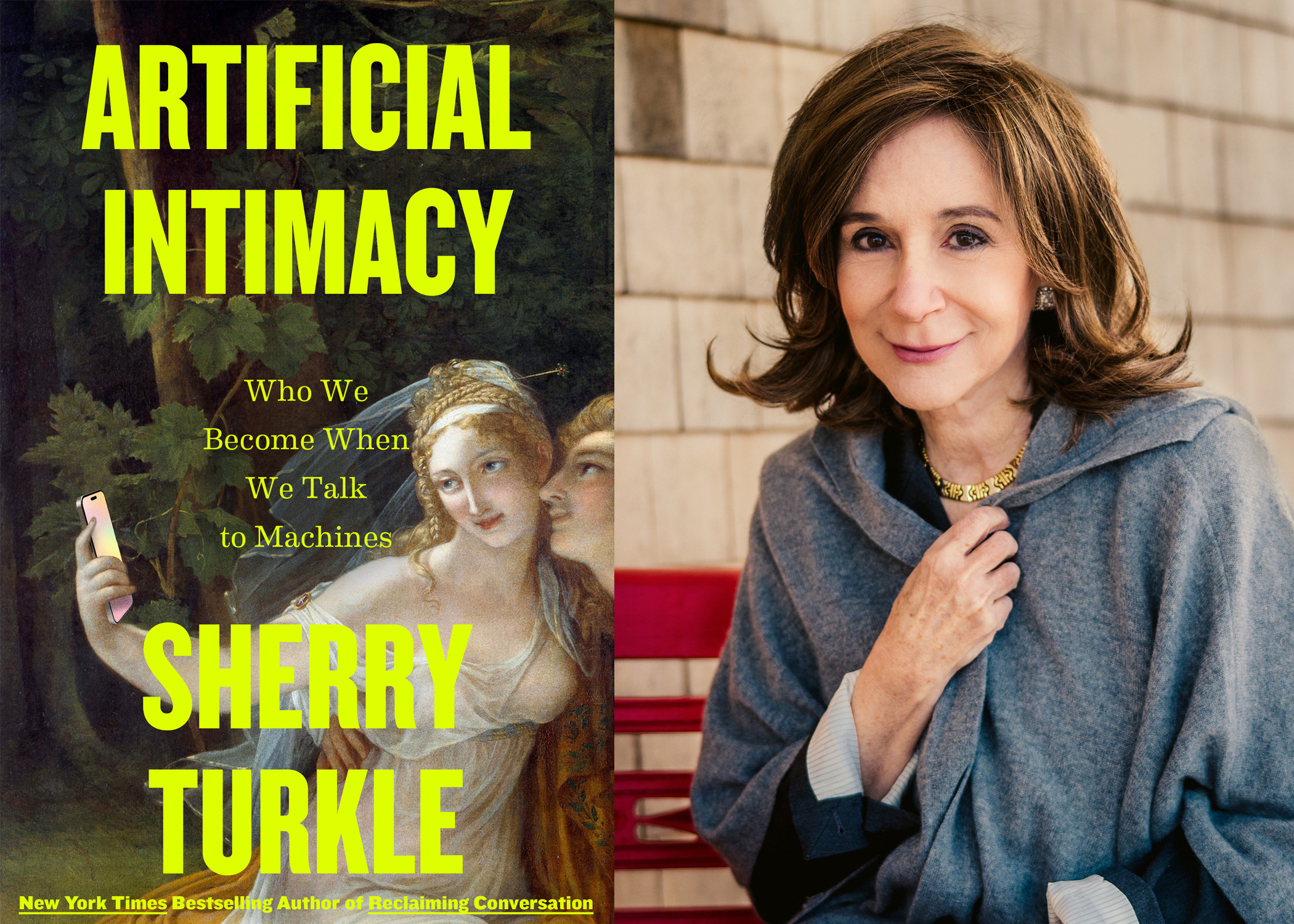
Professor Sherry Turkle’s new book, “Artificial Intimacy,” offers a withering critique of chatbots and the antisocial dynamics she believes they encourage.