AutoNovo: Agentic Program Search Discovers Transferable Nucleic Acid Design Algorithms
Joel ShorSubhashini Venugopalan
Oct 2026
Artificial IntelligenceMachine Learning
Abstract
In-silico optimization of nucleic acids relies on predictive oracles that imperfectly capture biological function, so sequences optimized against one model may exploit model-specific artifacts and fail to generalize to independent models. Recent studies have shown that not all designers generalize equally well to independent models. In this work, we use agentic program search to iteratively propose, execute, evaluate, and revise code for nucleic-acid designers. We describe the successful strategies used to prompt the search. AutoNovo designers achieved the best observed mean among the evaluated methods on 3/3 DNA-design tasks in terms of in-silico performance, and 6/6 transfer tasks in terms of independent models. The designers come from a family of discovered nucleic acid designers rather than a single universal best designer. We plan to release the resulting designers. These results are the first steps in creating nucleic acid designers that maximize cross-model generalization, and thus improving the odds that in-silico designed sequences reflect real biology.
The results indicate that software engineering work practices are chosen opportunistically, adapted and configured to provide value under the constrains imposed by the startup context.
Nicolò Paternoster, Carmine Giardino, M. Unterkalmsteiner et al.· Information and Software Tec...· 394 citations· ⚡54
The possibility of inferring high-dimensional data inference in a model that consists of a prior and an auxiliary differentiable constraint given some additional information is considered, thereby allowing a range of potential applications in adapting models to new domains and tasks.
Alexandros Graikos, Esmeralda S. Whitammer, N. Jojic et al.· Neural Information Processin...· 316 citations· ⚡15
It is proved that any global minimizer of the trajectory balance objective can define a policy that samples exactly from the target distribution, and empirically demonstrate the benefits of the trajectories balance objective for GFlowNet convergence, diversity of generated samples, and robustness to long action sequenc...
Esmeralda S. Whitammer, Moksh Jain, Emmanuel Bengio et al.· Neural Information Processin...· 302 citations· ⚡60
GAOKAO-Bench is introduced, an intuitive benchmark that employs questions from the Chinese GAOKAO examination as test samples, including both subjective and objective questions that contribute a robust evaluation benchmark for future large language models and offers valuable insights into the advantages and limitations...
Xiaotian Zhang, Chun-yan Li, Yi Zong et al.· arXiv.org· 216 citations· ⚡17
An algorithm is proposed which leverages disentangled semantic factors to generate adversarial perturbation by altering controlled semantic attributes to fool the learner towards various "adversarial" targets.
Haonan Qiu, Chaowei Xiao, Lei Yang et al.· arXiv.org· 208 citations· ⚡17
This work proposes a HALO that directly maximizes the utility of generations instead of maximizing the log-likelihood of preferences, and suggests that the best loss depends on the inductive biases most appropriate for a given setting, an oft-overlooked consideration.
Machine-learning networks can learn without detailed instructions from a designer. Those that do may offer insight into how the brain reorganizes itself during learning.
MIT News · Artificial Intelligence· news.mit.eduSep 29, 2026
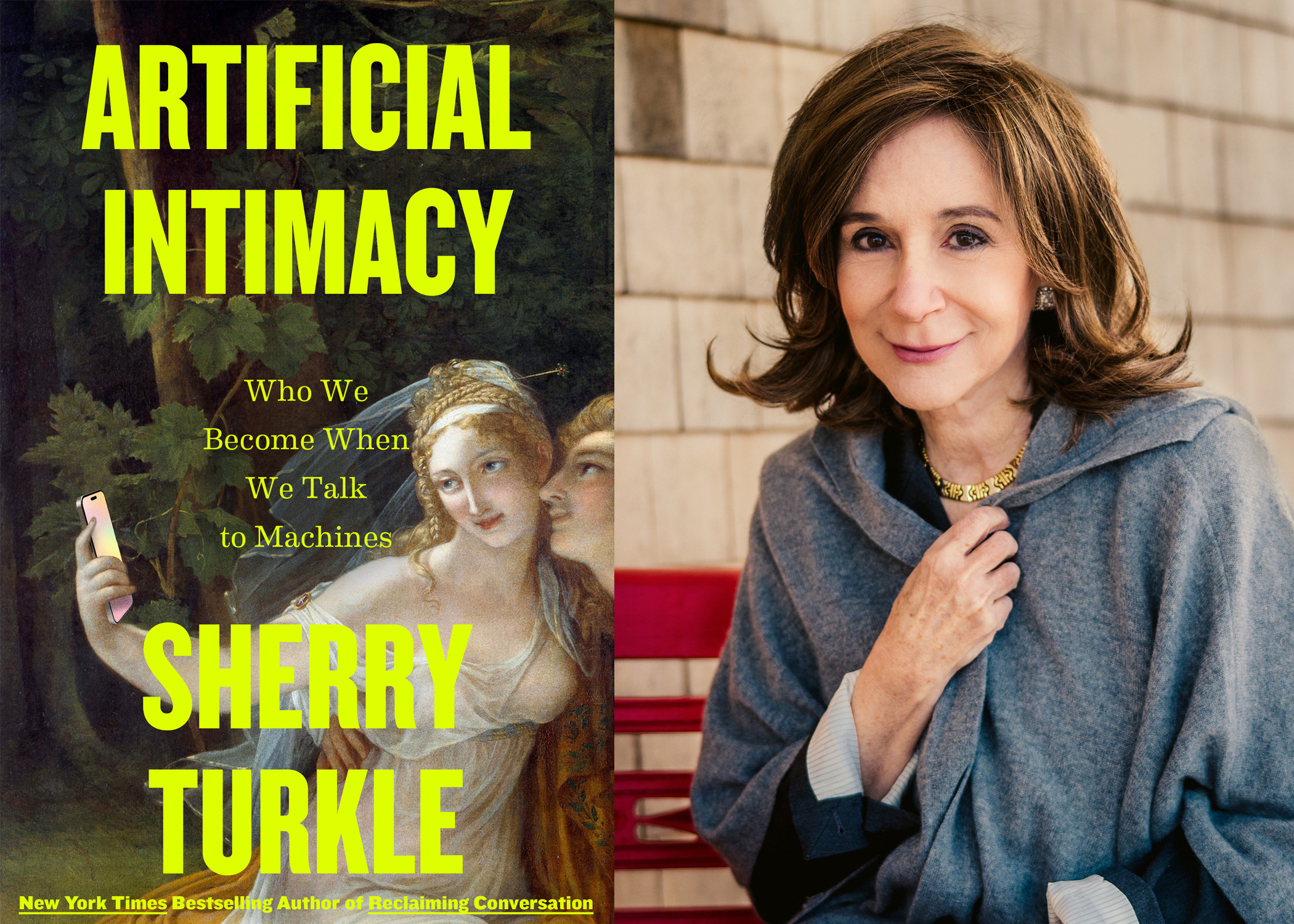
Professor Sherry Turkle’s new book, “Artificial Intimacy,” offers a withering critique of chatbots and the antisocial dynamics she believes they encourage.