Skip to content
#machine learning #quantum computing Preprint Open access

Large-Scale Benchmarking of Quantum Neural Network Configurations for Financial Time Series Forecasting

Jack Waller Xing Liang Dimitrios Makris Rajagopal Nilavalan
Oct 2026
Machine Learning Quantum Computing

Abstract

Quantum machine learning, and quantum neural networks (QNNs) in particular, are advancing fields with growing potential. Although systematic comparisons of QNN configurations have been explored primarily for classification tasks, comparatively little attention has been given to regression problems, particularly financial time series forecasting. This study presents a large-scale systematic comparative evaluation of QNN component configurations for financial time series forecasting, using the GBP/USD spot exchange rate as a case study. A grid search across encoding methods, ansatz designs, qubit counts, layer depths, and cost functions yields 1,368 distinct model configurations, each evaluated in terms of prediction accuracy, computational cost, and convergence behaviour. The results reveal unique insights into how the choice of methods influences performance, such as that gate selection and arrangement are more critical to model success than raw parameter count, and that entanglement is a system-level property of the full circuit rather than solely at the ansatz level. The best-performing QNN configuration achieves an $R^2$ score of 0.985, outperforming a classical BiLSTM baseline. Additionally, the impact of real quantum hardware noise is assessed through execution on the IQM Emerald device, revealing that gate errors and decoherence represent a significant barrier to practical deployment, with gate selection and circuit depth identified as key determinants of hardware noise resilience. Overall, the findings provide practical architectural guidance for QNN design and establish a baseline characterisation of QNN noise sensitivity on near-term quantum devices.

View source

Similar papers

#computer vision Review Sep 2017

Agile Software Development Methods: Review and Analysis

This publication proposes a definition and a classification of agile software development approaches and analyses ten software development methods that can be characterized as being "agile" against the defined criterion.

P. Abrahamsson, O. Salo, Jussi Ronkainen et al. · 727 citations · ⚡54
#computer vision Jun 2008

The impact of agile practices on communication in software development

The study shows that agile practices improve both informal and formal communication, but indicates that, in larger development situations involving multiple external stakeholders, a mismatch of adequate communication mechanisms can sometimes even hinder the communication.

M. Pikkarainen, Jukka Haikara, O. Salo et al. · 401 citations · ⚡48
#machine learning Review Open access Oct 2014

Software development in startup companies: A systematic mapping study

The results indicate that software engineering work practices are chosen opportunistically, adapted and configured to provide value under the constrains imposed by the startup context.

Nicolò Paternoster, Carmine Giardino, M. Unterkalmsteiner et al. · 394 citations · ⚡54

Diffusion models as plug-and-play priors

The possibility of inferring high-dimensional data inference in a model that consists of a prior and an auxiliary differentiable constraint given some additional information is considered, thereby allowing a range of potential applications in adapting models to new domains and tasks.

Alexandros Graikos, Esmeralda S. Whitammer, N. Jojic et al. · 316 citations · ⚡15

Related blog posts

MIT News · Artificial Intelligence Aug 27, 2026

Looking beyond natural sequences

A new machine-learning framework aims to improve the success rate of computational protein design while moving away from results that reproduce sequences found in nature.

Microsoft Research Blog Aug 20, 2026

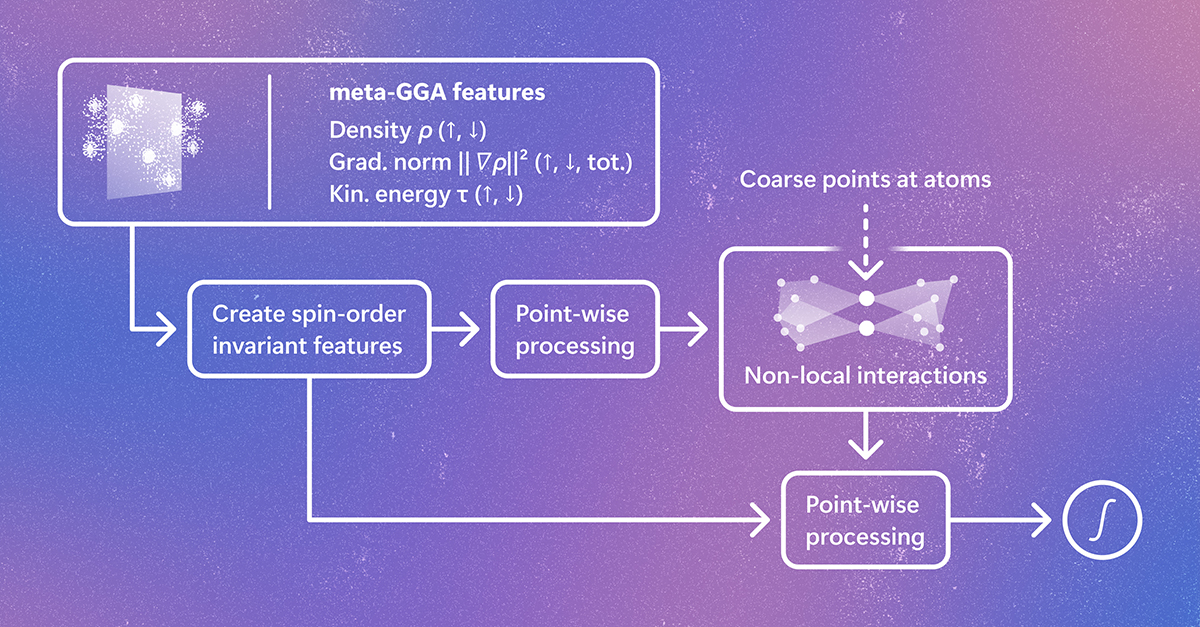
Broadening access to Skala creates a faster path to predictive DFT 

Skala 1.1, the updated deep-learning exchange-correlation functional from Microsoft Research, provides greater accuracy, expanded accessibility across the computational chemistry ecosystem, and a living benchmark to track computational performance. The post Broadening access to Skala creates a faster path to predictive DFT  appeared first on Microsoft Research.

We use cookies to run the site and, with your consent, for analytics and to show ads. See our Cookie Policy.