Rubix: Global Correspondence-Free Point Set Alignment through Assignment Geometry
Subhransu S. BhattacharjeeDylan CampbellRahul Shome
Oct 2026
Machine LearningComputer VisionRobotics
Abstract
Procrustes-Wasserstein alignment jointly estimates a matching and rotation without supplied correspondences, but alternating minimization can stop at suboptimal solutions. Rubix solves the equally weighted planar problem globally under squared Euclidean loss. Each matching $\sigma$ of two centered $n$-point sets defines a complex correlation $z_\sigma=\sum_i\bar x_i y_{\sigma(i)}$. Their convex hull is the permutation polygon: supporting vertices give optimal matchings at fixed rotations, and the farthest vertex gives the global alignment. We prove the sharp bound of $n(n-1)$ vertices for $n\ge2$, answering Rote's rotation-assignment open problem. In exact arithmetic, assignment queries recover the polygon in $\mathcal O(n^5)$ operations. Assignment-based bounds extend the approach to three-dimensional rotations and partial matching at a supplied translation through branch-and-bound. On timed MPEG-7 shape pairs, Rubix attains every numerical reference value in 12 ms on average, 50 times faster than a rotation grid at the same accuracy. Its distances improve gravity-aligned matching of real 3D scans, shape retrieval and noisy crystal classification over alternating minimization.
This publication proposes a definition and a classification of agile software development approaches and analyses ten software development methods that can be characterized as being "agile" against the defined criterion.
P. Abrahamsson, O. Salo, Jussi Ronkainen et al.· arXiv.org· 727 citations· ⚡54
The study shows that agile practices improve both informal and formal communication, but indicates that, in larger development situations involving multiple external stakeholders, a mismatch of adequate communication mechanisms can sometimes even hinder the communication.
M. Pikkarainen, Jukka Haikara, O. Salo et al.· Empirical Software Engineeri...· 401 citations· ⚡48
The results indicate that software engineering work practices are chosen opportunistically, adapted and configured to provide value under the constrains imposed by the startup context.
Nicolò Paternoster, Carmine Giardino, M. Unterkalmsteiner et al.· Information and Software Tec...· 394 citations· ⚡54
The possibility of inferring high-dimensional data inference in a model that consists of a prior and an auxiliary differentiable constraint given some additional information is considered, thereby allowing a range of potential applications in adapting models to new domains and tasks.
Alexandros Graikos, Esmeralda S. Whitammer, N. Jojic et al.· Neural Information Processin...· 316 citations· ⚡15
It is proved that any global minimizer of the trajectory balance objective can define a policy that samples exactly from the target distribution, and empirically demonstrate the benefits of the trajectories balance objective for GFlowNet convergence, diversity of generated samples, and robustness to long action sequenc...
Esmeralda S. Whitammer, Moksh Jain, Emmanuel Bengio et al.· Neural Information Processin...· 302 citations· ⚡60
Exploring how generative AI could make machine vision more accessible to businesses. The post GenEye in a Box: Making Machine Vision Something You Can Just Ask For appeared first on GPT-Lab.
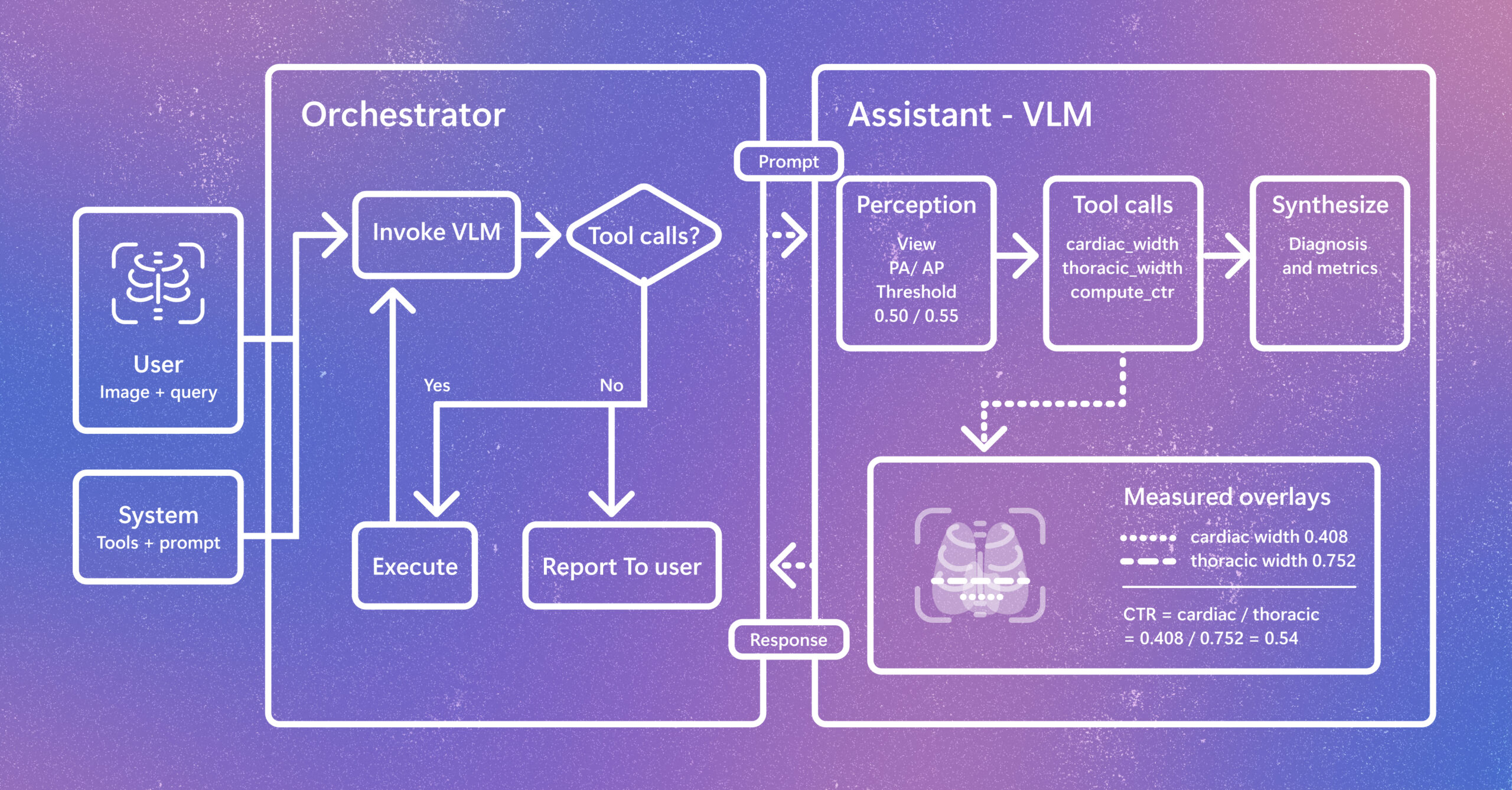
Radiology AI is evolving beyond report generation. CARE-X explores a unified approach that combines flexible reasoning, calibrated predictions, and measurement-based tools for chest X-ray interpretation. The post Introducing CARE-X: Towards Clinically Useful Radiology VLMs with Auxiliary Supervision, Reward-Aligned Learning, and Tool-Augmented Measurement appeared first on Microsoft Research.