Skip to content
#machine learning #quantum computing Preprint Open access

Physics-Aligned Electronic Ground-State Learning Improves Generalization

Eike S. Eberhard Xaver Kainz Viktor Kotsev Abdulrahman Aldossary Stephan G\"unnemann
Oct 2026
Machine Learning Quantum Computing

Abstract

Machine-learned interatomic potentials (MLIPs) excel at in-distribution tasks, accelerating drug and material development, yet they struggle to generalize out-of-distribution. We propose to push the cost-accuracy Pareto frontier by designing observable-agnostic electronic ground-state descriptor models (GSMs) with computational costs situated between MLIPs and Kohn-Sham density functional theory (KS-DFT). We align the learning objectives and architectures of GSMs with the governing equations of KS-DFT by enforcing physical constraints and removing optimization pressure on unphysical or irrelevant degrees of freedom. In our size-extrapolation experiments from QM9 to QM40, our combined contributions OrthoNormal-Loss (ON-Loss) and Grassmann Restricted Occupied-Orbital Training (GROOT) reach a 79.1% energy and 83.4% force mean absolute error (MAE) reduction over previous state-of-the-art density GSMs. For Hamiltonian GSMs, ON-Loss and Residual Optimal-gauge Conditioning-aware KS-Eq. Training (ROCKET) together reduce the energy and force MAEs of the strongest baseline by 99.8% and 95.9%, respectively. Using a self-consistency rejection criterion, we filter out extrapolation errors on QMugs, rejecting fewer than 0.4% of predictions while reaching an energy MAE of 0.07 mHa. Finally, we demonstrate the efficiency of label-free self-consistency fine-tuning, and transfer GSMs to reactive chemistry in Transition1x, reaching energy errors below chemical accuracy.

View source

Similar papers

#computer vision Review Sep 2017

Agile Software Development Methods: Review and Analysis

This publication proposes a definition and a classification of agile software development approaches and analyses ten software development methods that can be characterized as being "agile" against the defined criterion.

P. Abrahamsson, O. Salo, Jussi Ronkainen et al. · 727 citations · ⚡54
#computer vision Jun 2008

The impact of agile practices on communication in software development

The study shows that agile practices improve both informal and formal communication, but indicates that, in larger development situations involving multiple external stakeholders, a mismatch of adequate communication mechanisms can sometimes even hinder the communication.

M. Pikkarainen, Jukka Haikara, O. Salo et al. · 401 citations · ⚡48
#machine learning Review Open access Oct 2014

Software development in startup companies: A systematic mapping study

The results indicate that software engineering work practices are chosen opportunistically, adapted and configured to provide value under the constrains imposed by the startup context.

Nicolò Paternoster, Carmine Giardino, M. Unterkalmsteiner et al. · 394 citations · ⚡54

Diffusion models as plug-and-play priors

The possibility of inferring high-dimensional data inference in a model that consists of a prior and an auxiliary differentiable constraint given some additional information is considered, thereby allowing a range of potential applications in adapting models to new domains and tasks.

Alexandros Graikos, Esmeralda S. Whitammer, N. Jojic et al. · 316 citations · ⚡15

Related blog posts

MIT News · Artificial Intelligence Aug 27, 2026

Looking beyond natural sequences

A new machine-learning framework aims to improve the success rate of computational protein design while moving away from results that reproduce sequences found in nature.

Microsoft Research Blog Aug 20, 2026

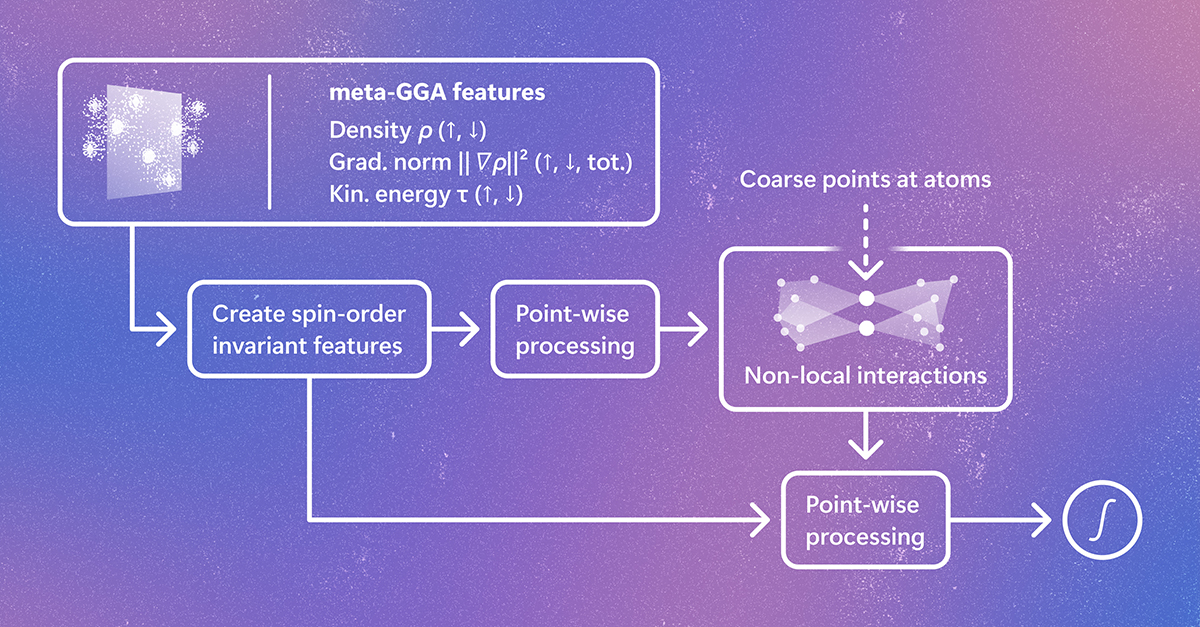
Broadening access to Skala creates a faster path to predictive DFT 

Skala 1.1, the updated deep-learning exchange-correlation functional from Microsoft Research, provides greater accuracy, expanded accessibility across the computational chemistry ecosystem, and a living benchmark to track computational performance. The post Broadening access to Skala creates a faster path to predictive DFT  appeared first on Microsoft Research.

We use cookies to run the site and, with your consent, for analytics and to show ads. See our Cookie Policy.