Existing robotic foundation policies are trained primarily via large-scale imitation learning. While such models demonstrate strong capabilities, they often struggle with long-horizon tasks due to distribution shift and error accumulation. While reinforcement learning (RL) can finetune these models, it cannot work well across diverse tasks without manual reward engineering. We propose VLLR, a dense reward framework combining (1) an extrinsic reward from Large Language Models (LLMs) and Vision-Language Models (VLMs) for task progress recognition, and (2) an intrinsic reward based on policy self-certainty. VLLR uses LLMs to decompose tasks into verifiable subtasks and then VLMs to estimate progress to initialize the value function for a brief warm-up phase, avoiding prohibitive inference cost during full training; and self-certainty provides per-step intrinsic guidance throughout PPO finetuning. Ablation studies reveal complementary benefits: VLM-based value initialization primarily improves task completion efficiency, while self-certainty primarily enhances success rates, particularly on out-of-distribution tasks. On the CHORES benchmark covering mobile manipulation and navigation, VLLR achieves up to 56% absolute success rate gains over the pretrained policy, up to 5% gains over state-of-the-art RL finetuning methods on in-distribution tasks, and up to $10\%$ gains on out-of-distribution tasks, all without manual reward engineering. Additional visualizations can be found in https://silongyong.github.io/vllr_project_page/
This publication proposes a definition and a classification of agile software development approaches and analyses ten software development methods that can be characterized as being "agile" against the defined criterion.
P. Abrahamsson, O. Salo, Jussi Ronkainen et al.· arXiv.org· 727 citations· ⚡54
The study shows that agile practices improve both informal and formal communication, but indicates that, in larger development situations involving multiple external stakeholders, a mismatch of adequate communication mechanisms can sometimes even hinder the communication.
M. Pikkarainen, Jukka Haikara, O. Salo et al.· Empirical Software Engineeri...· 401 citations· ⚡48
The results indicate that software engineering work practices are chosen opportunistically, adapted and configured to provide value under the constrains imposed by the startup context.
Nicolò Paternoster, Carmine Giardino, M. Unterkalmsteiner et al.· Information and Software Tec...· 394 citations· ⚡54
The possibility of inferring high-dimensional data inference in a model that consists of a prior and an auxiliary differentiable constraint given some additional information is considered, thereby allowing a range of potential applications in adapting models to new domains and tasks.
Alexandros Graikos, Esmeralda S. Whitammer, N. Jojic et al.· Neural Information Processin...· 316 citations· ⚡15
Exploring how generative AI could make machine vision more accessible to businesses. The post GenEye in a Box: Making Machine Vision Something You Can Just Ask For appeared first on GPT-Lab.
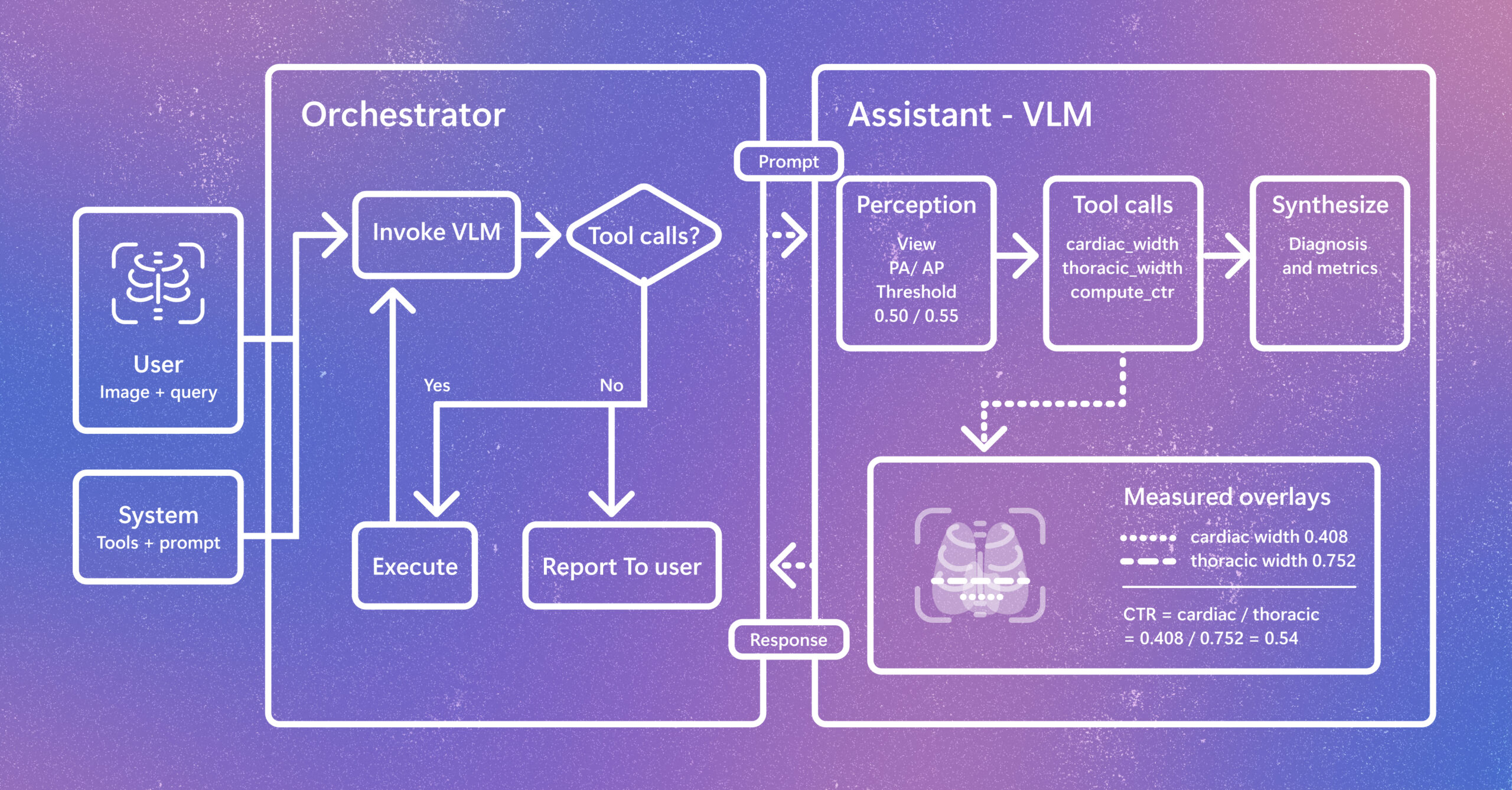
Radiology AI is evolving beyond report generation. CARE-X explores a unified approach that combines flexible reasoning, calibrated predictions, and measurement-based tools for chest X-ray interpretation. The post Introducing CARE-X: Towards Clinically Useful Radiology VLMs with Auxiliary Supervision, Reward-Aligned Learning, and Tool-Augmented Measurement appeared first on Microsoft Research.