World Action Models (WAMs) incorporate visual representations from video generation backbones to guide action prediction. Recent efficient WAMs adopt Mixture-of-Transformers (MoT) architectures and compute video representations once for reuse by the action expert. However, intra-expert iteration (\ie, multi-step action denoising) and inter-expert waiting (\ie, sequential execution of the video and action experts) still limit inference efficiency. To this end, we present RealtimeWAM, an extremely efficient WAM variant with one-step action generation and asynchronous inference, addressing these two bottlenecks. To reduce intra-expert iteration, we propose Teacher-Anchored Consistency Distillation (TACD) to address a local-global error gap: low local consistency error alone does not guarantee accurate final actions. TACD supplements local consistency with explicit supervision from the frozen teacher's multi-step rollout endpoint, enabling accurate one-step action generation. Additionally, we propose Cross-Expert Wavefront Pipelining (CEWP) to eliminate unnecessary expert-level waiting. It overlaps the two experts through block-wise sharing of the video KV cache, synchronizing only immediately before the corresponding action attention consumes it. Extensive experiments across diverse benchmarks (\eg, LIBERO, LIBERO-Plus and RoboTwin) and model variants (\eg, Fast-WAM and Faster-WAM) demonstrate the superiority of RealtimeWAM. Notably, RealtimeWAM maintains near-lossless performance (\ie, $<1\%$ drop) across these benchmarks while delivering significant end-to-end speedup (\eg, $\sim25\times$ on H100). Our code and checkpoints are available via this \href{https://github.com/ModelTC/LightX2V/tree/main/examples/realtimewam}{link}.
This publication proposes a definition and a classification of agile software development approaches and analyses ten software development methods that can be characterized as being "agile" against the defined criterion.
P. Abrahamsson, O. Salo, Jussi Ronkainen et al.· arXiv.org· 727 citations· ⚡54
The study shows that agile practices improve both informal and formal communication, but indicates that, in larger development situations involving multiple external stakeholders, a mismatch of adequate communication mechanisms can sometimes even hinder the communication.
M. Pikkarainen, Jukka Haikara, O. Salo et al.· Empirical Software Engineeri...· 401 citations· ⚡48
The results indicate that software engineering work practices are chosen opportunistically, adapted and configured to provide value under the constrains imposed by the startup context.
Nicolò Paternoster, Carmine Giardino, M. Unterkalmsteiner et al.· Information and Software Tec...· 394 citations· ⚡54
The possibility of inferring high-dimensional data inference in a model that consists of a prior and an auxiliary differentiable constraint given some additional information is considered, thereby allowing a range of potential applications in adapting models to new domains and tasks.
Alexandros Graikos, Esmeralda S. Whitammer, N. Jojic et al.· Neural Information Processin...· 316 citations· ⚡15
Exploring how generative AI could make machine vision more accessible to businesses. The post GenEye in a Box: Making Machine Vision Something You Can Just Ask For appeared first on GPT-Lab.
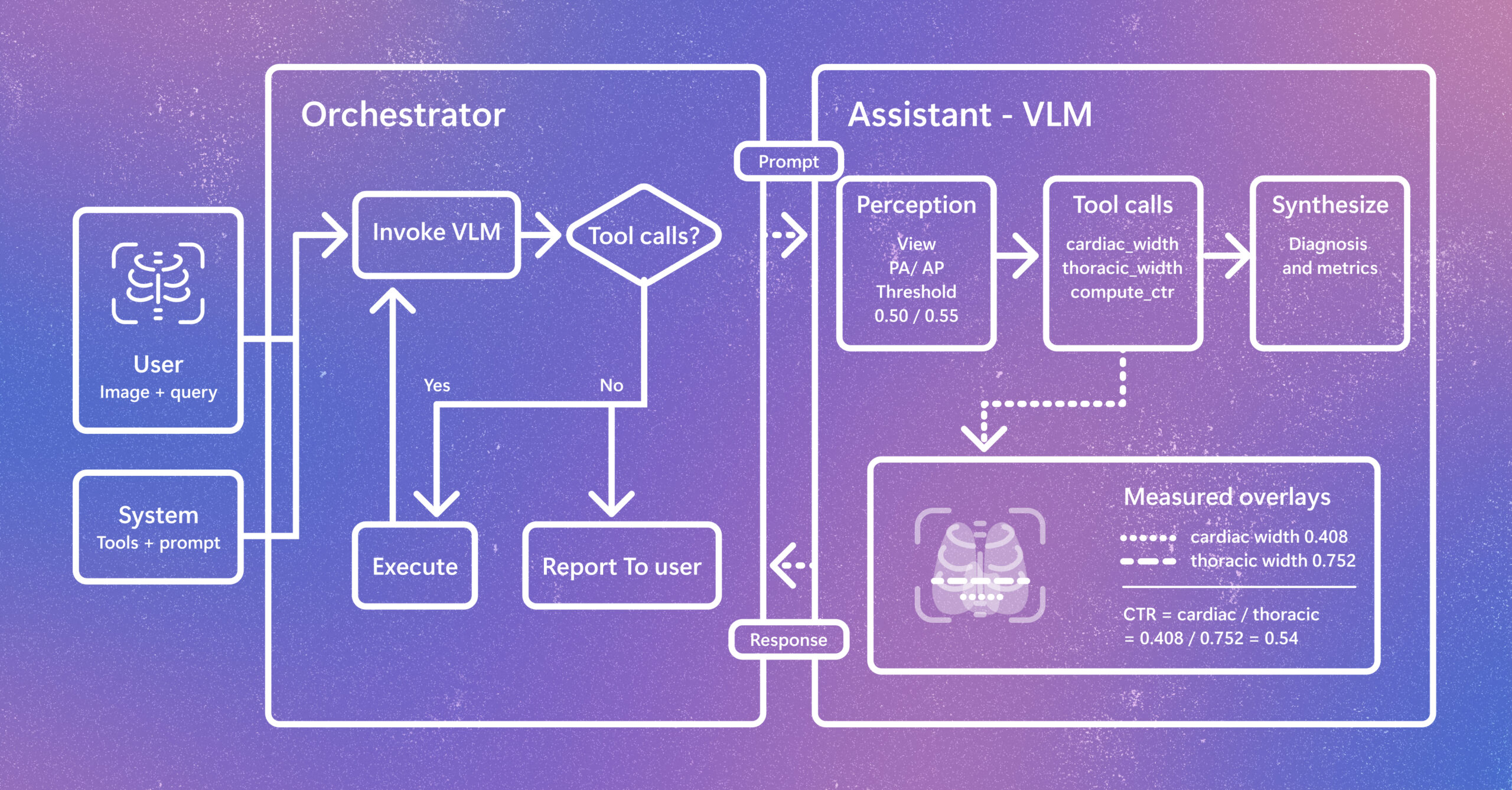
Radiology AI is evolving beyond report generation. CARE-X explores a unified approach that combines flexible reasoning, calibrated predictions, and measurement-based tools for chest X-ray interpretation. The post Introducing CARE-X: Towards Clinically Useful Radiology VLMs with Auxiliary Supervision, Reward-Aligned Learning, and Tool-Augmented Measurement appeared first on Microsoft Research.