Dual Variational Autoencoders for Efficient Sim-to-Real Transfer in Low-Cost Robotic Navigation
\'Alvaro D\'iez (Department of Computer ScienceArtificial IntelligenceUniversity of Alicante)Fidel Aznar (Department of Computer ScienceArtificial IntelligenceUniversity of Alicante)
Oct 2026
Machine LearningComputer VisionRobotics
Abstract
Vision-based autonomous navigation for low-cost robots remains a fundamental challenge, primarily due to the significant gap between simulated training environments and real-world operational conditions. Direct policy transfer from simulation is often ineffective, while training exclusively on real data is impractical. We propose a hybrid transfer learning framework that effectively bridges the sim-to-real gap by combining domain randomization with feature-level domain adaptation. Our method employs a dual convolutional variational autoencoder architecture with a shared decoder, trained on an extensive set of 45225 simulated images and a minimal set of only 4556 real-world samples. This architecture learns a compact, common latent representation space that aligns the distributions of both domains. The adaptation process is further enhanced by two complementary data augmentation techniques designed to expand the limited real-world data. Experimental evaluation demonstrates that our method achieves an average success rate of almost 91% on image classification tasks for real-world indoor navigation, significantly outperforming both simulation-only and real-world-only training. We validate these findings through a direct, real-world deployment, where the proposed policy successfully guides a low-cost robot in a reactive exploration task. Furthermore, we validate the model's efficiency through a rigorous computational estimation, confirming its suitability for resource-constrained embedded platforms such as the Raspberry Pi 4 and NVIDIA Jetson Nano. This work presents a practical solution for developing effective and efficient navigation policies for low-cost robotic systems.
This publication proposes a definition and a classification of agile software development approaches and analyses ten software development methods that can be characterized as being "agile" against the defined criterion.
P. Abrahamsson, O. Salo, Jussi Ronkainen et al.· arXiv.org· 727 citations· ⚡54
The study shows that agile practices improve both informal and formal communication, but indicates that, in larger development situations involving multiple external stakeholders, a mismatch of adequate communication mechanisms can sometimes even hinder the communication.
M. Pikkarainen, Jukka Haikara, O. Salo et al.· Empirical Software Engineeri...· 401 citations· ⚡48
The results indicate that software engineering work practices are chosen opportunistically, adapted and configured to provide value under the constrains imposed by the startup context.
Nicolò Paternoster, Carmine Giardino, M. Unterkalmsteiner et al.· Information and Software Tec...· 394 citations· ⚡54
The possibility of inferring high-dimensional data inference in a model that consists of a prior and an auxiliary differentiable constraint given some additional information is considered, thereby allowing a range of potential applications in adapting models to new domains and tasks.
Alexandros Graikos, Esmeralda S. Whitammer, N. Jojic et al.· Neural Information Processin...· 316 citations· ⚡15
It is proved that any global minimizer of the trajectory balance objective can define a policy that samples exactly from the target distribution, and empirically demonstrate the benefits of the trajectories balance objective for GFlowNet convergence, diversity of generated samples, and robustness to long action sequenc...
Esmeralda S. Whitammer, Moksh Jain, Emmanuel Bengio et al.· Neural Information Processin...· 302 citations· ⚡60
Exploring how generative AI could make machine vision more accessible to businesses. The post GenEye in a Box: Making Machine Vision Something You Can Just Ask For appeared first on GPT-Lab.
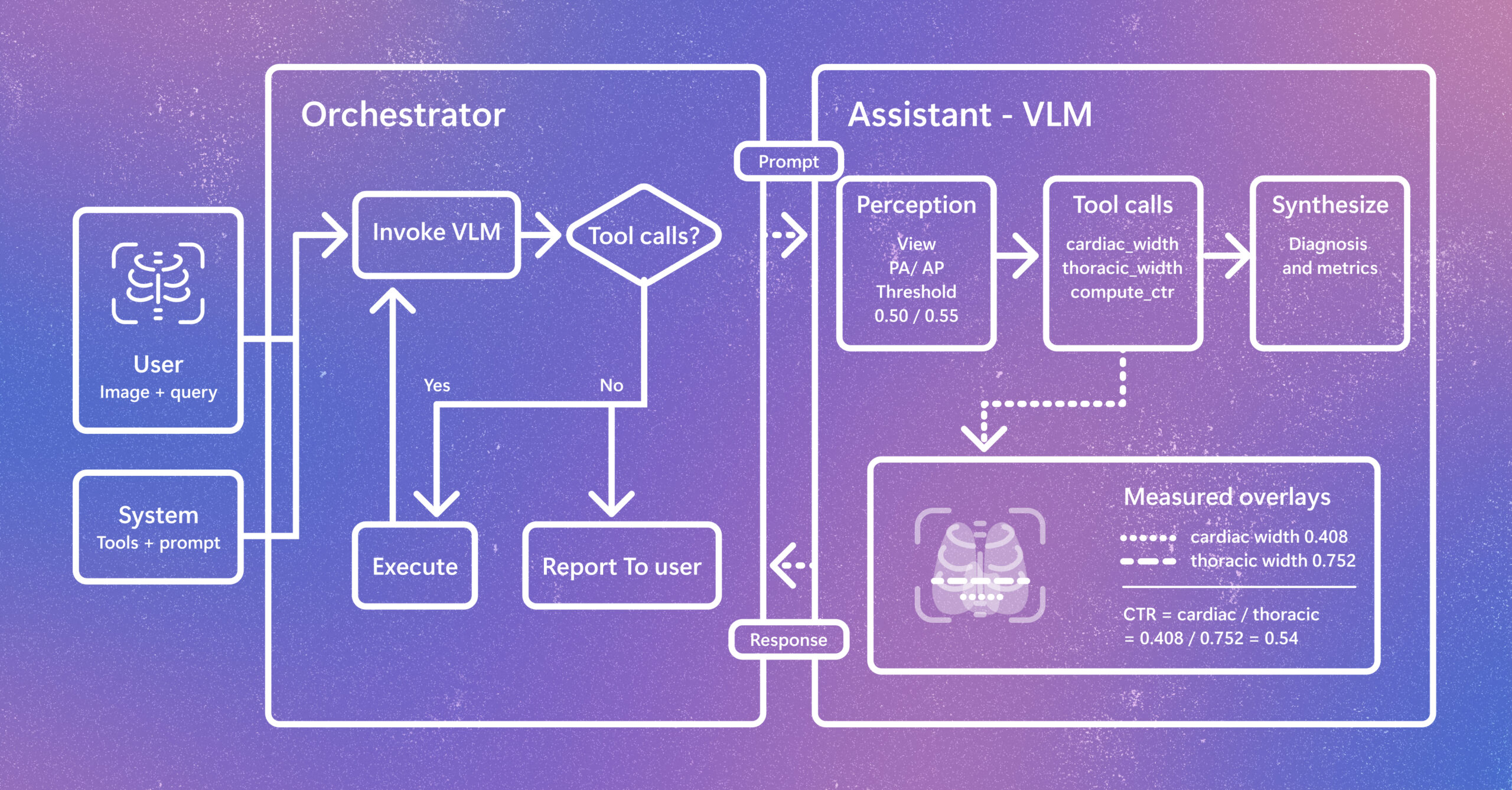
Radiology AI is evolving beyond report generation. CARE-X explores a unified approach that combines flexible reasoning, calibrated predictions, and measurement-based tools for chest X-ray interpretation. The post Introducing CARE-X: Towards Clinically Useful Radiology VLMs with Auxiliary Supervision, Reward-Aligned Learning, and Tool-Augmented Measurement appeared first on Microsoft Research.