Skip to content

Scaling Down the Scaling Laws: Parameter Efficiency and Compute-Optimal Training in Resource-Constrained Large Language Models

Oct 2026 · 0 citations · 52 references
Computer Science

Abstract

Large language models (LLMs) have achieved substantial performance gains through increases in model size, training data, and computational resources. However, traditional scaling approaches produce diminishing returns, rising financial and environmental costs, and barriers to participation for researchers operating outside large industrial laboratories. This review examines the evolution of LLM scaling theory from empirical scaling laws to compute-optimal training, with particular emphasis on parameter efficiency, token utilization, data efficiency, and resource-constrained environments. Foundational work on scaling laws is synthesized alongside later research on compute-optimal training, data pruning, efficient architectures, quantization, low-rank adaptation, and edge-oriented optimization. The literature indicates a shift from scale maximization toward more deliberate allocation of parameters, tokens, compute, and hardware resources. At the same time, important empirical, theoretical, and methodological gaps remain regarding whether scaling principles established on enterprise-grade infrastructure generalize to smaller models and constrained computing environments. This review organizes these developments into a unified framework for resource-efficient LLM training and argues that future progress should evaluate efficiency not solely through model performance, but through the relationship among performance, parameter count, computational cost, token allocation, and hardware constraints.

View source

Similar papers

#computer vision Review Sep 2017

Agile Software Development Methods: Review and Analysis

This publication proposes a definition and a classification of agile software development approaches and analyses ten software development methods that can be characterized as being "agile" against the defined criterion.

P. Abrahamsson, O. Salo, Jussi Ronkainen et al. · 727 citations · ⚡54
#computer vision Jun 2008

The impact of agile practices on communication in software development

The study shows that agile practices improve both informal and formal communication, but indicates that, in larger development situations involving multiple external stakeholders, a mismatch of adequate communication mechanisms can sometimes even hinder the communication.

M. Pikkarainen, Jukka Haikara, O. Salo et al. · 401 citations · ⚡48
#machine learning Review Open access Oct 2014

Software development in startup companies: A systematic mapping study

The results indicate that software engineering work practices are chosen opportunistically, adapted and configured to provide value under the constrains imposed by the startup context.

Nicolò Paternoster, Carmine Giardino, M. Unterkalmsteiner et al. · 394 citations · ⚡54

Diffusion models as plug-and-play priors

The possibility of inferring high-dimensional data inference in a model that consists of a prior and an auxiliary differentiable constraint given some additional information is considered, thereby allowing a range of potential applications in adapting models to new domains and tasks.

Alexandros Graikos, Esmeralda S. Whitammer, N. Jojic et al. · 316 citations · ⚡15

Related blog posts

Microsoft Research Blog Jul 30, 2026

EvoLib: Turning experience into evolving knowledge

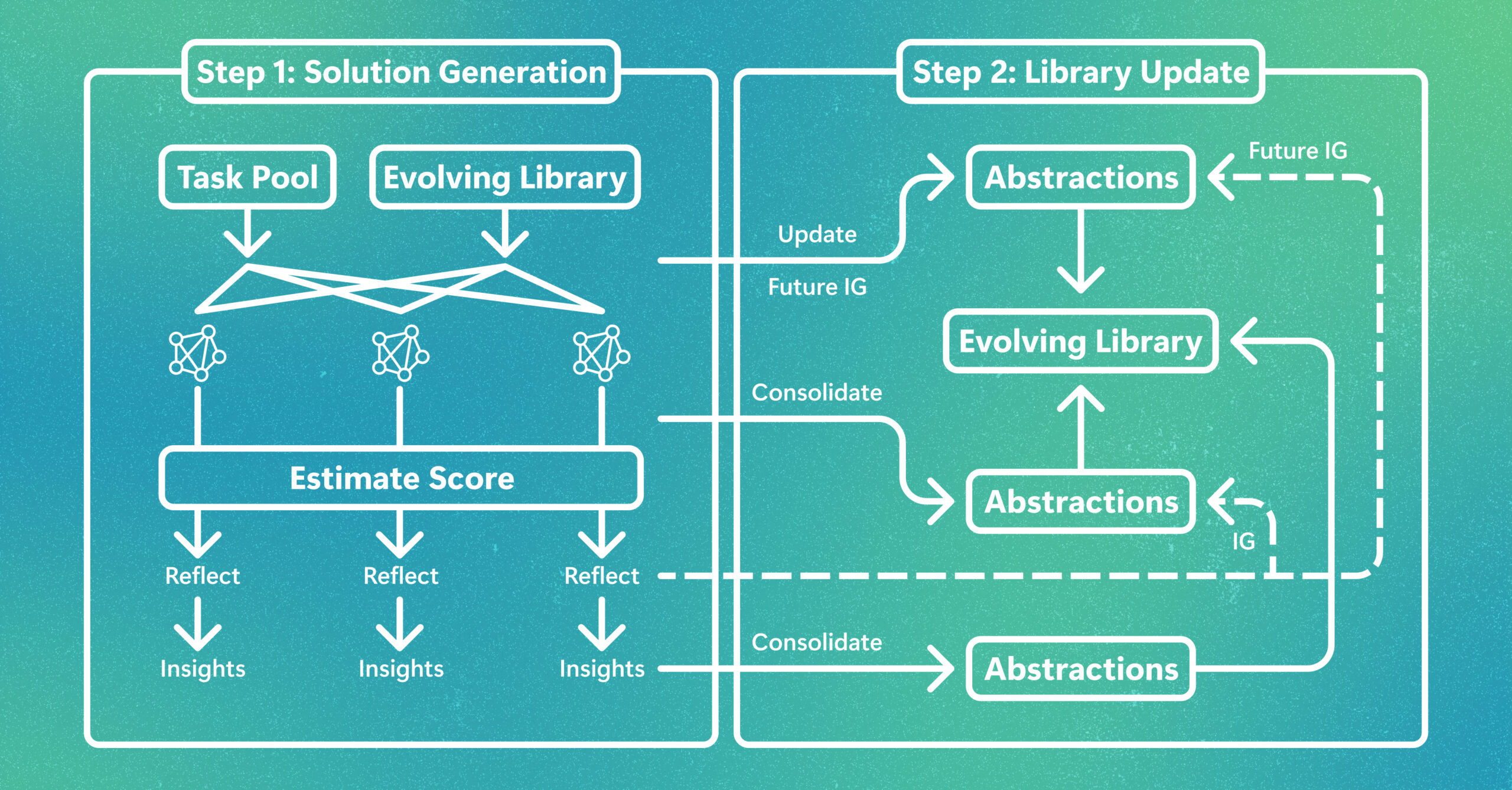
LLMs do not get smarter just by remembering more. EvoLib turns experience into evolving knowledge, taking reusable skills and insights that help models learn and adapt across tasks long after deployment. The post EvoLib: Turning experience into evolving knowledge appeared first on Microsoft Research.

We use cookies to run the site and, with your consent, for analytics and to show ads. See our Cookie Policy.
