Oct 2026· Zenodo (CERN European Organization for Nuclear Research)
Abstract
artificial intelligence (AI) and machine learning (ML) have become general-purpose technologies that are reshaping how organisations make decisions, serve customers, design products and run operations. This chapter provides a management-oriented treatment of the principal AI and ML techniques and of the organisational conditions under which they create business value. It first positions AI as a business capability that lowers the cost of prediction and enables both automation and augmentation of human work. It then explains the fundamental concepts of machine learning, including features and labels, training and testing, generalisation, overfitting and the bias–variance trade-off, before examining the major families of algorithms: supervised learning methods such as regression, decision trees, support vector machines and ensemble models; unsupervised methods such as clustering, association rule mining and dimensionality reduction; and reinforcement learning. Deep learning architectures and generative AI, including large language models and retrieval-augmented generation, are discussed with reference to emerging empirical evidence on productivity. The chapter sets out the ML project lifecycle, model evaluation metrics and MLOps practices, and examines explainability and fairness as conditions for responsible deployment. It then addresses AI strategy, including use-case prioritisation, build-versus-buy decisions, adoption theories and operating models, and discusses human–AI collaboration and the Indian business context. The chapter argues that sustained value arises when appropriate techniques are matched to well-framed business problems and embedded in processes, skills and governance.
The results indicate that software engineering work practices are chosen opportunistically, adapted and configured to provide value under the constrains imposed by the startup context.
Nicolò Paternoster, Carmine Giardino, M. Unterkalmsteiner et al.· Information and Software Tec...· 394 citations· ⚡54
This state-of-practice investigation was performed using a literature review followed by a multiple-case study approach and presents how inconsistency between managerial strategies and execution can lead to failure by means of a behavioral framework.
Carmine Giardino, Xiaofeng Wang, P. Abrahamsson· International Conference on...· 175 citations· ⚡19
This study conducts a case survey study based on the secondary data of the major pivots happened in 49 software startups, and demonstrates that customer need pivot is the most common among all pivot types.
Sohaib Shahid Bajwa, Xiaofeng Wang, Anh Nguyen-Duc et al.· Empirical Software Engineeri...· 127 citations· ⚡15
It is found that roles of MVPs in startups were not fully aware by entrepreneurs, and entrepreneurs should consider a systematic approach to fully explore the value of MVP, as a multiple facet product (MFP).
Anh Nguyen-Duc, P. Abrahamsson· International Conference on...· 93 citations· ⚡9
The method, ECCOLA, is presented, which aims at making the high-level AI ethics principles more practical, making it possible for developers to more easily implement them in practice.
Ville Vakkuri, Kai-Kristian Kemell, P. Abrahamsson· EUROMICRO Conference on Soft...· 64 citations· ⚡6
The goal is to not only refine the accuracy of the LLM-based tool but also to underscore its potential in streamlining the software development lifecycle through proactive code improvement and education.
Z. Rasheed, Malik Abdul Sami, Muhammad Waseem et al.· arXiv.org· 62 citations· ⚡3
Training AI agents with reinforcement learning can be challenging because their tools, context, and decision-making are managed by complex frameworks. Agent Lightning connects existing agents to RL training, making it easier to improve them without rebuilding them. The post Agent Lightning v1.0: A 3,500-Line Lightweight Agentic RL Framework for Training Agents with Real Harnesses appeared first on Microsoft Research.
MIT News · Artificial Intelligence· news.mit.eduOct 6, 2026
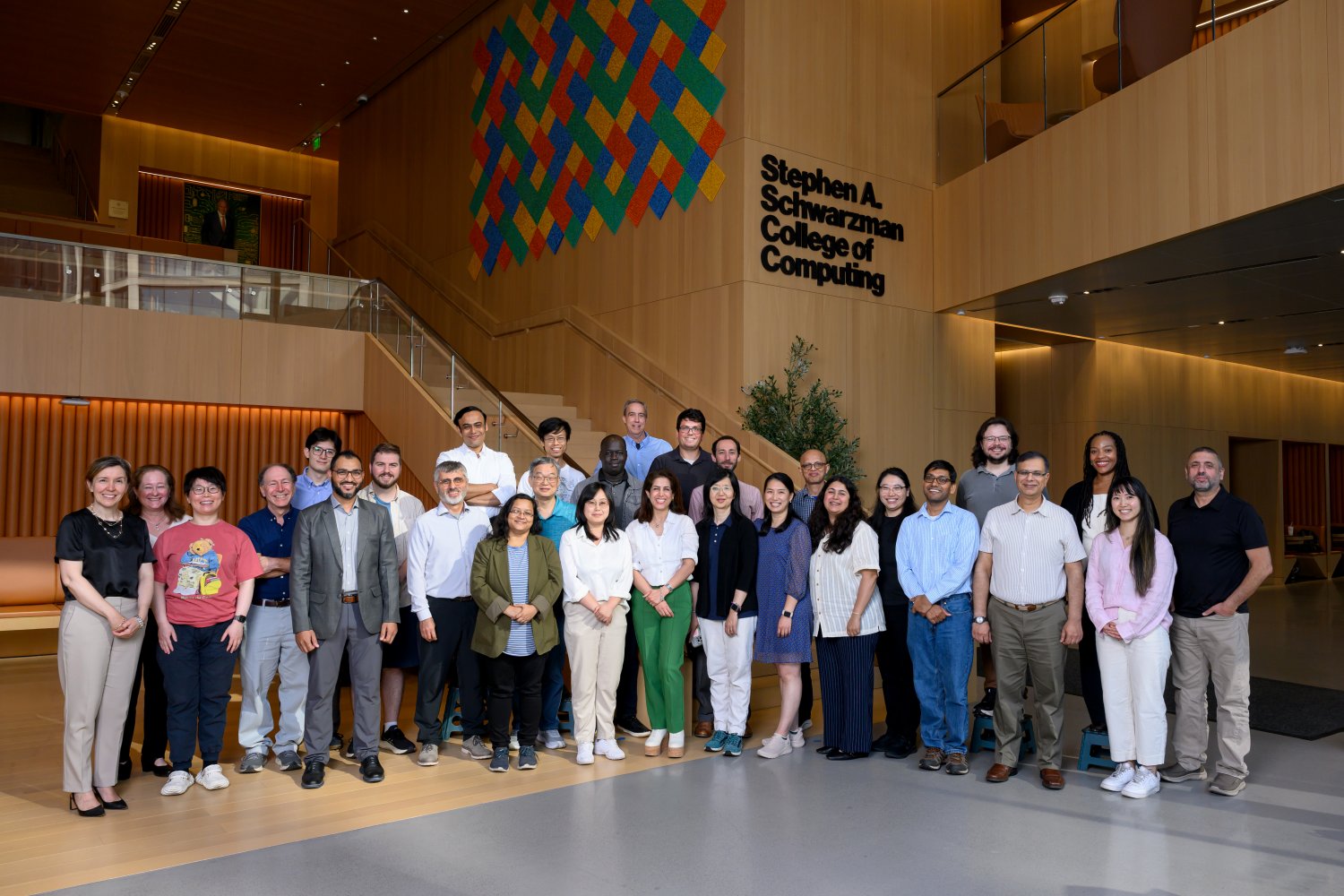
A weeklong summer workshop brought higher education faculty to campus to explore how AI and machine learning materials can be adapted for their classrooms.
What does it take to trust AI-driven HVAC optimization? Our AI Model Factory combines agents, machine learning, reinforcement learning and deterministic checks in a governed workflow designed for messy, real-world building data. The post We built an AI factory for HVAC control appeared first on GPT-Lab.
We use cookies to run the site and, with your consent, for analytics and to show ads.
See our Cookie Policy.