Continual learners that keep a task-specific adapter in every block of a pre-trained vision transformer accumulate storage linearly with the number of tasks; keeping task-specific adapters in only a few blocks curbs this growth but raises the question of where to place them. We investigate this question from two perspectives. Algorithmically, training all contiguous four-block placements yields an inverted U: final accuracy peaks at intermediate depth and varies by up to 3.5 percentage points (pp), while inexpensive criteria based on weight spectra or activation statistics favor the deepest blocks. From neuroscience, the hierarchical organization and intermediate-stage plasticity of the visual cortex motivate us to ask whether a measurement taken outside the learner can guide layer specialization without placement search. LS-B observes the first tasks through a frozen fMRI encoding model of twelve human visual areas and commits task-specific capacity once to the blocks whose readouts vary most across tasks relative to their stable structure. Across three ViT-B/16 backbones, LS-B yields stable, backbone-specific allocations. On the two backbones with placement search, AugReg and iBOT, the selected blocks overlap the intermediate-depth region identified by search. Under matched storage and observation budgets, the selected blocks outperform the shallowest and deepest four-block configurations. On Split ImageNet-R, LS-B uses 60% of full-BiLoRA adapter storage while remaining within 1.5 pp of its final accuracy. The allocation requires no labels or backpropagation, adds under 0.6% runtime, and exhibits backbone-specific cortical signatures.
This publication proposes a definition and a classification of agile software development approaches and analyses ten software development methods that can be characterized as being "agile" against the defined criterion.
P. Abrahamsson, O. Salo, Jussi Ronkainen et al.· arXiv.org· 727 citations· ⚡54
The study shows that agile practices improve both informal and formal communication, but indicates that, in larger development situations involving multiple external stakeholders, a mismatch of adequate communication mechanisms can sometimes even hinder the communication.
M. Pikkarainen, Jukka Haikara, O. Salo et al.· Empirical Software Engineeri...· 401 citations· ⚡48
The results indicate that software engineering work practices are chosen opportunistically, adapted and configured to provide value under the constrains imposed by the startup context.
Nicolò Paternoster, Carmine Giardino, M. Unterkalmsteiner et al.· Information and Software Tec...· 394 citations· ⚡54
The possibility of inferring high-dimensional data inference in a model that consists of a prior and an auxiliary differentiable constraint given some additional information is considered, thereby allowing a range of potential applications in adapting models to new domains and tasks.
Alexandros Graikos, Esmeralda S. Whitammer, N. Jojic et al.· Neural Information Processin...· 316 citations· ⚡15
Exploring how generative AI could make machine vision more accessible to businesses. The post GenEye in a Box: Making Machine Vision Something You Can Just Ask For appeared first on GPT-Lab.
Microsoft Research Blog· microsoft.comAug 11, 2026
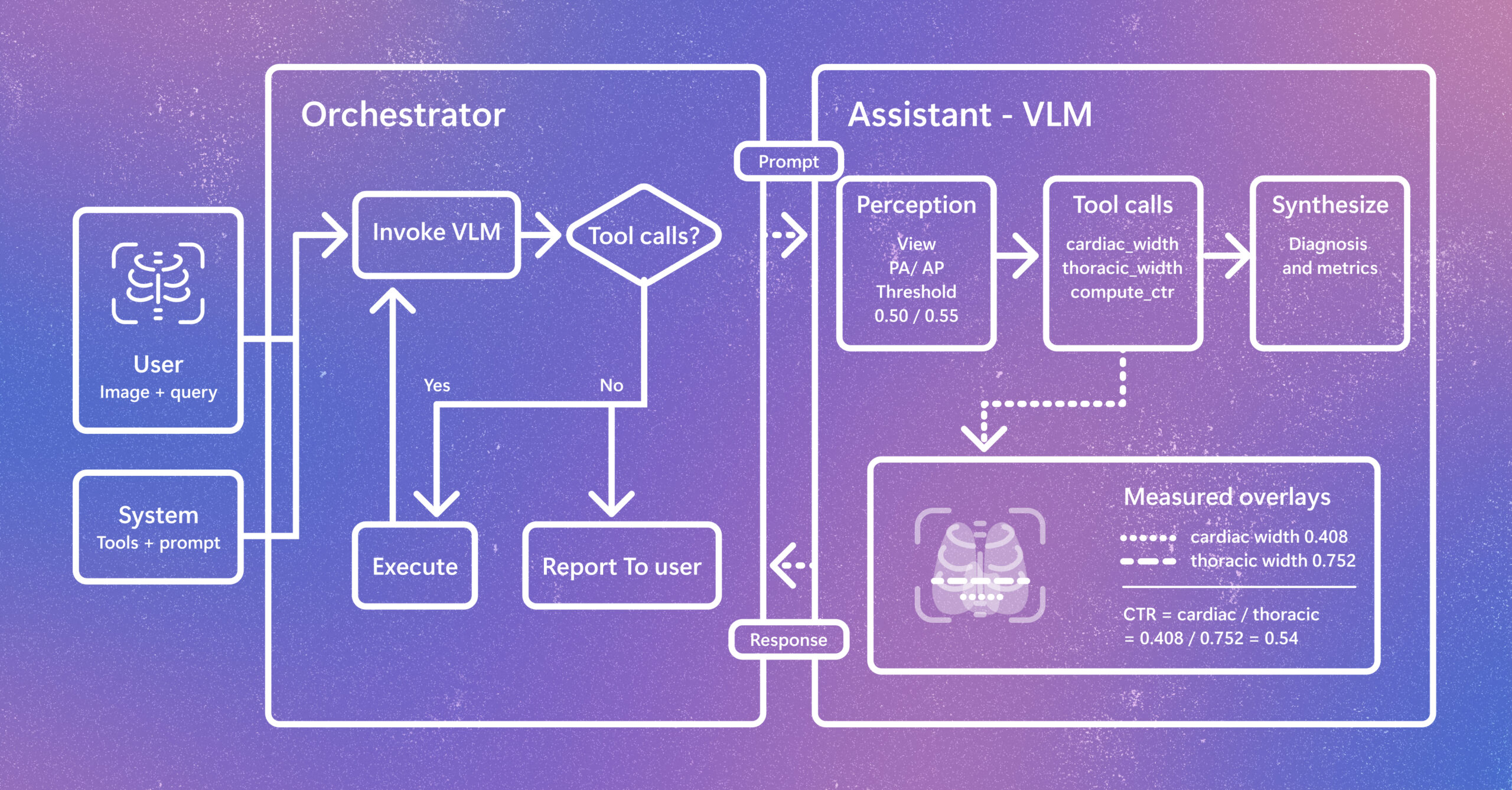
Radiology AI is evolving beyond report generation. CARE-X explores a unified approach that combines flexible reasoning, calibrated predictions, and measurement-based tools for chest X-ray interpretation. The post Introducing CARE-X: Towards Clinically Useful Radiology VLMs with Auxiliary Supervision, Reward-Aligned Learning, and Tool-Augmented Measurement appeared first on Microsoft Research.
Students in MIT’s Concourse program delve deeply into the human condition, debate challenging questions, and learn to develop judgment about issues that can’t be quantified.
We use cookies to run the site and, with your consent, for analytics and to show ads.
See our Cookie Policy.