Ranking-Aware Prompt Optimization for Multimodal Clinical Diagnosis
Tian XiaMinghao LiuYiqing LiangLaixi ShiJiayun Wang
Oct 2026
Machine LearningNatural Language ProcessingComputer Vision
Abstract
Multimodal large language models (MLLMs) are rapidly advancing clinical diagnosis, yet their adaptation pipelines remain anchored to accuracy-based objectives. Clinical data are heavily class-imbalanced: a constant-majority predictor can score above 90% accuracy while being clinically useless. We therefore evaluate and optimize for AUROC, a threshold-free score that ranks positives above negatives and is invariant to class balance. We focus on prompt optimization in MLLMs. Reflective methods such as GEPA use a binary scores matrix with one row per evaluation instance and one column per candidate prompt; cells record per-instance correctness, so the column average is accuracy and drives candidate selection. We introduce pair-level Pareto prompt evolution (Ranking-PE), which replaces each correctness row with a pairwise-ordering row over (positive, negative) instance pairs: the cell is 1 if the candidate scores the positive higher than the paired negative. The column average then equals empirical AUROC (by the Wilcoxon-Mann-Whitney identity). We apply this swap at all three layers the prompt evolution search reads from - the scores matrix that decides Pareto dominance, the per-example feedback to the reflection LM, and final candidate selection - at no extra model calls and with no surrogate loss. Across three diseases on MIMIC, accuracy-based prompt evolution can degrade ranking; Ranking-PE reverses this, beating the accuracy-based recipe by +5.8 AUROC pp on fine-tuned Qwen3-VL-8B and +16.2 pp on MedGemma-4B. Ablations examine each design component and show that a medical-grade visual backbone - via vision-encoder-tuned SFT or medical pretraining - is a prerequisite that prompt search cannot replace - our recipe extends reflective prompt evolution from text-only data to multimodal clinical decision-making.
This publication proposes a definition and a classification of agile software development approaches and analyses ten software development methods that can be characterized as being "agile" against the defined criterion.
P. Abrahamsson, O. Salo, Jussi Ronkainen et al.· arXiv.org· 727 citations· ⚡54
The study shows that agile practices improve both informal and formal communication, but indicates that, in larger development situations involving multiple external stakeholders, a mismatch of adequate communication mechanisms can sometimes even hinder the communication.
M. Pikkarainen, Jukka Haikara, O. Salo et al.· Empirical Software Engineeri...· 401 citations· ⚡48
The results indicate that software engineering work practices are chosen opportunistically, adapted and configured to provide value under the constrains imposed by the startup context.
Nicolò Paternoster, Carmine Giardino, M. Unterkalmsteiner et al.· Information and Software Tec...· 394 citations· ⚡54
The possibility of inferring high-dimensional data inference in a model that consists of a prior and an auxiliary differentiable constraint given some additional information is considered, thereby allowing a range of potential applications in adapting models to new domains and tasks.
Alexandros Graikos, Esmeralda S. Whitammer, N. Jojic et al.· Neural Information Processin...· 316 citations· ⚡15
Exploring how generative AI could make machine vision more accessible to businesses. The post GenEye in a Box: Making Machine Vision Something You Can Just Ask For appeared first on GPT-Lab.
A new machine-learning framework aims to improve the success rate of computational protein design while moving away from results that reproduce sequences found in nature.
Microsoft Research Blog· microsoft.comAug 11, 2026
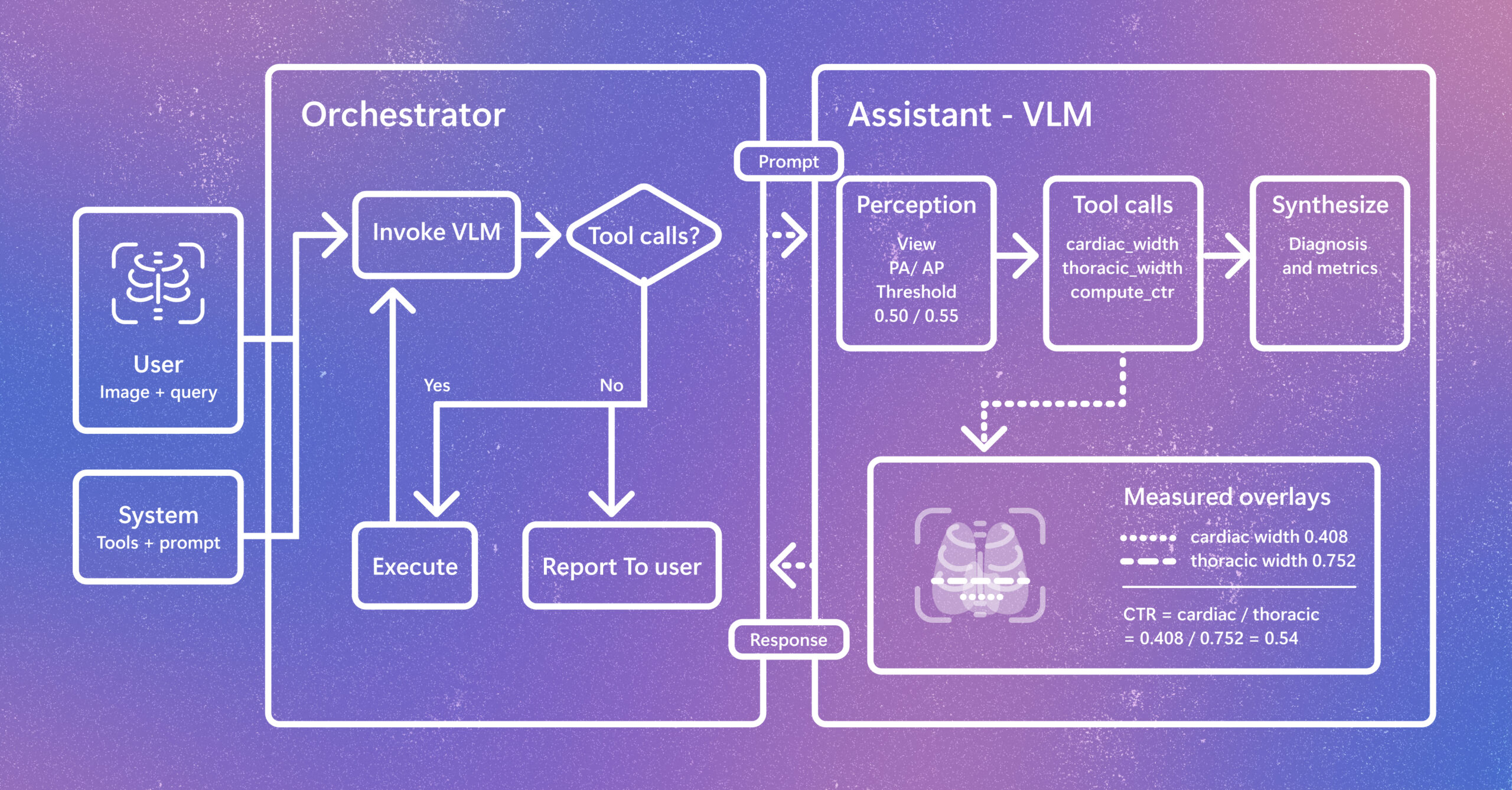
Radiology AI is evolving beyond report generation. CARE-X explores a unified approach that combines flexible reasoning, calibrated predictions, and measurement-based tools for chest X-ray interpretation. The post Introducing CARE-X: Towards Clinically Useful Radiology VLMs with Auxiliary Supervision, Reward-Aligned Learning, and Tool-Augmented Measurement appeared first on Microsoft Research.
We use cookies to run the site and, with your consent, for analytics and to show ads.
See our Cookie Policy.