PQ-HSA (hybrid sparse-approximate attention) attends the selected tokens with their original keys and values, and the unselected tokens, the background, enter the same softmax through those scores, summed per inverted list and multiplied by the list's mean value.
Abstract
At each decoding step a language model attends over the key-value (KV) cache of every earlier token, so at long context the attention call is bounded by memory bandwidth. Sparse attention reads only a subset of keys chosen by a cheap score estimate, and most methods give the unread tokens zero weight. The output then draws on only a small fraction of the KV cache, and accuracy drops at small budgets, most on tasks that aggregate information across the context. An inverted-file product-quantization (IVF-PQ) index over the cached keys computes an approximate score for every indexed token in order to rank them; after ranking, those scores approximate the attention logits of the tokens left out. PQ-HSA (hybrid sparse-approximate attention) attends the selected tokens with their original keys and values, and the unselected tokens, the background, enter the same softmax through those scores, summed per inverted list and multiplied by the list's mean value. At 128K and a 1-2% retrieval budget, PQ-HSA is more accurate than Quest and SnapKV on Llama-3.1-8B and Qwen3-30B-A3B and stays close to full attention in macro accuracy; with the same selector, the background term raises macro accuracy on the 8B model from 0.71 to 0.83. In the same 128K setting, inside vLLM on one NVIDIA H20, the decode attention call runs 1.6x faster than the FlashAttention-3 kernel; the speedup grows with context length, and a cost model fitted on 8B to 30B models gives the context length at which it begins. A vLLM plugin runs PQ-HSA on two engine versions without changes to the engine source; code is available at https://github.com/KunmingSHAO/pqhsa_release.

Attention often concentrates on a small subset of tokens in the context, but which subset matters changes from one query to the next. To exploit this changing structure, we introduce SANTA++, a training-free stochastic attention method that uses representative keys for memory-efficient selection without scanning the en...
Kyle Lee, Christian Z. Pratt, Ruo-Yu Fang et al.· 0 citations
Across reasoning, long-context understanding, and agentic tasks, SAS consistently outperforms trainable sparse attention baselines across attention budgets, with especially large gains under tight budgets, demonstrating more effective context ranking for downstream tasks.
Most post-training quantization pipelines fit each weight matrix to its pretrained counterpart, one matrix at a time. Whether that proxy tracks what an attention block actually computes, or how errors in the Q, K and V projections compound inside the softmax, is rarely checked. We write the objective on the attention o...
Nafiseh HosseinpourFardi, Negar Alihadi, Mahmoudreza Babaei et al.· 0 citations
Results motivate CertKV, a training-free compressor that reserves one tail-summary slot per head and allocates the rest by value dispersion, which is top-two in seven of nine LongBench-v2 settings, remains in the leading compressed tier on 128K RULER, and realizes a ten-fold cache budget in a packed Llama prototype.
FullAttn often assigns negligible normalized mass to much of the causal score space, yet dense kernels execute the complete post-score path after forming each QK tile. We introduce MALA, a fused attention primitive that preserves score access to every legal causal interaction and uses normalized contribution to allocat...
Jing-Ze Shi, Zhang-Yang Peng, Xian-Duo Li et al.· 0 citations
Adaptive AI agents can help make BIM data more machine-readable by navigating IFC models, interpreting inconsistent information, and mapping it to defined standards. In this blog, Alok Rawat shares findings from a real-world pilot in construction workflows. The post Adaptive AI Agents in Construction Workflows appeared first on GPT-Lab.
What does it take to trust AI-driven HVAC optimization? Our AI Model Factory combines agents, machine learning, reinforcement learning and deterministic checks in a governed workflow designed for messy, real-world building data. The post We built an AI factory for HVAC control appeared first on GPT-Lab.
MIT News · Artificial Intelligence· news.mit.eduAug 18, 2026
A new method for surgically removing training examples from a model reveals that as datasets grow, the link between what a model learns and what it produces dissolves.
Microsoft Research Blog· microsoft.comJul 30, 2026
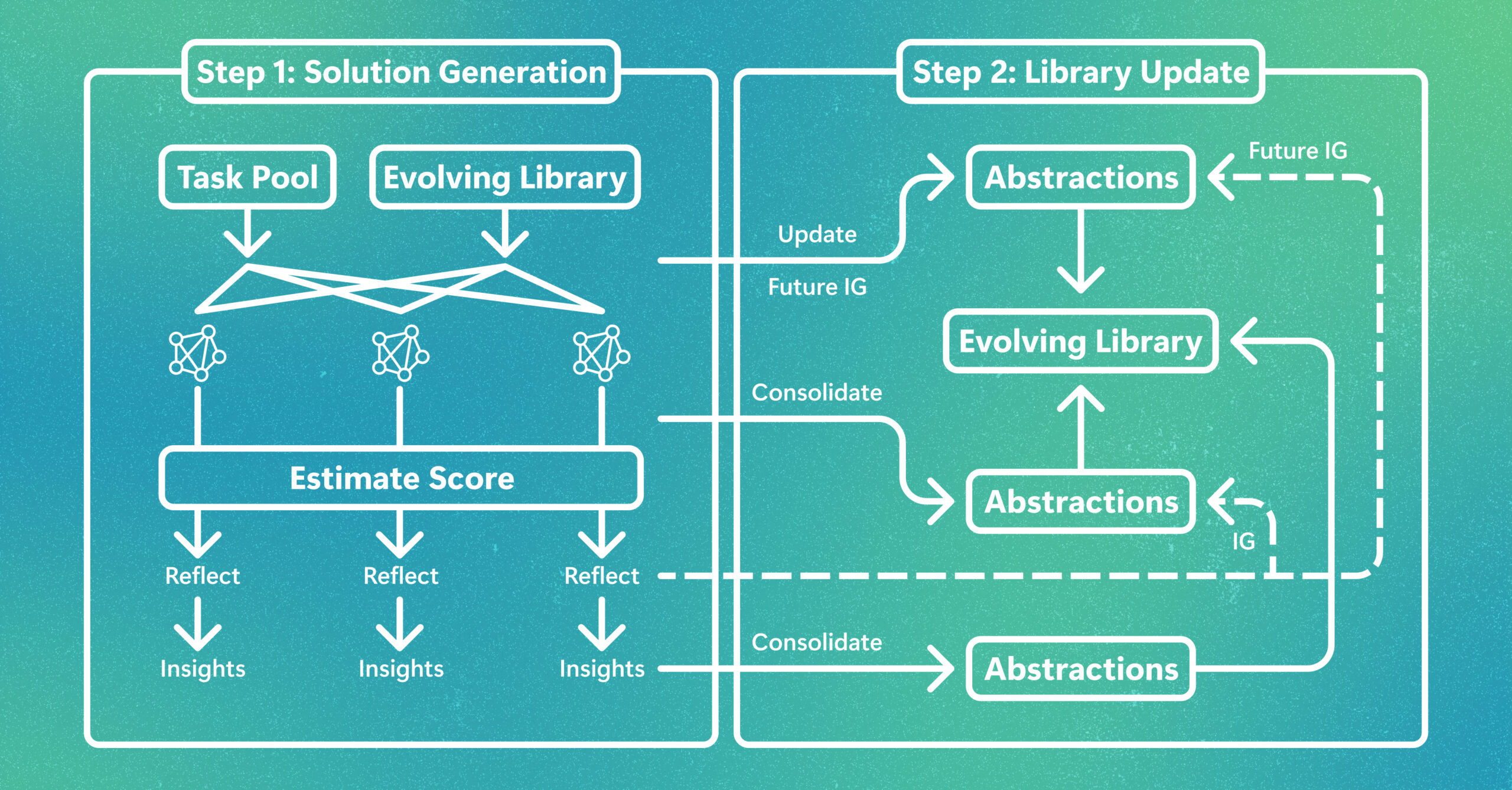
LLMs do not get smarter just by remembering more. EvoLib turns experience into evolving knowledge, taking reusable skills and insights that help models learn and adapt across tasks long after deployment. The post EvoLib: Turning experience into evolving knowledge appeared first on Microsoft Research.
We use cookies to run the site and, with your consent, for analytics and to show ads.
See our Cookie Policy.