When an Evaluation Rule Writes Training Labels: Measuring Human-Reference Forgiveness in NAVSIM
Jiaxuan GuoJingxin YangJiaqi YeYouran SunShuo XinKejia ZhangHaizhao Yang
Sep 2026
Machine LearningComputer VisionRobotics
Abstract
When the human reference scores zero on a metric, the released GTRS-Dense label generator for NAVSIM marks every candidate trajectory in the scene as passing it. NAVSIM's authors introduced this human-reference forgiveness to avoid penalizing contextually justified maneuvers when scoring one trajectory, and warned that it could overlook important failures. In label generation it sets a whole column of 16,384 candidate targets to passing. To measure the consequences for supervision, we re-run the generator with the overwrite disabled and compare the pre-overwrite targets with the released labels on all 103,288 navtrain scenes. The rule erases a candidate distinction that the training loss reads on 11,237 of them (10.8793%). Firing usually changes most of a column: lane keeping carries 9,982 of the 13,042 forgiven loss columns, and its median forgiven column had 14,391 of 16,384 candidates failing before the overwrite. On held-out navtest scenes forgiven on lane keeping, the released lane-keeping head's median AUC against the pre-overwrite outcome is 0.7095; on unforgiven scenes matched on failing-candidate count it is 0.9807. For the Hydra-MDP checkpoint released with GTRS, whose configuration takes the same label file, the two values are 0.6627 and 0.9761. Continuing the released GTRS-Dense checkpoint for 300 optimizer steps with three paired seeds, we observe the forgiven-scene AUC 0.1086-0.1251 higher with pre-overwrite than with published targets, and a narrower gap between matched groups, still above zero. Scoring with forgiveness disabled, we observe lane keeping higher by 2.478-3.524 points on navtest scenes forgiven on any of five loss metrics, with lower adjacent-frame plan consistency. Both changes are larger there than on the rest. EPDMS, scored the same way, does not separate the two target sets.
This publication proposes a definition and a classification of agile software development approaches and analyses ten software development methods that can be characterized as being "agile" against the defined criterion.
P. Abrahamsson, O. Salo, Jussi Ronkainen et al.· arXiv.org· 727 citations· ⚡54
The study shows that agile practices improve both informal and formal communication, but indicates that, in larger development situations involving multiple external stakeholders, a mismatch of adequate communication mechanisms can sometimes even hinder the communication.
M. Pikkarainen, Jukka Haikara, O. Salo et al.· Empirical Software Engineeri...· 401 citations· ⚡48
The results indicate that software engineering work practices are chosen opportunistically, adapted and configured to provide value under the constrains imposed by the startup context.
Nicolò Paternoster, Carmine Giardino, M. Unterkalmsteiner et al.· Information and Software Tec...· 394 citations· ⚡54
The possibility of inferring high-dimensional data inference in a model that consists of a prior and an auxiliary differentiable constraint given some additional information is considered, thereby allowing a range of potential applications in adapting models to new domains and tasks.
Alexandros Graikos, Esmeralda S. Whitammer, N. Jojic et al.· Neural Information Processin...· 316 citations· ⚡15
It is proved that any global minimizer of the trajectory balance objective can define a policy that samples exactly from the target distribution, and empirically demonstrate the benefits of the trajectories balance objective for GFlowNet convergence, diversity of generated samples, and robustness to long action sequenc...
Esmeralda S. Whitammer, Moksh Jain, Emmanuel Bengio et al.· Neural Information Processin...· 302 citations· ⚡60
Exploring how generative AI could make machine vision more accessible to businesses. The post GenEye in a Box: Making Machine Vision Something You Can Just Ask For appeared first on GPT-Lab.
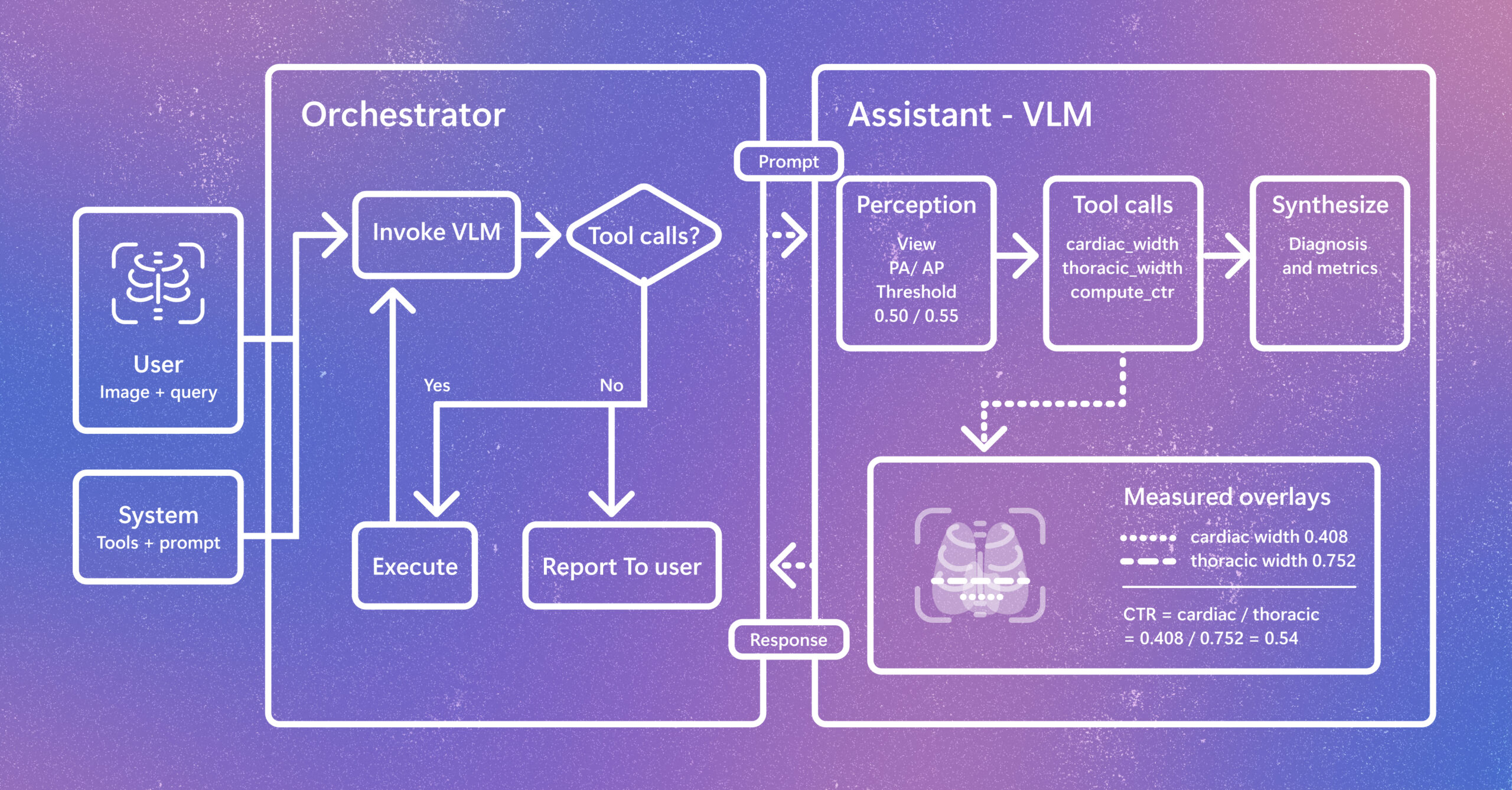
Radiology AI is evolving beyond report generation. CARE-X explores a unified approach that combines flexible reasoning, calibrated predictions, and measurement-based tools for chest X-ray interpretation. The post Introducing CARE-X: Towards Clinically Useful Radiology VLMs with Auxiliary Supervision, Reward-Aligned Learning, and Tool-Augmented Measurement appeared first on Microsoft Research.