Sep 2026· 2026 14th International Conference on Affective Computing and Intelligent Interaction Workshops and Demos (ACIIW)· pp. 1-5· 0 citations· 42 references
Computer Science
TL;DR
This research focuses on auditory hypersensitivity in people with autism, a phenomenon that is often difficult to evaluate and unique to each individual.
Abstract
My doctoral work aims to explore Audio Emotion Recognition (AER) in the context of atypical listening. This research focuses on auditory hypersensitivity in people with autism, a phenomenon that is often difficult to evaluate and unique to each individual. Our core idea is to leverage our understanding of affect from acoustic traits, relying on the possibility of generalizing affective responses from a small amount of annotated data. As a first step, we fine-tune a large foundation model, Contrastive Language-Audio Pretraining (CLAP) using low-rank adaptation (LoRA), trained on a valence and arousal dataset of neurotypical listeners.
Emotion prosody perception requires simultaneous processing of acoustic cues and speaker identity. While listeners effortlessly decode natural speech, AI synthetic voices introduce cognitive complexities due to subtle acoustic atypicalities. It remains unclear how these synthetic features interact with a listener's pri...
Feng-Yi Xu, Gao-Yuan Zhang, Shan-Shan Xue et al.· 0 citations
The results show that the evaluated baselines can extract some affective signal from speech, but discrete expressed-emotion recognition remains fragile, especially for non-neutral emotions that are often most important in voice agent workflows.
Luc Debaupte, Tyler Baumgartner, Brandon Tai et al.· 1 citation
Facial Emotion Expression Recognition is widely agreed to be one aspect of social function that is impaired within the usual characterisation of Autism Spectrum Disorder. The ”Reading the Mind in the Eyes” test is used to this day in the diagnostic process. However, it disregards temporal data, has potential test forma...
Sean Haddick, David J. Brown, James Lewis et al.· Proceedings of the Internati...· 0 citations
Introduction Emotion recognition from speech prosody is a complex cognitive ability that depends on the functional integrity of a distributed neuronal network and may be shaped by demographic, clinical and lifestyle factors. The Terrapino mobile application was developed as a tool to promote cognitive health, but its d...
Martin Šimčík, Ross Andel, Jan Pavlík et al.· Frontiers in Psychology· 0 citations
Multimodal emotion recognition (MER) increasingly pairs EEG with speech, treating internal neural signals and external vocal expression as informative views of affect. In practice, naive fusion underperforms the stronger single modality, because EEG artifacts inject noise that corrupts the shared representation. We int...
Philip H. Lee, Shreeram Suresh Chandra, John H. L. Hansen· 0 citations
Adaptive AI agents can help make BIM data more machine-readable by navigating IFC models, interpreting inconsistent information, and mapping it to defined standards. In this blog, Alok Rawat shares findings from a real-world pilot in construction workflows. The post Adaptive AI Agents in Construction Workflows appeared first on GPT-Lab.
What does it take to trust AI-driven HVAC optimization? Our AI Model Factory combines agents, machine learning, reinforcement learning and deterministic checks in a governed workflow designed for messy, real-world building data. The post We built an AI factory for HVAC control appeared first on GPT-Lab.
MIT News · Artificial Intelligence· news.mit.eduAug 18, 2026
A new method for surgically removing training examples from a model reveals that as datasets grow, the link between what a model learns and what it produces dissolves.
Microsoft Research Blog· microsoft.comJul 30, 2026
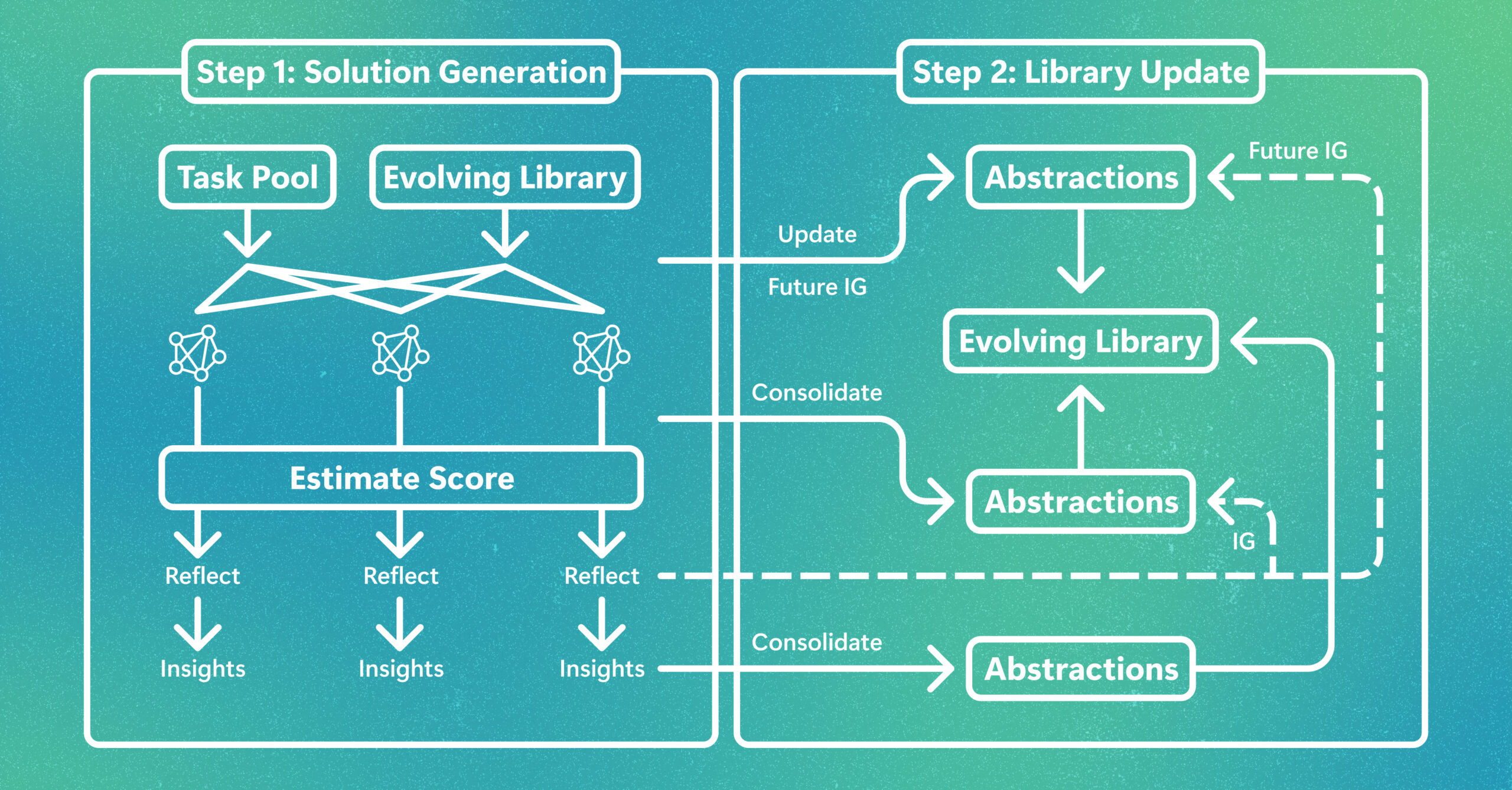
LLMs do not get smarter just by remembering more. EvoLib turns experience into evolving knowledge, taking reusable skills and insights that help models learn and adapt across tasks long after deployment. The post EvoLib: Turning experience into evolving knowledge appeared first on Microsoft Research.
We use cookies to run the site and, with your consent, for analytics and to show ads.
See our Cookie Policy.