Skip to content

Optimizing Resource Allocation in Cloud Computing Environments using Reinforcement Learning

Dec 2026 · International Journal of Technology, Management and Humanities · 0 citations · 51 references
Cloud Computing and Resource Management

TL;DR

A deep reinforcement learning framework for intelligent cloud resource allocation that jointly optimizes resource utilization, Service Level Agreement compliance, infrastructure cost, and energy efficiency, and adapts to workload distribution shifts within 200 episodes without manual retuning is presented.

Abstract

Cloud computing resource allocation remains a critical challenge, with organizations wasting an estimated $109 billion annually on idle or over-provisioned resources. Traditional allocation strategies—static provisioning, threshold-based autoscaling, and time-series forecasting—fail to capture the complex, non-stationary dynamics of modern cloud workloads characterized by bursty arrivals, heterogeneous resource demands, and multi-tenant interference effects. This paper presents CloudRL, a deep reinforcement learning framework for intelligent cloud resource allocation that jointly optimizes resource utilization, Service Level Agreement (SLA) compliance, infrastructure cost, and energy efficiency. CloudRL formulates resource allocation as a continuous-action Markov Decision Process (MDP) and employs a Soft Actor-Critic (SAC) agent with a multi-objective reward function that balances competing optimization goals through adaptive weighting. The system observes a high-dimensional state space comprising real-time CPU, memory, GPU, storage I/O, and network utilization metrics alongside workload arrival patterns and SLA parameters, and outputs fine-grained scaling, migration, and configuration actions. We evaluate CloudRL on a production-scale testbed comprising 500 virtual machines processing six diverse workload traces (web serving, batch analytics, machine learning training, video transcoding, database, and microservices) over 30 days. Results demonstrate that CloudRL achieves 88% average resource utilization (compared to 42% for static allocation and 65% for predictive methods), reduces SLA violations by 91.7% (from 12% to 0.98%), decreases infrastructure costs by 37.5%, and lowers energy consumption by 59% compared to static provisioning. CloudRL converges within 3,000 training episodes and adapts to workload distribution shifts within 200 episodes without manual retuning.

Read PDF

Similar papers

Open access Oct 2026

Adaptive machine learning for intelligent resource allocation in cloud computing: a comparative study

Efficient cloud resource allocation requires controllers that anticipate workload variation rather than respond only after demand changes. This study evaluates an adaptive machine learning (AML) controller that integrates one-step-ahead random forest forecasting, capacity-constrained resource adjustment, and 24-hour mo...

A. D. Samala, Soha Rawas · 0 citations
Conference Aug 2026

AI-Driven Autonomous Resource Scheduling in Cloud–Edge Environments

Cloud Edge computing provides services with low latencies by allocating workloads between centralized cloud servers and geographically close edge nodes, but dynamic workloads and nonhomogeneous resources render the scheduling of workloads a thorny multi-objective optimization problem. The given paper proposes a framewo...

Vaibhav Sawalkar, Anuja Gaikwad, Vishal Bogum et al. · 0 citations
Review Sep 2026

Task scheduling and load balancing in cloud, fog, and edge computing systems: a survey

A structured taxonomy is presented that classifies algorithms into traditional, heuristic, meta-heuristic, and modern learning-based approaches, with a particular emphasis on the increasing adoption of Reinforcement Learning (RL) and Deep Reinforcement Learning (DRL) for dynamic and adaptive scheduling.

Rihem Zorgati, Hassen Hamdi, Mohamed Nazih Omri · 0 citations
Sep 2026

Time-Series Load Prediction and Deep Deterministic Policy Gradient-Based Task Scheduling Optimization for Cloud-Edge Collaborative Networks

PL-DDPG, a prediction-enhanced load-aware deep deterministic policy gradient algorithm for cloud-edge task scheduling that consistently improves delay, energy efficiency, SLA satisfaction, load balancing, and scheduling stability, is proposed.

Lei Zhong, Min Wu, Peng-Jia Wei et al. · 0 citations
Conference Aug 2026

A Predictive Autoscaling Framework for Cloud Deployment Infrastructure Optimization

Cloud Computing has played a vital role in handling data storage, access and processing in distributed environments. Cloud Computing delivers scalable servers, databases and storage resources and abstracts the backend infrastructure to the end users. Workloads exhibit higher instability due to the increase in the depen...

Raghav Rs, Vignesh R, Arunprasad P et al. · 0 citations

Related blog posts

Microsoft Research Blog Nov 16, 2026

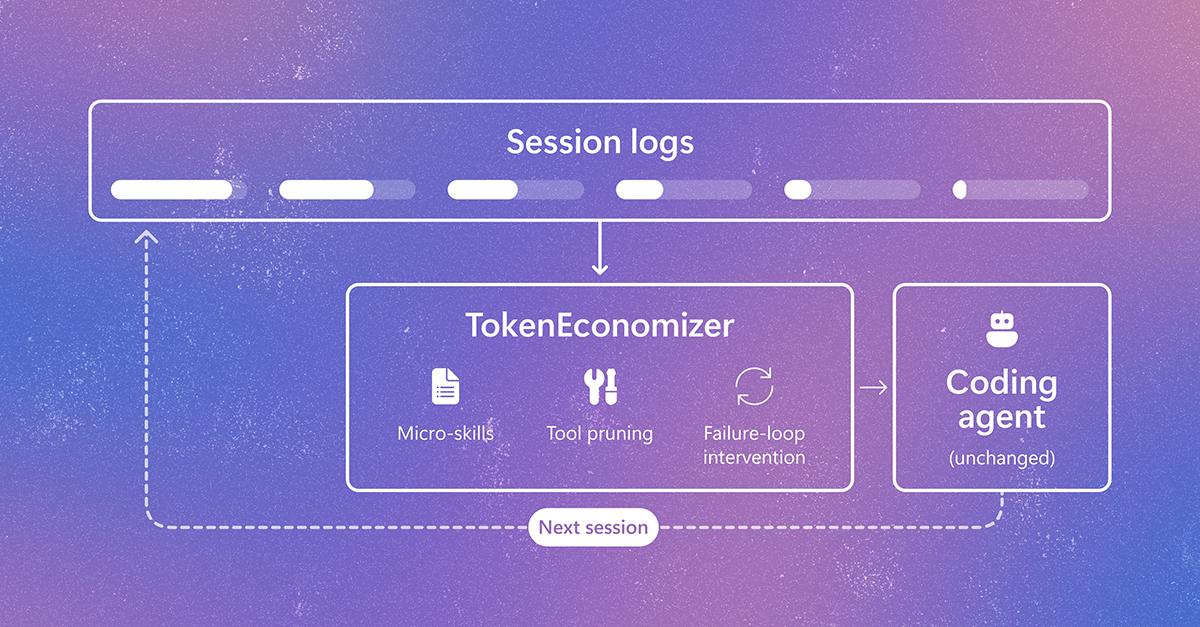
TokenEconomizer: Learning from Experience to Make AI Coding Agents More Efficient

AI coding agents are increasingly help developers fix bugs and build features largely on their own, but every interaction with their models consumes tokens. In each session, an agent sends instructions, tool descriptions, and session history to its model. Most efforts to reduce this cost focus on individual tasks. Yet developers return to the same […] The post TokenEconomizer: Learning from Experience to Make AI Coding Agents More Efficient appeared first on Microsoft Research.

We use cookies to run the site and, with your consent, for analytics and to show ads. See our Cookie Policy.