A family of open-weights foundation models for forecasting with multivariate context, which is among the most accurate models with a context of nearly a year and its calibration, its rollout strategy on long horizons, and its robustness to missing data are examined.
Abstract
We present $t_0$, a family of open-weights foundation models for forecasting with multivariate context. We release its first two members: $\texttt{t0-alpha}$ and $\texttt{t0-beta}$, respectively 102M and 256M parameters. Both condition their forecasts on target history, past covariates, and known-future covariates, without task-specific retraining. Their transformer layers alternate attention along time and across variates. They produce probabilistic forecasts through quantile predictions. Pretraining combines curated public data with synthetic generator families constructed to contain covariate-to-target dependencies. On GIFT-Eval, $\texttt{t0-alpha}$ reaches an aggregate CRPS of 0.4941, and $\texttt{t0-beta}$ a CRPS of 0.4738 and a MASE of 0.6865, third on both and within 4.0% of the best zero-shot TSFM. On fev-bench they score 42.2 and 46.7 in skill, the latter third again and 2.0 points behind the leader. We analyze $\texttt{t0-alpha}$ in depth. Known-future covariates raise its skill by 6.3 percentage points across 30 tasks. The report also examines its calibration, its rollout strategy on long horizons, and its robustness to missing data. On the Victoria electricity-demand benchmark, $\texttt{t0-beta}$ is among the most accurate models with a context of nearly a year. In an independent Macrocosm evaluation of hourly ERCOT prices over 29 months, both cut the MAE of the lagged-price baseline by 38%.

We introduce Timestral, a family of four time series foundation models for probabilistic forecasting, with 5M, 28M, 123M, and 209M parameters. Timestral sets a new state of the art on GIFT-Eval, TIME, and fev-bench, where Timestral-209M and Timestral-123M take the top two places on every metric. We achieve this with th...
Adrien Petralia, Alexandre Gavaudan, Artjom Joosen et al.· 1 citation
A novel pattern-guided mixture-of-experts that expands model capacity through sparse activation and uses shallow patch similarities to constrain deep-layer routing, guiding expert specialization across heterogeneous time series and an implicit quantile network head that predicts arbitrary quantiles to characterize pred...
Assessment of pretrained forecasters on tasks beyond value forecasting requires reporting their outputs, supervised probes of their representations, and raw-context and randomized controls side by side, since each supports a different conclusion.
Daniel Schoess, F. von Wangenheim· arXiv.org· 0 citations
It is demonstrated that the way information is propagated into the model substantially affects forecast accuracy of TSFMs, and the findings suggest that current benchmarks for covariate-informed TSFMs can distort model comparisons by imposing fixed encoding strategies.
Alexander Kreusel, M. Beichter, Alexandra Nikoltchovska et al.· 0 citations
We consider the problem of testing Granger causality in time series, specifically, whether the future outcome $Y_{t+1}$ and the exposure history $\bar X_t$ are conditionally independent given the history of $\bar Y_t$ and a set of confounding variables $\bar Z_t$ up to time $t$. This testing procedure distinguishes tru...
Latent Inference-Time Guidance for TSFMs is introduced, which adaptively combines a pool of TSFM forecasts through a time-dependent latent space with independent components that comes equipped with identifiability and reconstruction guarantees, whilst maintaining the off-the-shelf aspect of foundation models.
Machine-learning networks can learn without detailed instructions from a designer. Those that do may offer insight into how the brain reorganizes itself during learning.
MIT News · Artificial Intelligence· news.mit.eduSep 29, 2026
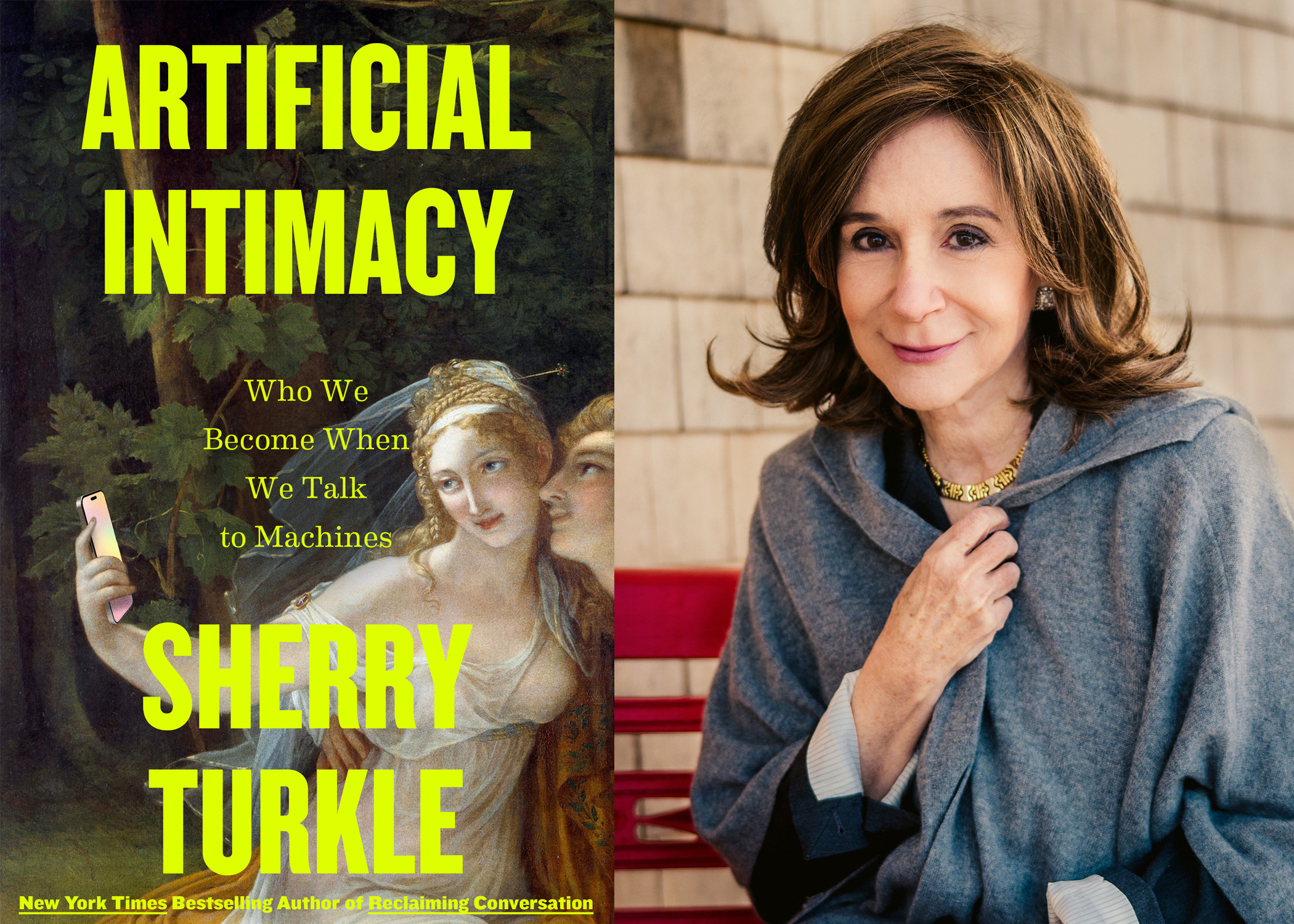
Professor Sherry Turkle’s new book, “Artificial Intimacy,” offers a withering critique of chatbots and the antisocial dynamics she believes they encourage.