It is proved that no single ANN score feature achieves best predictive performance across all failure regimes; the dominant feature differs between datasets (query length on MuSiQue, hop-1 concentration on HoVer), and a constructive witness pair shows each is necessary in one regime and non-contributory in the other.
Abstract
Multi-hop retrieval failures are not uniformly distributed across queries: they cluster in structurally predictable subpopulations. We prove two results formalizing this structure. First (CWAR Reducibility): confident-failure reduction is achievable if and only if retrieval features carry mutual information about success, a condition satisfied by LLM-judge pipelines but substantially weaker in dense-only settings, explaining the AUC-AC gap between regimes. Second (Feature Regime Complementarity): no single ANN score feature achieves best predictive performance across all failure regimes; the dominant feature differs between datasets (query length on MuSiQue, hop-1 concentration on HoVer), and a constructive witness pair shows each is necessary in one regime and non-contributory in the other. We instantiate these principles in RegimeAbstain, which computes a Retrieval Confidence Score (RCS), a logistic function of up to nine query-ANN structural features, all available without any additional LLM call, and uses it to implement a calibrated abstention policy. We define the Confident-Wrong-Answer Rate (CWAR) metric and evaluate across three multi-hop benchmarks (MuSiQue, 2WikiMultiHopQA, HoVer) and two retrieval architectures (LLM-judge and dense-only), covering five failure regimes with CWAR from 14.5% to 62.1%. RCS achieves best or co-best AUC-AC in all five conditions against eight confidence baselines. On MuSiQue (LLM-judge), RCS reduces CWAR from 39.5% to 20.6% at 50% coverage (47.8% relative reduction), with ECE=0.035. A model trained on MuSiQue transfers to 2WikiMultiHopQA with only -0.5pp AUC loss, confirming the domain-agnostic structure of regime features.
Retrieval diversification is widely available in retrieval-augmented generation (RAG) frameworks, yet prior studies disagree on whether it improves retrieval and answer quality. We show that its effectiveness varies primarily with candidate-pool redundancy, in a pattern consistent with the number of distinct evidence p...
Guillaume Brouillette, Faustin Kagabo, Usef Faghihi et al.· 0 citations
STAR is presented, a structure-aware adaptive retrieval framework for RAG that treats this mismatch as a problem of diagnosing evidence sufficiency and benefits from a control signal that preserves structurally distinct insufficiency patterns rather than collapsing them into a single scalar confidence estimate.
Results show that method ranking in continual updating can depend jointly on when performance is measured and how much replay-side adaptation capacity the baseline receives, and propose reporting trajectories and capacity sweeps, and declaring a robust winner only when the ordering is stable across the evaluation regio...
JudgeMoE, a lightweight aggregator that assigns example-specific weights to cached judge score distributions and fuses them before computing a final score is introduced, showing that score-range choice is unstable across judge--dataset settings and that soft scoring usually outperforms hard decoding.
Yiqi Liu, Joseph James, Yang Wang et al.· 0 citations
In extractive document question answering whose questions were generated from the passages that contain their answers -- so that retrieval recovers 92-99.8% of what any mode combination could reach, whatever its absolute accuracy -- confidence-driven mechanisms have little to gain. Fine-tuning an open language model on...
Gun-Woo Lee, Chang-Min Sung, Sang-Hwan Gwak et al.· 0 citations
Retrieval-Grounded Voting (RGV), which scores each rollout by the lexical overlap between its final answer and the documents it retrieved, consistently outperforms confidence-based voting and identifies the underlying failure reason as copy inflation.
Hyunho Kook, Junhyuk So, Tianyu Fu et al.· 0 citations
Related blog posts
MIT News · Artificial Intelligence· news.mit.eduAug 27, 2026
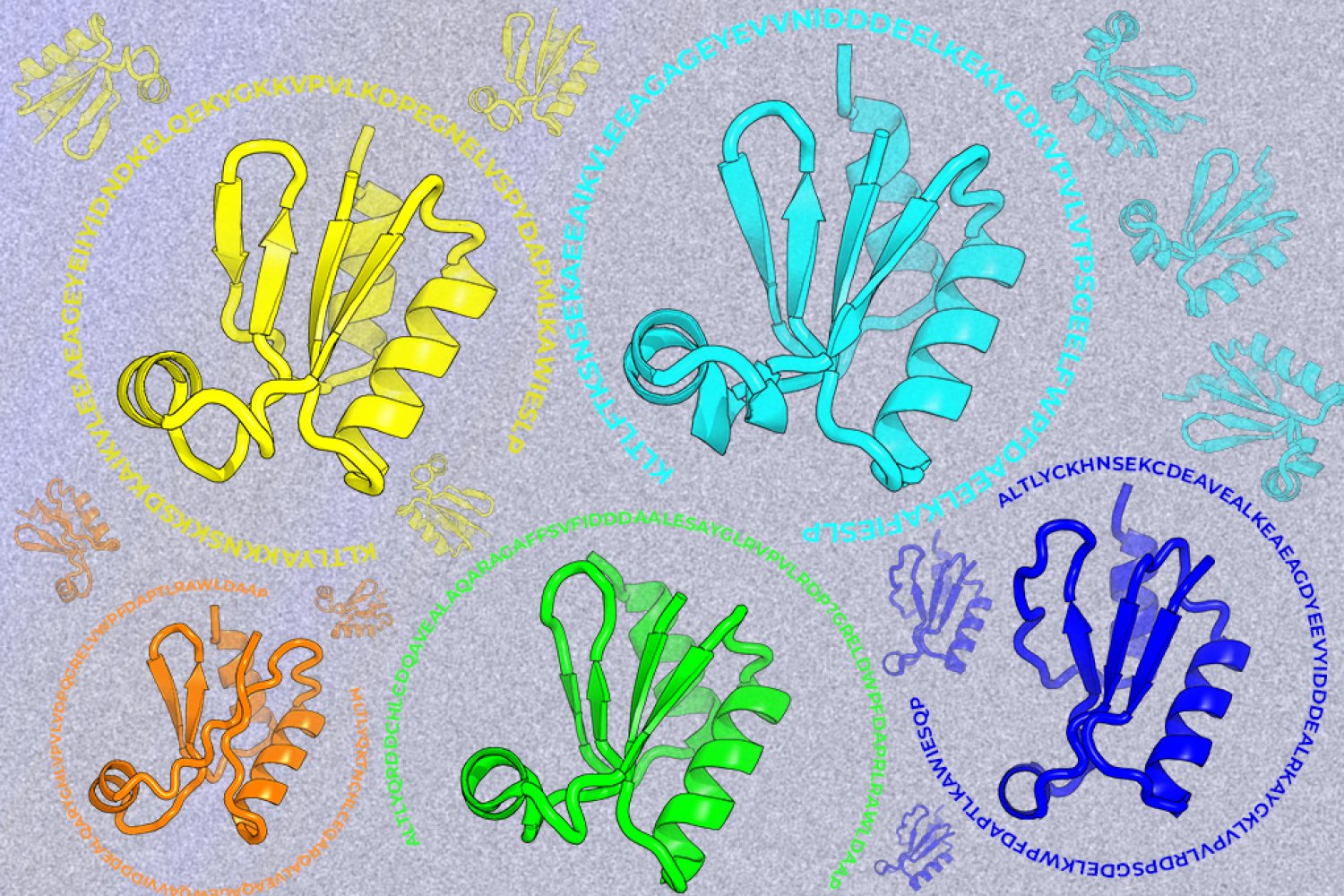
A new machine-learning framework aims to improve the success rate of computational protein design while moving away from results that reproduce sequences found in nature.