Results show that Bio-MF enables fast EEG-to-fNIRS synthesis while preserving task-relevant generation quality for downstream hybrid MI decoding, and integrates Spatial-Temporal Interactive 4D Encoding, cross-modal classifier-free guidance, and noise-level-gated FFT regularization.
Abstract
Hybrid motor-imagery brain-computer interfaces (MI-BCIs) combining EEG and fNIRS can outperform EEG-only systems by exploiting complementary electrophysiological and hemodynamic information. To obtain such hybrid information when paired EEG-fNIRS acquisition is unavailable or inconvenient, recent studies have focused on EEG-to-fNIRS cross-modal generation. However, existing methods still suffer from slow generation and often require pretraining, limiting their use in real-time MI-BCI scenarios. Although one-step generative models offer an attractive route to low-latency synthesis, removing the iterative refinement process can reduce generation fidelity and introduce non-physiological artifacts. To address these problems, this paper proposes Bio-MF, a latent-free one-step MeanFlow framework for EEG-conditioned fNIRS generation. Bio-MF performs direct signal-space x-prediction, converts this signal-space output into MeanFlow velocity supervision, and completes inference with one network evaluation. To preserve task-relevant hemodynamic structure under heterogeneous sensor layouts, Bio-MF integrates Spatial-Temporal Interactive 4D Encoding, cross-modal classifier-free guidance, and noise-level-gated FFT regularization. On Dataset 1, EEG + synthetic fNIRS improves ACC over EEG-only by 3.37 and 4.15 percentage points for HbR and HbO, respectively. On Dataset 2, the corresponding gains remain 2.98 and 2.50 percentage points under the unseen 64-channel EEG montage. On an RTX PRO 6000 GPU, Bio-MF generates one fNIRS trial in 7.0 ms, corresponding to an 857x speedup over the 1000-step SCDM latency. These results show that Bio-MF enables fast EEG-to-fNIRS synthesis while preserving task-relevant generation quality for downstream hybrid MI decoding. Our code is available at https://github.com/psychosiwa/Bio-MF.

This paper investigates developing real-world perception for active agents, proposes Gibson Environment for this purpose, and showcases a set of perceptual tasks learned therein.
F. Xia, Amir Zamir, Zhi-Yang He et al.· 2018 IEEE/CVF Conference on...· 1,069 citations· ⚡112
The results indicate that software engineering work practices are chosen opportunistically, adapted and configured to provide value under the constrains imposed by the startup context.
Nicolò Paternoster, Carmine Giardino, M. Unterkalmsteiner et al.· Information and Software Tec...· 394 citations· ⚡54
The possibility of inferring high-dimensional data inference in a model that consists of a prior and an auxiliary differentiable constraint given some additional information is considered, thereby allowing a range of potential applications in adapting models to new domains and tasks.
Alexandros Graikos, Esmeralda S. Whitammer, N. Jojic et al.· Neural Information Processin...· 316 citations· ⚡15
It is proved that any global minimizer of the trajectory balance objective can define a policy that samples exactly from the target distribution, and empirically demonstrate the benefits of the trajectories balance objective for GFlowNet convergence, diversity of generated samples, and robustness to long action sequenc...
Esmeralda S. Whitammer, Moksh Jain, Emmanuel Bengio et al.· Neural Information Processin...· 302 citations· ⚡60
GAOKAO-Bench is introduced, an intuitive benchmark that employs questions from the Chinese GAOKAO examination as test samples, including both subjective and objective questions that contribute a robust evaluation benchmark for future large language models and offers valuable insights into the advantages and limitations...
Xiaotian Zhang, Chun-yan Li, Yi Zong et al.· arXiv.org· 216 citations· ⚡17
An algorithm is proposed which leverages disentangled semantic factors to generate adversarial perturbation by altering controlled semantic attributes to fool the learner towards various "adversarial" targets.
Haonan Qiu, Chaowei Xiao, Lei Yang et al.· arXiv.org· 208 citations· ⚡17
Related blog posts
MIT News · Artificial Intelligence· news.mit.eduOct 13, 2026
Machine-learning networks can learn without detailed instructions from a designer. Those that do may offer insight into how the brain reorganizes itself during learning.
MIT News · Artificial Intelligence· news.mit.eduSep 29, 2026
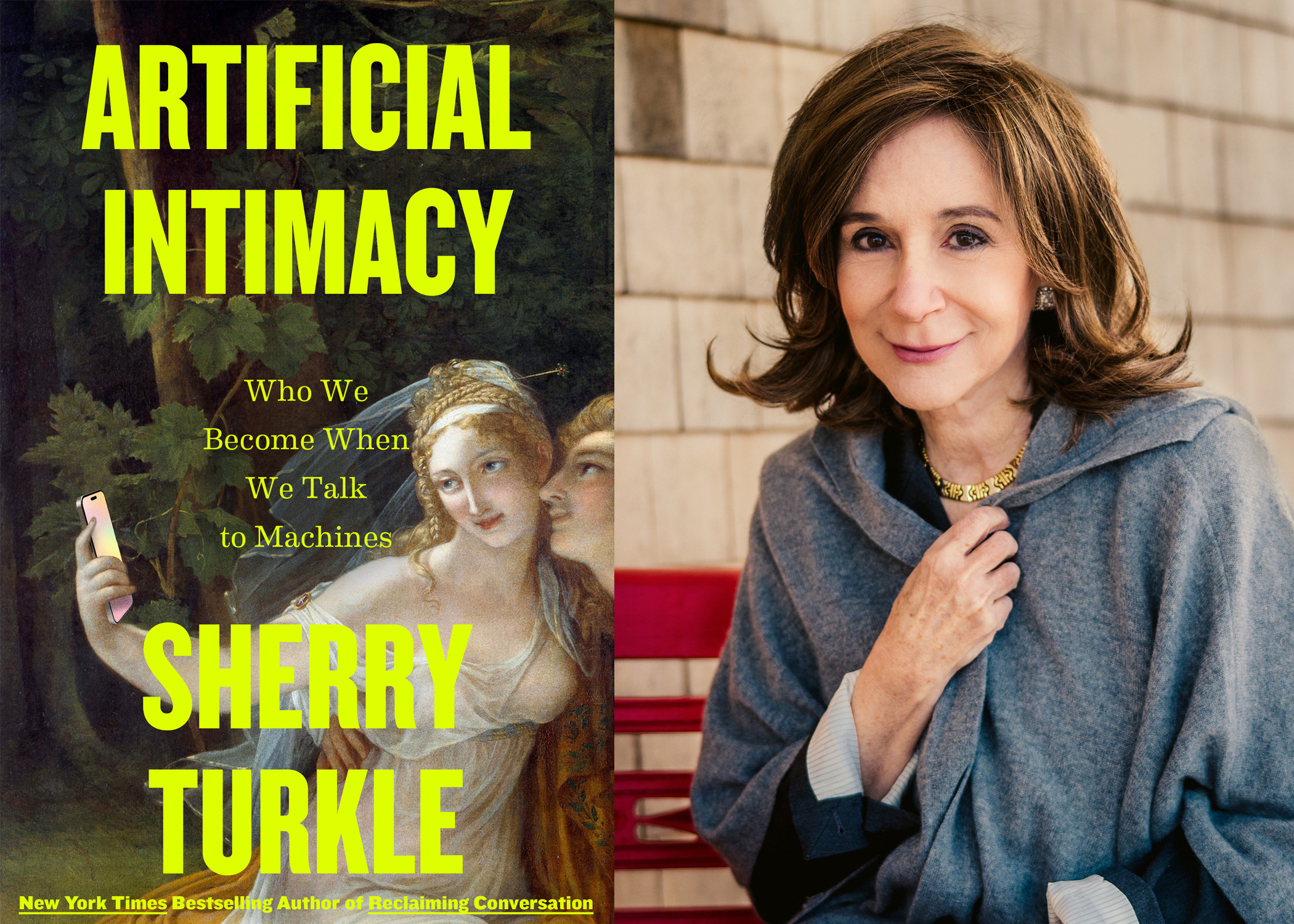
Professor Sherry Turkle’s new book, “Artificial Intimacy,” offers a withering critique of chatbots and the antisocial dynamics she believes they encourage.