Skip to content

Think-to-Personalize: Unifying Reasoning and Retrieval for User-Centric Personalized Dense Retrieval

Aug 2026 · ACM International Conference on Information and Knowledge Management (CIKM) · 0 citations
Computer Science

Abstract

Dense retrieval has become a cornerstone of modern local-lifestyle e-commerce search by encoding queries and items into semantic embedding spaces. While recent advancements have transitioned from BERT-based embedding models to Large Language Models (LLMs), most approaches still treat LLMs as static text encoders, neglecting their inherent reasoning capabilities. Furthermore, standard dense retrieval models remain query-centric, which is insufficient in e-commerce scenarios where sparse and ambiguous queries create an intent gap that can only be bridged by the rich context of user history. Meanwhile, existing personalized retrieval methods typically rely on implicit embedding interactions, which lack the reasoning capability to effectively disambiguate user intent from noisy historical behaviors. To address these challenges, we propose Think-to-Personalize (TTP), a novel framework that unifies explicit user-centric intent reasoning with dense retrieval. By reasoning over the user's historical purchase sequence, TTP explicitly deduces latent personalized needs and generates an intent-enhanced query, which is then encoded into a unified dense embedding. Specifically, we design a two-stage training paradigm: (1) a Supervised Fine-Tuning (SFT) stage that establishes cold-start capabilities; and (2) a Reinforcement Learning (RL) stage that aligns the reasoning process with retrieval utility using Group Relative Policy Optimization (GRPO). Extensive experiments on both proprietary and public benchmarks demonstrate that TTP significantly outperforms state-of-the-art baselines. Furthermore, in online A/B tests, it achieved a +0.46% lift in order volume, validating its practical effectiveness and establishing a new paradigm for reasoning-driven personalized dense retrieval.

View source

Similar papers

#machine learning Review Open access Oct 2014

Software development in startup companies: A systematic mapping study

The results indicate that software engineering work practices are chosen opportunistically, adapted and configured to provide value under the constrains imposed by the startup context.

Nicolò Paternoster, Carmine Giardino, M. Unterkalmsteiner et al. · 394 citations · ⚡54
#machine learning Review Open access Jun 2014

Why Early-Stage Software Startups Fail: A Behavioral Framework

This state-of-practice investigation was performed using a literature review followed by a multiple-case study approach and presents how inconsistency between managerial strategies and execution can lead to failure by means of a behavioral framework.

Carmine Giardino, Xiaofeng Wang, P. Abrahamsson · 175 citations · ⚡19
#machine learning Review Open access Oct 2016

“Failures” to be celebrated: an analysis of major pivots of software startups

This study conducts a case survey study based on the secondary data of the major pivots happened in 49 software startups, and demonstrates that customer need pivot is the most common among all pivot types.

Sohaib Shahid Bajwa, Xiaofeng Wang, Anh Nguyen-Duc et al. · 127 citations · ⚡15
#machine learning Review Open access May 2016

Key Challenges in Software Startups Across Life Cycle Stages

It is found that what perceived as biggest challenges by software startups do vary across different life cycle stages, even though its significance decreases when the learning focuses of the startups move from problem to solution and their products mature.

Xiaofeng Wang, Henry Edison, Sohaib Shahid Bajwa et al. · 62 citations · ⚡6

Related blog posts

Microsoft Research Blog Nov 16, 2026

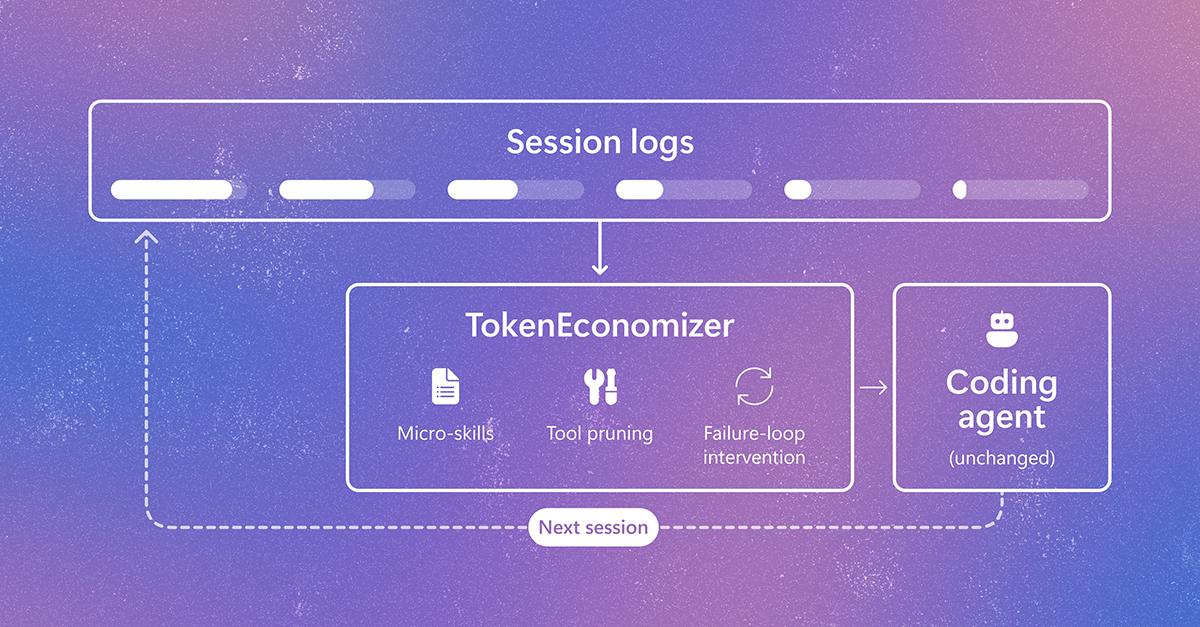
TokenEconomizer: Learning from Experience to Make AI Coding Agents More Efficient

AI coding agents are increasingly help developers fix bugs and build features largely on their own, but every interaction with their models consumes tokens. In each session, an agent sends instructions, tool descriptions, and session history to its model. Most efforts to reduce this cost focus on individual tasks. Yet developers return to the same […] The post TokenEconomizer: Learning from Experience to Make AI Coding Agents More Efficient appeared first on Microsoft Research.

We use cookies to run the site and, with your consent, for analytics and to show ads. See our Cookie Policy.