Skip to content
#software testing Open access

Size Classification for Software Maintenance Projects Through a Simplified Minimalist Machine Learning Algorithm

Sep 2026 · Journal of Advanced Computational Intelligence and Intelligent Informatics · Vol 30, pp. 1417-1430 · 0 citations · 33 references
Computer Science

TL;DR

It is concluded that the S-MML can be applied to classify the size of software enhancement projects from their size by applying a new model termed simplified minimalist machine learning (S-MML) algorithm, which belongs to the minimalist machine learning (MML) paradigm.

Abstract

In the software engineering field, the size of projects is used as explanatory variable for predicting the effort, duration, defects, costs, or risks of a project. Thus, the software project size has been considered the most influential factor. A systematic mapping study on the use of categorical data in software prediction concludes that the use of categorical data as explanatory variable in prediction models is an important issue because in the first phases of the software development process, the information is expressed in a categorical manner rather than numerical; however, at date, software size has mostly been used in its quantitative form rather than in its categorical representation. Because the software enhancement maintenance has the highest impact on business, our purpose is to classify software enhancement projects from their size by applying a new model termed simplified minimalist machine learning (S-MML) algorithm, which belongs to the minimalist machine learning (MML) paradigm. S-MML reduces five attributes commonly used for sizing a software project to only one. The performance of the S-MML is compared to those obtained from three classifiers. Seven public datasets of projects obtained from an international public repository of software projects were used to train and test the classifiers. Results showed that the S-MML had a better f -measure than the other three classifiers for all of the datasets at 95% confidence. We can conclude that the S-MML can be applied to classify the size of software enhancement projects.


Read PDF

Similar papers

Conference Open access Sep 2026

A Machine Learning Framework for Predictive Modeling of Construction Project Duration Using Data-Driven Intelligent Methods

Construction project duration is considered a critical challenge due to the complex interactions between technical, environmental, and management variables that exist in all projects. The present study develops an intelligent approach to predict the duration of construction projects based on machine learning methods. A...

Ayah A. Alkhawaldeh, Yousef B. Aburizeq · 0 citations
Open access Oct 2026

SOFTWARE DEVELOPMENT COST PREDICTION USING ENSEMBLE LEARNING TECHNIQUES

Cost estimation of software is an important task and should be done to complete the software project successfully. Traditional approaches of software cost estimation suffer from subjectivity and additional cost. To overcome these limitations with the traditional methods, the field of Machine learning has been incorpora...

M. Ismael, I. Saleh, F. A. Yousif et al. · 0 citations
Review Open access Oct 2026

An Intelligent Machine Learning Approach for Software Project Management and Performance Prediction

SPM (Software Project Management) is the most important and toughest job in software engineering organizations. For successful project management, it needs the proper planning and scheduling of each software development umbrella activity. Software planning needs proper communication, requirement elicitation, suitable p...

D. B. Hanchate, C. Kulkarni · 0 citations
Open access 2026

Methods of predicting defects in software products based on retrospective and current information

This paper examines the management problems in organizational systems of IT companies related to predicting defects in the source code of software products. The purpose of this work is to determine the most effective method for accurately predicting defects in the source code of software products implemented by organiz...

Y. Leokhin, S. Dymkova, T. Fatkhulin et al. · 4 citations

Related blog posts

Microsoft Research Blog Nov 12, 2026

Microsoft Research Focus – Edition #98

What's new in research at Microsoft? Host Anson Ho explores the latest, including AI-powered universal translation, a breakthrough in a 31-year-old mathematics challenge, and advances making AI coding agents faster and more efficient.  The post Microsoft Research Focus – Edition #98 appeared first on Microsoft Research.

Microsoft Research Blog Nov 5, 2026

Formally verifying agent-written full-stack web apps with PDD Kit

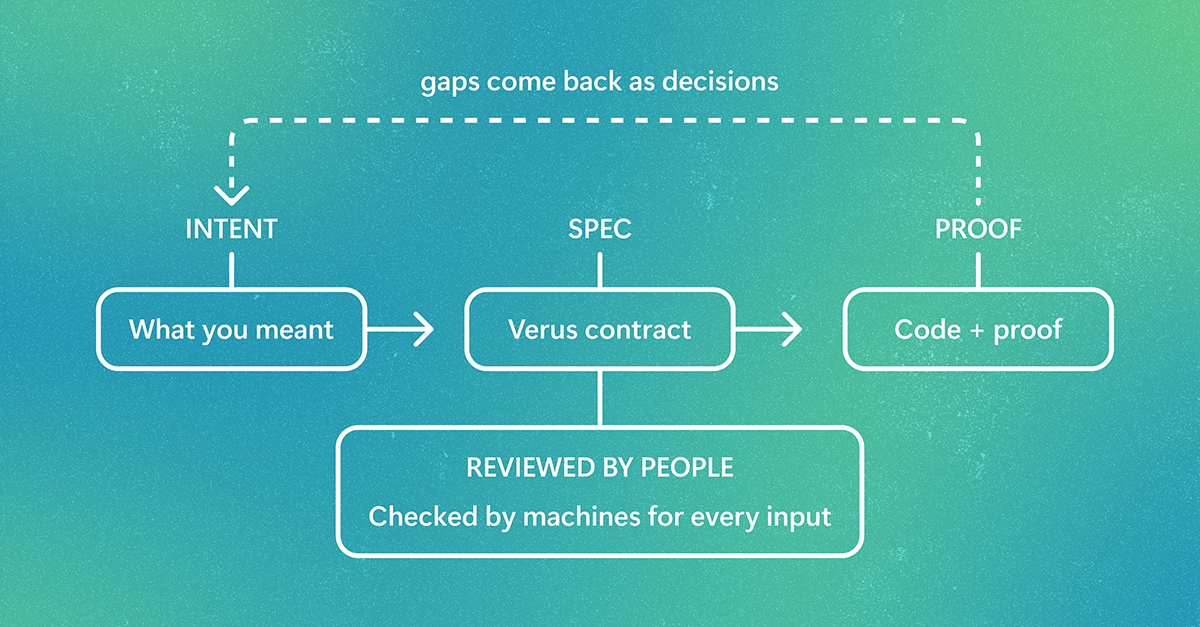
AI agents can generate code at a scale that’s hard for humans to review line-by-line. PDD Kit helps ensure the code is doing what the developer intended by creating formal specifications and testing against them. It converts developer intent into a Verus specification, proves AI-generated code meets it for every input, and uses tests where proofs aren't practical. Developers review intent, not every line. The post Formally verifying agent-written full-stack web apps with PDD Kit appeared first o…

We use cookies to run the site and, with your consent, for analytics and to show ads. See our Cookie Policy.