A recursive learning algorithm is proposed that orders SCCs topologically and, for each component, isolates its marginal dynamics and solves a linear system derived from the steady-state moment equations, leveraging parameters recovered for upstream components.
Abstract
We study the problem of recovering the parameters of a multivariate Ornstein-Uhlenbeck (OU) process from steady-state observational and interventional data. In many applications, such as large-scale gene perturbation experiments, only stationary"snapshot"measurements are available, making standard stochastic differential equation estimation methods that rely on time-series trajectories inapplicable. We first establish an identifiability result: one intervention per strongly connected component (SCC) of the drift graph suffices to recover all OU process parameters generically up to a global scaling factor. This holds provided that the SCC condensation graph is connected with a single root and certain spectral nondegeneracy assumptions hold. We propose a recursive learning algorithm that orders SCCs topologically and, for each component, isolates its marginal dynamics and solves a linear system derived from the steady-state moment equations, leveraging parameters recovered for upstream components. Building on this theoretical foundation, we propose a regularized least-squares estimator that jointly minimizes residuals of the steady-state mean and covariance equations across observational and interventional data. Experimental results validate our theoretical findings in recovering parameters of the underlying OU process.
For two concepts, this work proves a constructive structural identifiability theorem for the associated inverse problem under explicit excitation conditions, together with monotonicity, robustness and L-stability results.
Many real-world processes exhibit long-range dependence, where the current state depends on a slowly decaying trace of past states rather than on the most recent state alone. This paper studies system identification for discrete-time fractional-order linear time-invariant systems from a single observed trajectory of le...
Xiao-Le Zhang, Zi-Yi Zhang, Ze-Hao Zhao et al.· 0 citations
This work introduces innovation-based sampling of continuous stochastic processes, in which a sample is generated only when the process reveals ``sufficiently new''information relative to all previous samples. The resulting innovation process admits a lattice structure and a three-dimensional state representation. For...
Ji-Ping Luo, Anthony Ephremides, Nikolaos Pappas· 0 citations
What determines the unavoidable sample cost of learning cyclic causal structure? For cyclic linear non-Gaussian models, we study exact condensation recovery from observational data: identifying the strongly connected component (SCC) partition and all edges between components. We establish the first information-theoreti...
This paper shows that the original stationary-equilibrium problem can be reduced to a finite-dimensional self-consistency equation, separating steady-state analysis of the underlying Markov system from equilibrium computation, and uses properties of the resulting self-consistency map to guide the choice among fixed-poi...
This work exploits the affine state update to obtain the exact one-step conditional-mean sensitivity by differentiating normalized reaction propensities, and defines the propensity straight-through (PST) estimator, a temperature- and Gumbel-free path to scalable gradient-based learning through exact stochastic trajecto...
Jose M. G. Vilar, Leonor Saiz· 0 citations
Related blog posts
MIT News · Artificial Intelligence· news.mit.eduNov 17, 2026
By studying the computational foundations of language learning, Associate Professor Jacob Andreas builds intelligent systems that can communicate effectively with humans.
Microsoft Research Blog· microsoft.comNov 16, 2026
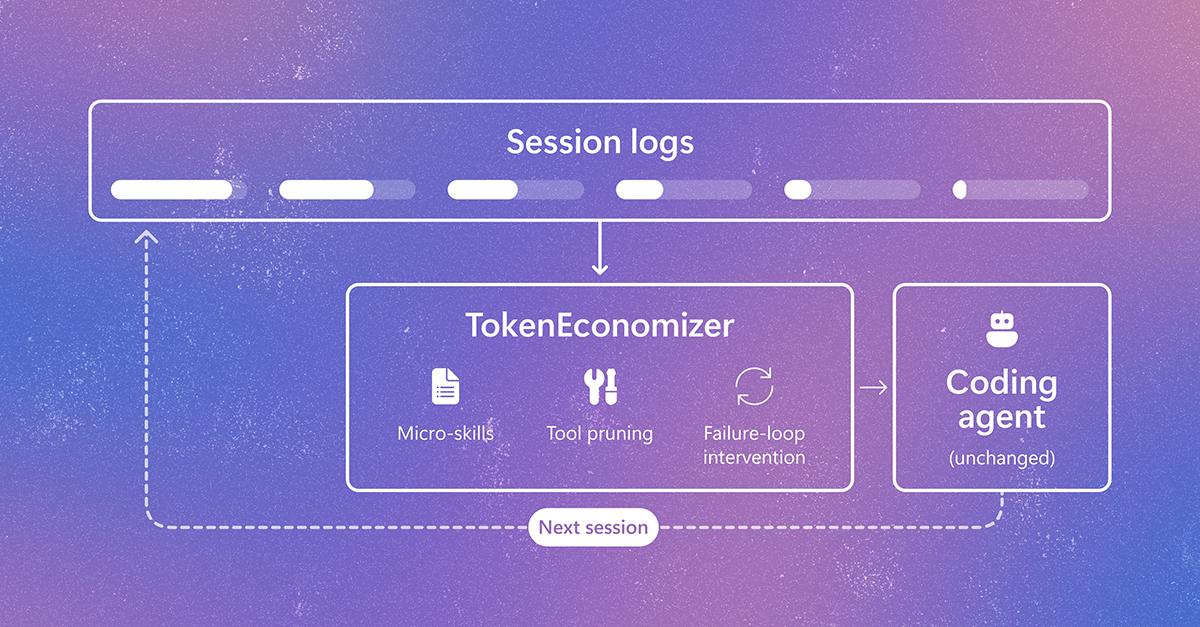
AI coding agents are increasingly help developers fix bugs and build features largely on their own, but every interaction with their models consumes tokens. In each session, an agent sends instructions, tool descriptions, and session history to its model. Most efforts to reduce this cost focus on individual tasks. Yet developers return to the same […] The post TokenEconomizer: Learning from Experience to Make AI Coding Agents More Efficient appeared first on Microsoft Research.
MIT News · Artificial Intelligence· news.mit.eduNov 13, 2026