Skip to content
#machine learning #quantum computing Preprint Open access

Solving Conic Programs over Sparse Graphs using a Variational Quantum Approach: The Case of the AC Optimal Power Flow

Thinh Viet Le Mark M. Wilde Vassilis Kekatos
Sep 2026
Machine Learning Quantum Computing

Abstract

Conic programs arising in physics, quantum information, machine learning, and engineering are often defined over sparse graphs. Although such problems can be solved in polynomial time using classical interior-point solvers, the computational complexity scales unfavorably with graph size. We propose a variational quantum paradigm for solving conic programs, including quadratically constrained quadratic programs and semidefinite programs. We encode primal variables via the state of a parameterized quantum circuit (PQC) and dual variables via the probability mass function associated with a second PQC. The Lagrangian function can thus be expressed as scaled expectations of quantum observables. We pursue approximately stationary points of the Lagrangian by minimizing/maximizing the Lagrangian over the parameters of the first/second PQC. This is accomplished in a hybrid fashion: gradients are estimated using the two PQCs, while their parameters are updated classically using a primal-dual method. We propose permuting primal variables so that related observables have a banded form, enabling efficient measurement. We provide a complexity analysis that is useful to determine which problem types may enjoy quantum advantage. The framework is applied to the AC OPF problem, a large-scale optimization problem central to electric power system operation. Numerical tests on the IEEE 57-node system using PennyLane's simulator show that the proposed doubly variational quantum framework can find high-quality OPF solutions. While this demonstration does not yield a quantum speedup, the results serve as a proof-of-concept and highlight challenges toward practical quantum advantage. Although showcased for OPF, the framework has broader scope, including conic programs with many variables and constraints, problems defined over sparse graphs, and training quantum machine learning models to satisfy constraints.

View source

Similar papers

#computer vision Review Sep 2017

Agile Software Development Methods: Review and Analysis

This publication proposes a definition and a classification of agile software development approaches and analyses ten software development methods that can be characterized as being "agile" against the defined criterion.

P. Abrahamsson, O. Salo, Jussi Ronkainen et al. · 727 citations · ⚡54
#computer vision Jun 2008

The impact of agile practices on communication in software development

The study shows that agile practices improve both informal and formal communication, but indicates that, in larger development situations involving multiple external stakeholders, a mismatch of adequate communication mechanisms can sometimes even hinder the communication.

M. Pikkarainen, Jukka Haikara, O. Salo et al. · 401 citations · ⚡48
#machine learning Review Open access Oct 2014

Software development in startup companies: A systematic mapping study

The results indicate that software engineering work practices are chosen opportunistically, adapted and configured to provide value under the constrains imposed by the startup context.

Nicolò Paternoster, Carmine Giardino, M. Unterkalmsteiner et al. · 394 citations · ⚡54

Diffusion models as plug-and-play priors

The possibility of inferring high-dimensional data inference in a model that consists of a prior and an auxiliary differentiable constraint given some additional information is considered, thereby allowing a range of potential applications in adapting models to new domains and tasks.

Alexandros Graikos, Esmeralda S. Whitammer, N. Jojic et al. · 316 citations · ⚡15

Related blog posts

MIT News · Artificial Intelligence Aug 27, 2026

Looking beyond natural sequences

A new machine-learning framework aims to improve the success rate of computational protein design while moving away from results that reproduce sequences found in nature.

Microsoft Research Blog Aug 20, 2026

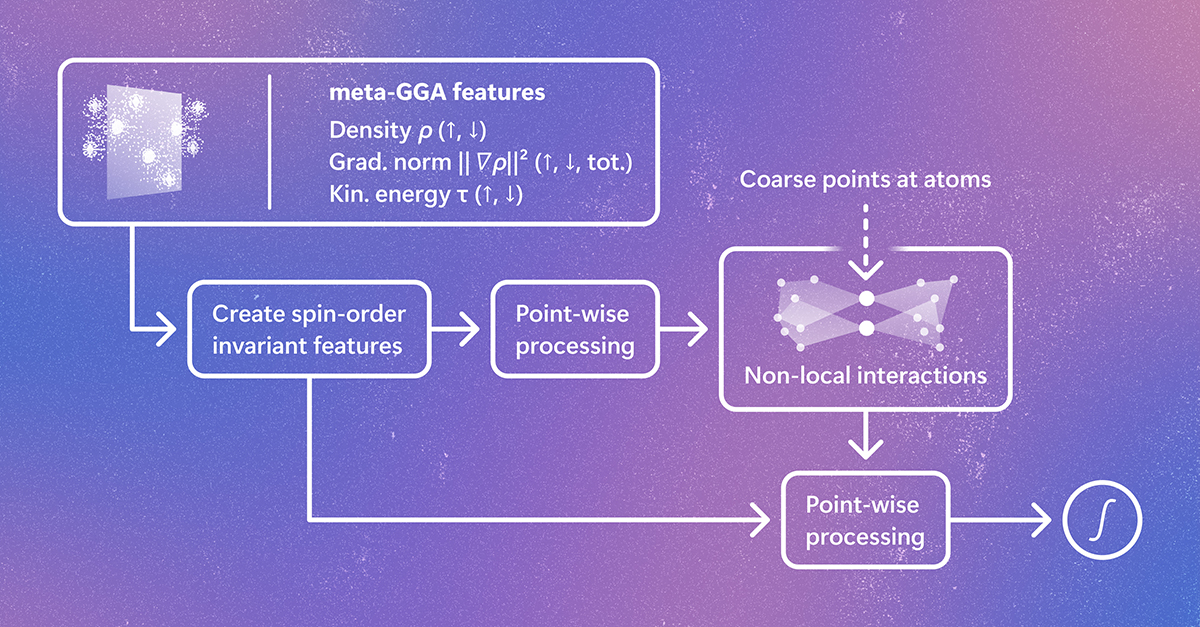
Broadening access to Skala creates a faster path to predictive DFT 

Skala 1.1, the updated deep-learning exchange-correlation functional from Microsoft Research, provides greater accuracy, expanded accessibility across the computational chemistry ecosystem, and a living benchmark to track computational performance. The post Broadening access to Skala creates a faster path to predictive DFT  appeared first on Microsoft Research.

We use cookies to run the site and, with your consent, for analytics and to show ads. See our Cookie Policy.