This work leverage pretrained score-based models as geometric priors and learn a vector field that evolves data along score-induced interpolation paths that supports generation at arbitrary timestamps and temporal super-resolution beyond the discretization of the training data.
Abstract
Generative modeling of time-dependent data is typically formulated on a discrete temporal grid, restricting supervision to the observed timestamps in the training data. We instead frame generation as continuous-time evolution on a learned data manifold. To this end, we leverage pretrained score-based models as geometric priors and learn a vector field that evolves data along score-induced interpolation paths. Because these dynamics follow transitions that respect the geometry learned by the score model, they support generation at arbitrary timestamps and temporal super-resolution beyond the discretization of the training data. Moreover, this geometric formulation allows us to train the vector field simulation-free through a regression objective. To improve long-horizon rollout robustness, we introduce an objective that promotes path-relative transverse exponential stability. While motivated by stability theory, it admits a practical interpretation as denoising score matching transverse to the interpolation path. Further, we extend the framework to a probabilistic setting that models a distribution over plausible future trajectories. We demonstrate the method on natural video and scientific dynamical data, including temporal super-resolution, PDE-based spatiotemporal fields, and molecular dynamics. Our results show that score-based priors provide a strong foundation for learning stochastic continuous-time generative dynamics.

This work introduces manifold-stable flow matching (MSFM), which can start from an arbitrary ambient prior, not necessarily supported on the manifold, and guarantees manifold invariance and transverse convergence to the manifold within a desired time window.
Amirhossein Nazerian, A. Pezeshki, Jian-Guo Zhao· 0 citations
We introduce a new framework for one-step generative modelling on finite state spaces. To extend drifting beyond continuous domains, we use discrete Wasserstein geometry to define a target-relative KL gradient flow over the transitions of a reversible Markov kernel. We realize this probability flow at the particle leve...
Alessandro Micheli, Andrea Zerio, Samir Bhatt· 0 citations
FreKoo++ is proposed, a novel continuous spectral-dynamical framework that pioneers the unification of continuous Koopman modal dynamics with adaptive spectral disentanglement and derives modal approximation and generalization bounds that characterize how amplitude and eigenvalue estimation errors propagate with the pr...
En-Shui Yu, Xiao-Yu Yang, Wei Duan et al.· 0 citations
This paper introduces PDE-JEPA for parametric PDE dynamics, and develops a physics-structured latent predictor that decomposes the dynamics into parameter-independent evolution and parameter-dependent response components.
Zhen-Tao Tan, Jian-Rong Zhang, Rui-Jie Quan et al.· 0 citations
Many scientific and machine learning systems, from molecular dynamics to diffusion models and beyond, are governed by stochastic dynamics with low-dimensional structure, evolving on slow timescales. However, target trajectories, used to identify and interpret such dynamics, are often inaccessible: only biased or static...
Vladimir R. Kostic, Karim Lounici, Hélène Halconruy et al.· 0 citations
This work proposes PolarFormer, a novel framework for time series generation that addresses limitations through a polar decomposition-based discrete representation, and proposes a structurally decoupled generation strategy that models radial and angular token sequences jointly while leveraging their orthogonality to su...
Jiahong Lyu, Hongfan Gao, Wang-Meng Shen et al.· Proceedings of the 32nd ACM...· 1 citation
Related blog posts
MIT News · Artificial Intelligence· news.mit.eduOct 13, 2026
Machine-learning networks can learn without detailed instructions from a designer. Those that do may offer insight into how the brain reorganizes itself during learning.
MIT News · Artificial Intelligence· news.mit.eduSep 29, 2026
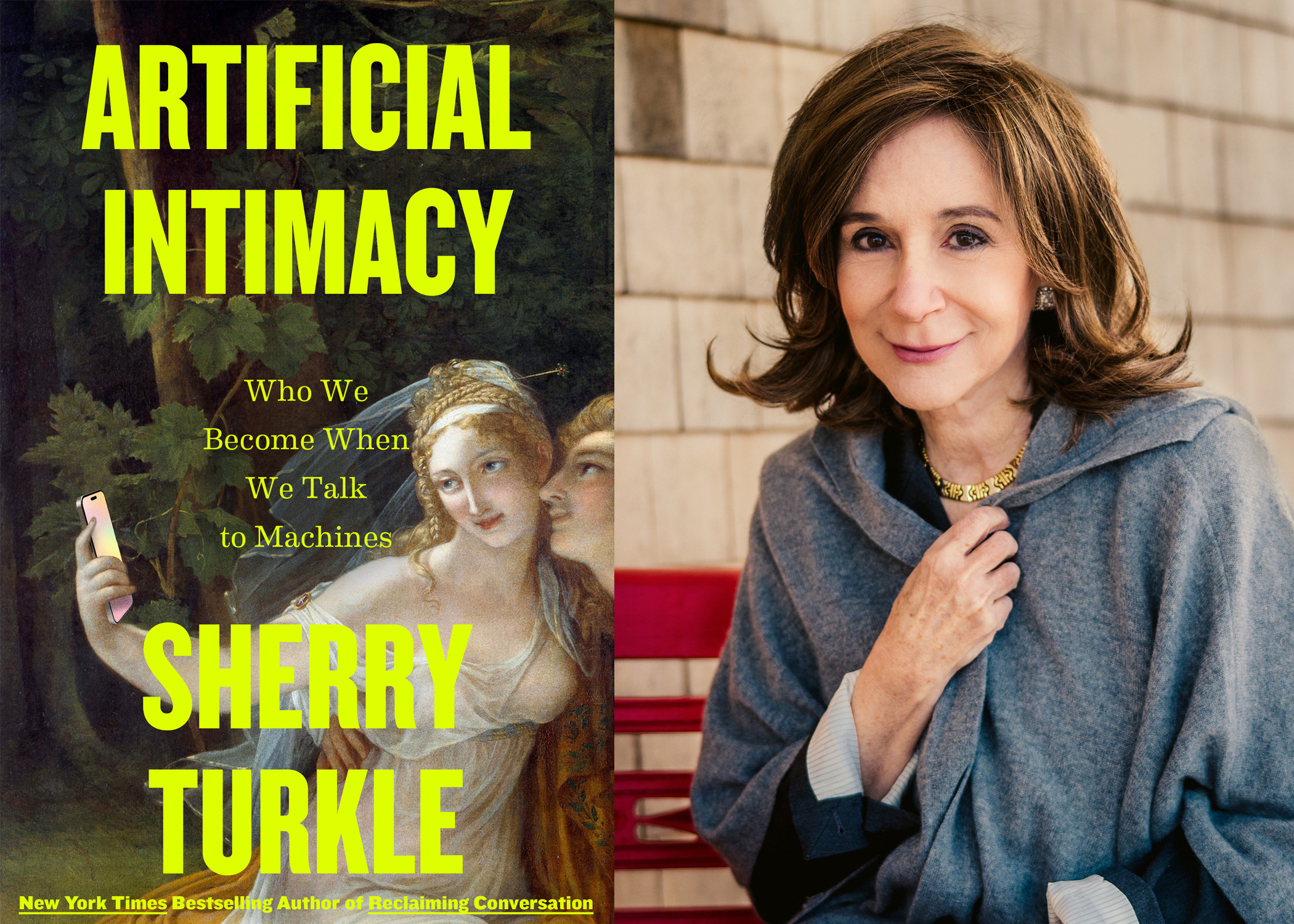
Professor Sherry Turkle’s new book, “Artificial Intimacy,” offers a withering critique of chatbots and the antisocial dynamics she believes they encourage.