Skip to content

Multi-Agent Learning with Cooperation-Driven Optimization Dynamics

Sep 2026 · 0 citations · 26 references
Computer Science

TL;DR

The results support the claim that several small agents can outperform a single large model on a given classification task; the shared signals affect each agent's optimization algorithm by modulating both the descent direction and the step size, converging toward a global consensus.

Abstract

Multilayer Artificial Neural Networks trained via backpropagation are the basic blocks of many, more complex, classification algorithms. Their strength lies in the possibility of realizing, with arbitrary precision, any function. This result comes at the cost of the large number of involved parameters to be optimized. In this work, we propose a mechanism for cooperation, i.e., information exchange among several artificial neural networks, with the goal of reducing model complexity while maintaining performance. More precisely, we consider several"small"agents, i.e., containing fewer parameters than a reference"large"one, that during training share their predictions by incorporating this information into the loss function and thus directly influence weight updates. We consider several strategies for implementing cooperation, e.g., the voter model, majority model, and weighted average model based on an agent's confidence in its prediction. We numerically compare the accuracy of those strategies on several standard benchmarks. Our results support the claim that several small agents can outperform a single large model on a given classification task; the shared signals affect each agent's optimization algorithm by modulating both the descent direction and the step size, converging toward a global consensus. The proposed proof-of-concept significantly reduces the number of parameters to be trained while preserving comparable performance, thereby limiting computational resource usage.


View source

Similar papers

#machine learning Review Open access Oct 2014

Software development in startup companies: A systematic mapping study

The results indicate that software engineering work practices are chosen opportunistically, adapted and configured to provide value under the constrains imposed by the startup context.

Nicolò Paternoster, Carmine Giardino, M. Unterkalmsteiner et al. · 394 citations · ⚡54

Diffusion models as plug-and-play priors

The possibility of inferring high-dimensional data inference in a model that consists of a prior and an auxiliary differentiable constraint given some additional information is considered, thereby allowing a range of potential applications in adapting models to new domains and tasks.

Alexandros Graikos, Esmeralda S. Whitammer, N. Jojic et al. · 316 citations · ⚡15

Trajectory Balance: Improved Credit Assignment in GFlowNets

It is proved that any global minimizer of the trajectory balance objective can define a policy that samples exactly from the target distribution, and empirically demonstrate the benefits of the trajectories balance objective for GFlowNet convergence, diversity of generated samples, and robustness to long action sequenc...

Esmeralda S. Whitammer, Moksh Jain, Emmanuel Bengio et al. · 302 citations · ⚡60

KTO: Model Alignment as Prospect Theoretic Optimization

This work proposes a HALO that directly maximizes the utility of generations instead of maximizing the log-likelihood of preferences, and suggests that the best loss depends on the inductive biases most appropriate for a given setting, an oft-overlooked consideration.

Kawin Ethayarajh, Winnie Xu, Niklas Muennighoff et al. · 195 citations · ⚡28
#machine learning Review Open access Jun 2014

Why Early-Stage Software Startups Fail: A Behavioral Framework

This state-of-practice investigation was performed using a literature review followed by a multiple-case study approach and presents how inconsistency between managerial strategies and execution can lead to failure by means of a behavioral framework.

Carmine Giardino, Xiaofeng Wang, P. Abrahamsson · 175 citations · ⚡19

Related blog posts

Microsoft Research Blog Oct 12, 2026

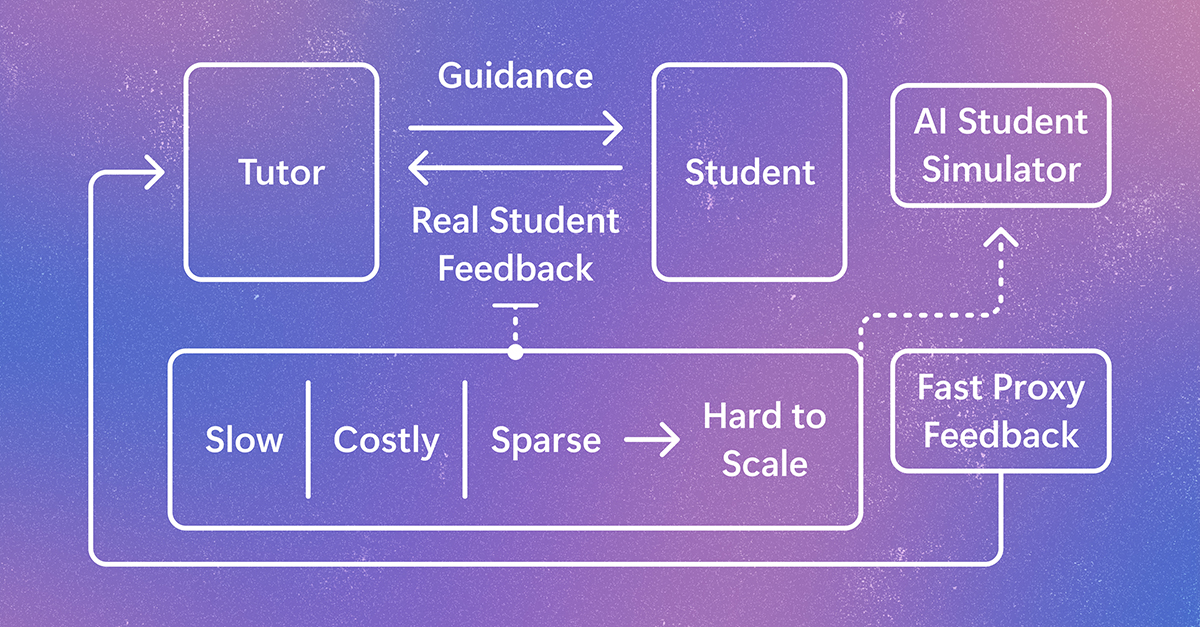
Simulating student learning for better AI tutoring

StudentSim is a research system for evaluating and improving AI tutoring tools before they are tested with learners. It models how individuals may engage with tutors, giving feedback to improve tutor performance across subjects like chess, writing, and mathematics. The post Simulating student learning for better AI tutoring appeared first on Microsoft Research.

We use cookies to run the site and, with your consent, for analytics and to show ads. See our Cookie Policy.