Biquaternionic Space with Complex-valued Attention (BSCA), a TKGE model that combines circular and hyperbolic rotations within a unified biquaternionic framework that adaptively fuses time-conditioned and relation-conditioned entity representations, allowing them to vary with temporal and relational context.
Abstract
Temporal knowledge graph embedding (TKGE) models infer missing facts in knowledge graphs that evolve over time. Many existing models use a single geometric space, which can limit their ability to represent diverse relational patterns, or treat entity representations as static. We propose Biquaternionic Space with Complex-valued Attention (BSCA), a TKGE model that combines circular and hyperbolic rotations within a unified biquaternionic framework. A complex-valued attention mechanism adaptively fuses time-conditioned and relation-conditioned entity representations, allowing them to vary with temporal and relational context. Experiments on five benchmark datasets show competitive performance across datasets, with the largest improvement on GDELT: BSCA achieves an MRR of 52.1\%, compared with 38.1\% for the strongest baseline in our comparison.
The Frequency-Modulated Spiral Manifold model, which includes a relation-adaptive spectral partition and relation-dimension gate for fusing long- and short-term relation channels, is proposed, which is a phase-conditioned spectral-geometric representation that separates recurring temporal facts while retaining multi-sc...
Xin-Dong You, Kai Long, Zhao-Jun Wang et al.· Mathematics· 0 citations
An adaptive geometric hypergraph encoder that projects entities into a product manifold and design a topology-aware gating mechanism to dynamically select optimal geometric spaces for each entity, and a role-aware Transformer equipped with role-specific projections and micro-structural bias injection to refine embeddin...
Ke-Jia Chen, Yu-Zhe Hu, Yu Ni et al.· Proceedings of the Thirty-Fi...· 0 citations
This paper introduces LaGR, a novel approach for integrating global information in knowledge graph reasoning that compresses the graph into a fixed, compact set of latent summaries and applies exact self-attention within this latent space, resulting in scale-invariant attention and stable performance across diverse dat...
Chen Lin, Lei Wang, Yin Zhang et al.· Proceedings of the Thirty-Fi...· 0 citations
This work introduces ICE (Interaction-aware Clifford Encoder), a multimodal graph foundation model built on a node-indexed Clifford latent field that ranks first in all 30 reported supervised and few-shot comparisons.
Xun-Kai Li, Xu Wang, Yin-Lin Zhu et al.· 0 citations
CurvBi (Curvature-aware Bicomplex), a novel framework for multimodal knowledge graph completion that unifies modality alignment and relational modeling under a coherent mathematical foundation, is proposed.
Thanh Le, Vy Cao, Duong-Khang Au et al.· Data mining and knowledge di...· 0 citations
Graph representation learning has emerged as a foundational discipline within modern data science, essential for modeling the complex relational systems ubiquitous in domains from social networks to bioinformatics. However, conventional approaches, particularly Graph Neural Networks (GNN), exhibit significant limitatio...
Justin Carpenter· 0 citations
Related blog posts
MIT News · Artificial Intelligence· news.mit.eduOct 13, 2026
Machine-learning networks can learn without detailed instructions from a designer. Those that do may offer insight into how the brain reorganizes itself during learning.
MIT News · Artificial Intelligence· news.mit.eduSep 29, 2026
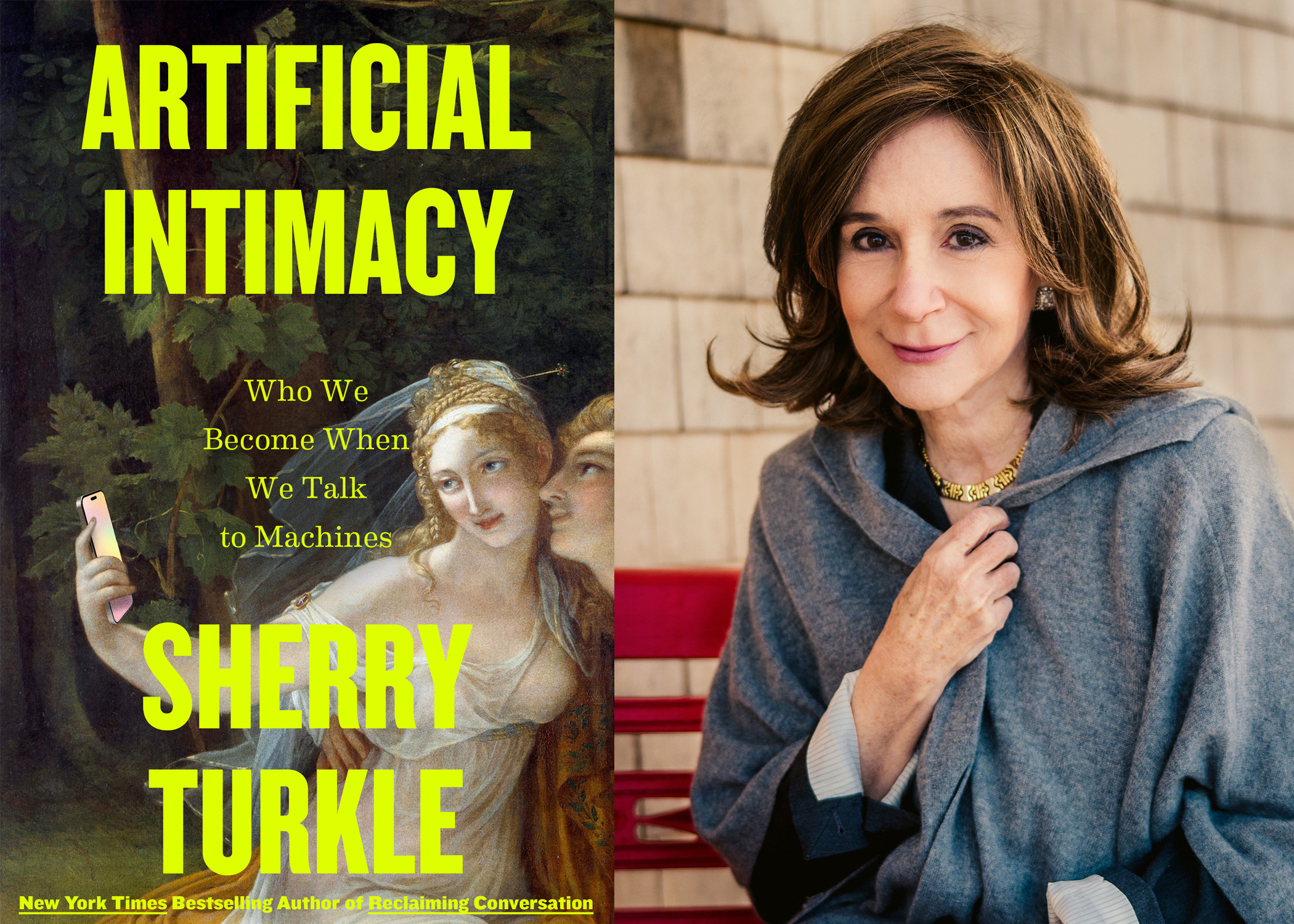
Professor Sherry Turkle’s new book, “Artificial Intimacy,” offers a withering critique of chatbots and the antisocial dynamics she believes they encourage.