It is argued that the right resolution is state-dependent, and GACA, a critic-free estimator whose granularity follows an uncertainty-based criticality proxy is proposed, improves task success over GRPO and GiGPO at both 1.5B and 7B scales.
Abstract
Long-horizon language-model agents trained with reinforcement learning oftenreceive sparse outcome rewards that do not reveal which decisions along a tra-jectory deserve credit. Episode-level advantages provide coarse trajectory-widecredit, while step-level comparisons offer finer resolution with context-dependentestimation noise. We propose Granularity-Adaptive Credit Assignment (GACA),a critic-free method that adaptively mixes episode- and step-level credit for eachdecision during policy optimization. GACA normalizes the sampled response'smean per-token negative log-likelihood (NLL) within each trajectory and uses theresulting criticality score to determine the step-specific mixture. The computationreuses rollout log-probabilities without additional training rollouts or model eval-uations. Our analysis characterizes optimal score-dependent mixing and derivesconditions linking expected NLL to a lower bound on the preferred step-levelweight. Across ALFWorld and WebShop with 1.5B and 7B backbones, GACAachieves the highest reported mean success rates among the compared methods,while introducing negligible additional computation.

Agentic reinforcement learning (RL) trains a large language model (LLM) to act over long, multi-step interactions. However, a single localized error can cause task failure, while trajectory-level rewards provide limited guidance for assigning credit to individual decisions. To address this limitation, we introduce Segm...
Xin-Chen Du, Zheng-Ze Zhou, Wen-Hui Zhu et al.· 0 citations
This work proposes AgentOPSD, a critic-free, recursive method for turn-level credit assignment in agentic reinforcement learning that aggregates token-level teacher-student log-probability gaps into turn-level evidence and recursively updates a Bayesian belief state in log-odds space.
Zi-Han Wang, Zhengxi Lu, Zhiyuan Yao et al.· 7 citations· ⚡1
A Graph-based Faithful sTep-level credit-assignment framework (GRAFT) that grafts all rollout trajectories into a trajectory graph, recovering node state-values via Bellman iteration on the graph, and assigning credit to each edge by the node value difference is proposed.
Xin-Cheng Yao, Haobo Fu, Wei-Ming Liu et al.· 0 citations
GraphHCA is proposed, a model-free realization of HCA that eliminates explicit hindsight-distribution estimation and achieves state-of-the-art results on ALFWorld and WebShop at both LLM scales, and on Sokoban with a vision-language agent.
Hao-Dong Zhu, Yang-Yang Ren, Chang-Bai Li et al.· 0 citations
Existing approaches to offline goal-conditioned reinforcement learning (GCRL) struggle with long-horizon tasks. Discounting shrinks value differences between distant states until they fall below the function approximation error, leaving the agent with no signal for ranking states. Temporal abstraction, which treats k e...
P. Dutenhefner, Dikshant Shehmar, Wagner Meira et al.· 0 citations
Related blog posts
MIT News · Artificial Intelligence· news.mit.eduOct 23, 2026
Assistant Professor Benjamin Lindquist studies how engineers deliberately injected randomness into early AI, giving rise to deep-learning models that sometimes hallucinate.
Learn how Google DeepMind and GovTech Singapore uses lightweight on-device Gemma models to intercept conversational scams in private chats with zero cloud data egress.
Microsoft Research Blog· microsoft.comOct 12, 2026
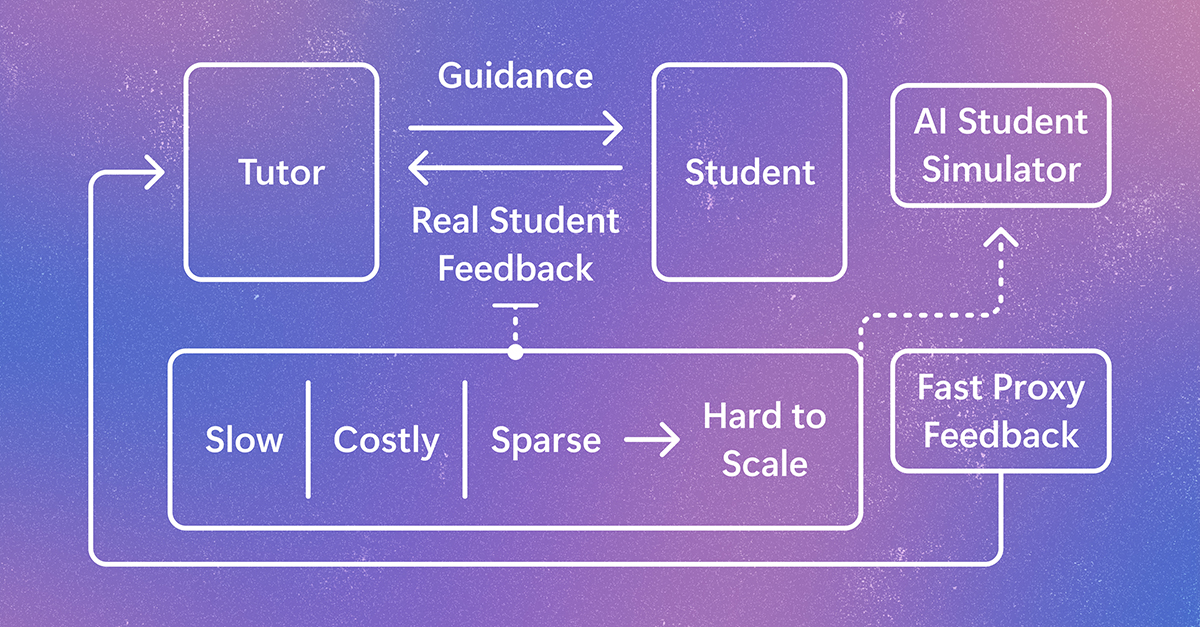
StudentSim is a research system for evaluating and improving AI tutoring tools before they are tested with learners. It models how individuals may engage with tutors, giving feedback to improve tutor performance across subjects like chess, writing, and mathematics. The post Simulating student learning for better AI tutoring appeared first on Microsoft Research.
We use cookies to run the site and, with your consent, for analytics and to show ads.
See our Cookie Policy.