Mobile manipulators such as humanoid robots are increasingly deployed in dynamic, unstructured environments to perform dexterous manipulation tasks. However, end-to-end manipulation policies trained to imitate demonstration data collected from a single robot pose are brittle: even centimeter-scale deviations in robot p...
Suzannah Wistreich, Stephen Tian, Isabella Huang et al.· 0 citations
Behavioral cloning (BC), despite its simplicity, exhibits many counterintuitive phenomena in the real world. For example, the performance of BC often keeps increasing as the model overfits more to the dataset, and fully closed-loop policies often completely fail without action chunking. Unfortunately, properly studying...
Gaussian Belief Propagation (GBP) is a distributed inference algorithm that passes messages in graphical models, making it attractive for scalable spatial intelligence. However, we find GBP most effective locally: it rapidly smooths message errors that vary sharply between neighbor variables, but corrects global errors...
Yuzhou Cheng, Tom Yates, Ignacio Alzugaray et al.· 0 citations
Reinforcement-learning quadrotor controllers are usually trained under simplified wind models, yet the impact of wind-field fidelity, as opposed to magnitude, on policy robustness remains unquantified. This paper compares five disturbance-fidelity levels, from wind-free flight and discrete 1-cosine gusts through statis...
Xun Huang· 0 citations
Reach audiences
Advertise in front of researchers, engineers, and readers.
Deep Reinforcement Learning policies can produce nonsmooth action oscillations that hinder deployment on physical robots. Existing architectural and penalty-based approaches seek spatial smoothness by directly reducing sensitivity to changes in state inputs, but their broad constraints can degrade task performance as s...
Robotic systems often exhibit unstable modes, along which small perturbations and disturbances can cause unbounded growth unless corrected through feedback. Controlling such systems from high-dimensional visual observations requires representations that preserve these modes. Joint-embedding predictive architectures (JE...
Leonardo F. Toso, Yann LeCun, James Anderson et al.· 0 citations
Heterogeneous multi-robot path planning is a well-studied problem in which agents with disparate kinematic and dynamic models must coordinate to achieve shared objectives. These formulations, however, treat all agents as robotic-their cost models are mechanical and their traversability is sensor-derived. In human-robot...
Kristian Dalland, Prithvi Poddar, Souma Chowdhury et al.· 0 citations
Robot delivery studies can overstate transport capacity when travel to pickups and human support fall outside the modeled schedule. We formulate a location aware dispatch model that couples robot admission to transporter support and shared elevators, charging, and cleaning. The model replays 33,079 observed hospital re...
Krzysztof Siwek, Aleksandra \'Swietlicka· 0 citations
Autonomous social navigation requires balancing efficiency, physical safety, and social compliance. Reinforcement Learning (RL) methods provide a viable and effective solution but often rely on unrealistic assumptions, such as the knowledge of humans' position and velocity. In this paper, we introduce JESSI (JAX-based...
Tommaso Van Der Meer Andrea Garulli, Antonio Giannitrapani, Renato Quartullo et al.· 0 citations
We propose a force-based model for social navigation of a tour-guide robot. Social forces due to various factors like obstacles, user position and heading, have been accounted for in the model. We claim that each one of these forces makes the robot more sociable to the user and we design an experimental setup for evalu...
For residual learning that refines existing behavior, sample efficiency depends on two things: how much information each rollout returns, and how efficiently the learner uses that information. Reinforcement learning's standard scalar reward carries far less information than the directional task error that defines the t...
Kai Ploeger, Alap Kshirsagar, Jan Peters· 0 citations
Reinforcement learning has shown strong performance in robotic manipulation, but learned policies often degrade in performance when test conditions differ from the training distribution. This limitation is especially important for reliable robot planning and control in contact-rich tasks such as pushing and pick-and-pl...
Shaifalee Saxena, Rafael Fierro, Alexander Scheinker· 0 citations
Robots are getting smarter, but how can their hardware match that growth? New Microsoft Research findings show that moving AI inference beyond the robot can improve task success, boost efficiency, and support more advanced physical AI workloads. The post Offloaded inference for real-world physical AI robotics appeared first on Microsoft Research.
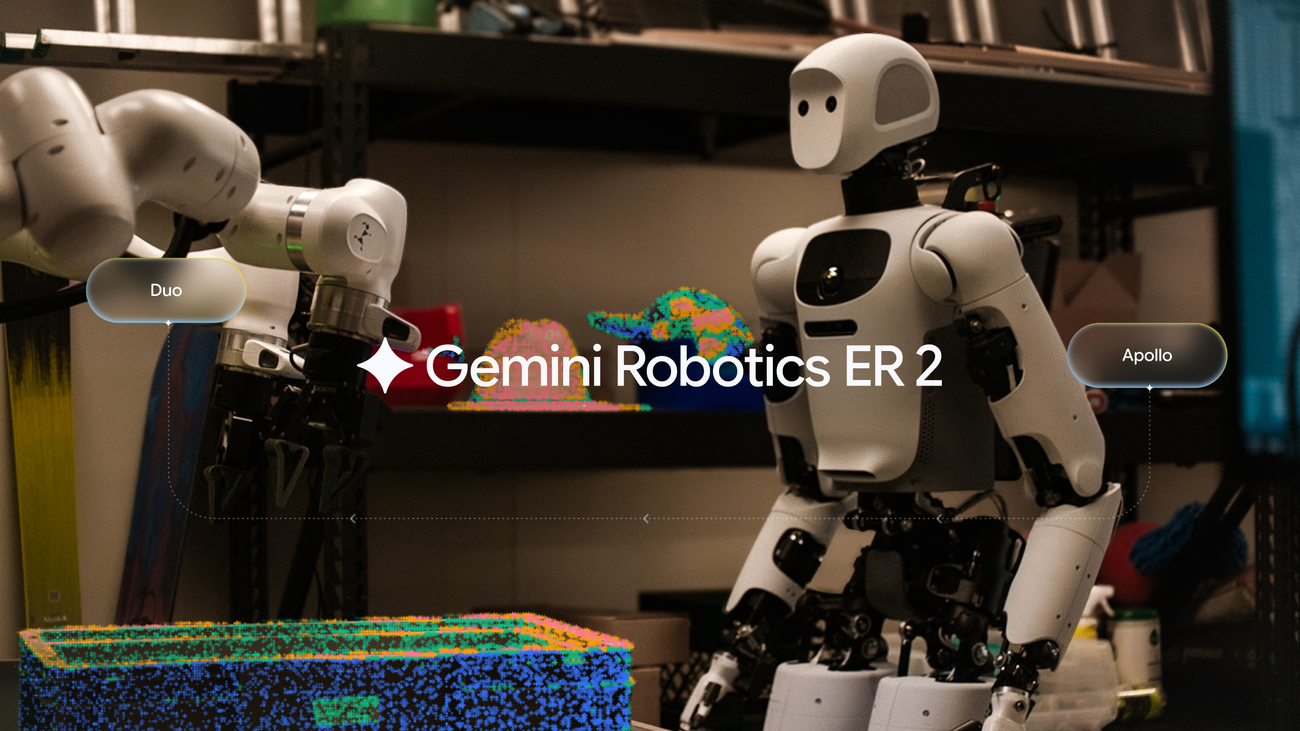
Gemini Robotics ER 2 helps robots reason, collaborate, and solve real-world tasks. It represents a step change in video understanding, tool orchestration, and multi-robot collaboration for robotic applications.
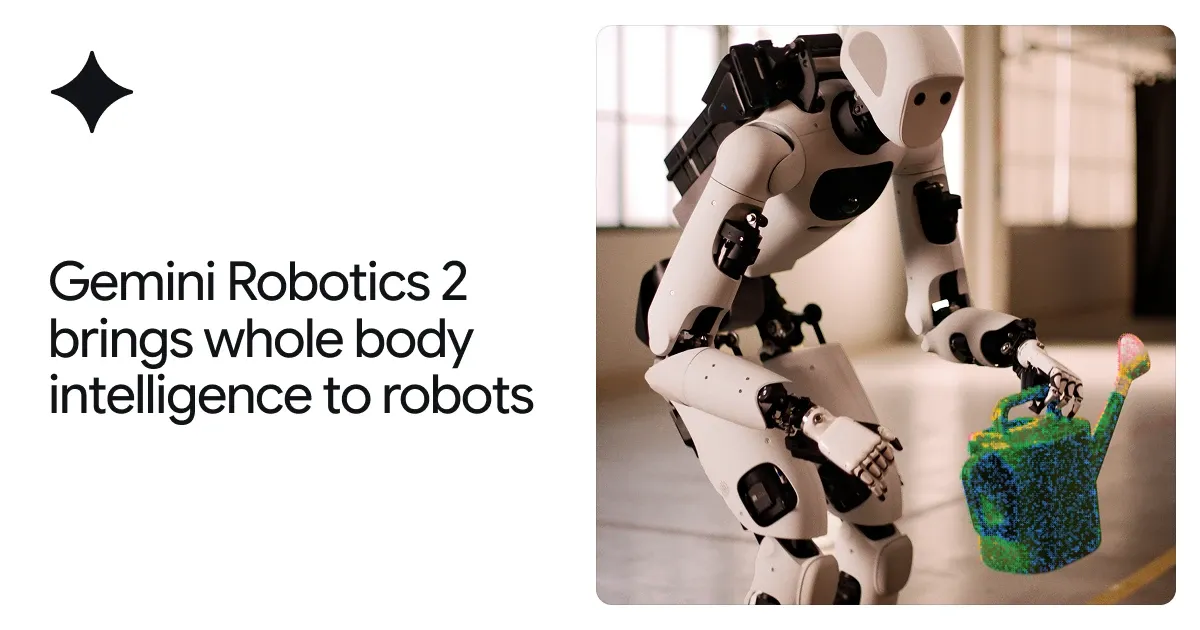
From feet to fingertips — we are teaching robots intelligent whole-body control, fine dexterity, and teamwork to complete a broad range of complex tasks.
We use cookies to run the site and, with your consent, for analytics and to show ads.
See our Cookie Policy.