LLM-based multi-agent systems can support strategic AI planning by enabling iterative refinement with human experts by supporting structured and collaborative Requirements Engineering processes for AI adoption planning.
Malik Abdul Sami, Zheying Zhang, Muhammad Waseem et al.· e-Informatica Software Engin...· 6 citations
GRAS is simple yet effective: across regulatory DNA and protein design it attains the best training-free reward, outperforming prior training-free methods and matching or surpassing a reward-fine-tuned model, and it remains effective even for non-differentiable rewards.
Securing AI systems is not a task any single discipline can accomplish alone; it requires sustained collaboration between machine learning researchers, cybersecurity professionals, and policymakers if AI technologies are to remain reliable, trustworthy, and resilient in adversarial environments.
Harsh Verma· International Journal of Sci...· 1 citation
Prior analyses by Derezinski and Warmuth established all-size sampling identities, selected-OLS unbiasedness, and inverse moments for ordinary volume sampling, while their exact arbitrary-fixed-response loss and prediction-covariance formulas are at the rank-size endpoint s=d. We establish a Loewner envelope for center...
Kihun Rhee· 0 citations
Reach audiences
Advertise in front of researchers, engineers, and readers.
This work proposes a two-stage algorithm that generates initial clusters with Mini-batch K-Means, then greedily selects representatives within each initial cluster -- a step equivalent to the Johnson-Chvatal heuristic for Set Cover over alpha-balls in embedding space.
This work introduces REFINE (Refactoring with Evidence-aware Flow for Integrated ageNtic Execution), a tool-agnostic, evidence-aware multi-agent approach for generating Java file-level refactoring candidates that achieves a higher median code-smell reduction with smaller edits and fewer public-method removals.
Muhammad Waseem, Aakash Ahmad, Pekka Abrahamsson· 0 citations
Local distillation is proposed, in which a black-box teacher guides a regularized linear"student" model at each query point, and it is proved that this randomization yields feature-selection probabilities that are stable under small perturbations of the training responses.
QUASAR is introduced, a QAT method that continuously performs lightweight, loss-aware reconstruction in the training loop to lower the loss floor and improve the resulting low-bit model, establishing QUASAR's objective as a principled optimization target.
Vincent Counathe, Ben Athiwaratkun, C. De Sa et al.· 1 citation
Extensive experiments across scientific evaluation, mathematical reasoning, and coding generation tasks with multiple large language models show that SR-OPSD achieves the state-of-the-art or competitive performance across various settings.
Zhuo Sun, Entong Li, Yan-Long Zhao et al.· 0 citations
A generalized data processing inequality is formulated, requiring the constrained Bayes risk of a joint distribution to lower bound the constrained Bayes risk on the stochastically modified distribution, regardless of the choice of distribution, to be equivalent to a set containment condition on a specific function set...
Laura Iacovissi, Rabanus Derr, Robert C. Williamson· 0 citations
Evidence that influential samples tend to lie close to the decision boundary, thereby making contact with a standard data selection heuristic in active learning is provided.
It is proved that the Wasserstein distance between a standard normal distribution and linear projections of the data is maximized when the projection recovers an independent component, and the OT-ICA algorithm which finds this projection by gradient-based optimization is proposed.
Ashutosh Jha, M. Besserve, Simon Buchholz· 1 citation
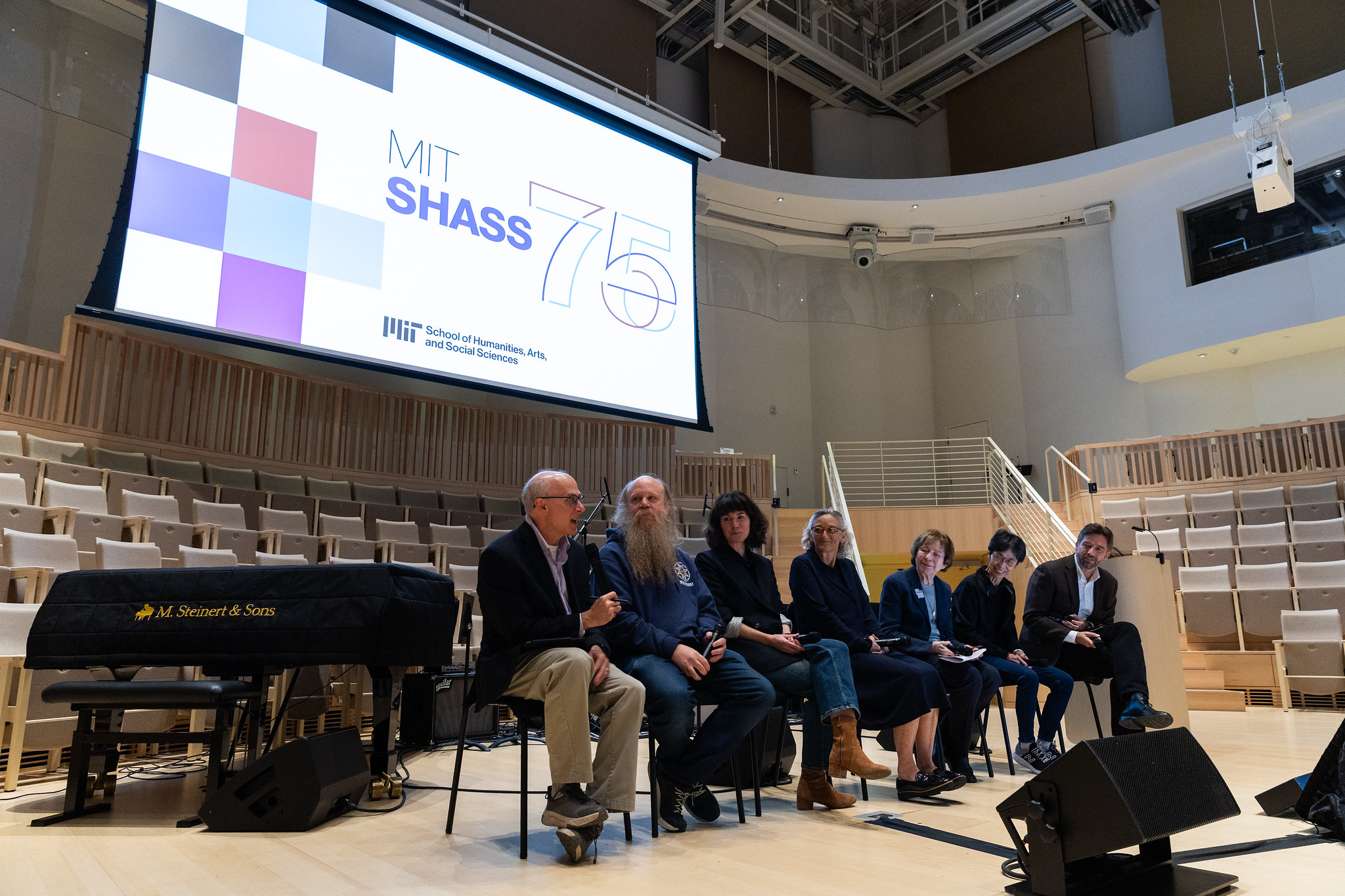
During the School of Humanities, Arts, and Social Sciences’ 75th Anniversary Symposium, President Sally Kornbluth said “MIT has never needed your particular insight and guidance more than we do now.”
Flint-interactive gives AI agents a language for creating interactive visualizations. Click a chart, filter data, highlight related content, and explore beyond the view the author originally chose. The post Flint-interactive: A language for creating interactive data visualizations appeared first on Microsoft Research.