QCell is presented, a novel query-based model that de-overlaps cell instances in microscopy scenes and outperforms state-of-the-art methods across multiple benchmarks, achieving +2.2 AP and +2.7 AJI on ISBI2014.
Yaroslav Prytula, A. Popov, Dmytro Fishman· 0 citations
The results indicate that subtraction-based input and ensembling support robust tumor segmentation under cross-site domain shift, whereas pCR prediction from baseline DCE-MRI alone remains limited.
High-resolution 3D radar data is scarce. Commodity mmWave sensors use small antenna arrays that limit angular resolution to several degrees, and existing datasets provide only 2D range-azimuth maps or sparse point clouds rather than raw analog-to-digital converter (ADC) signals. Hardware scaling is expensive, synthetic...
A. Armouti, Yixuan Gao, Rajalakshmi Nandakumar· 1 citation
The automated sorting of shredded black plastics from end-of-life (EOF) industrial waste presents a significant challenge in recycling facilities, primarily due to the limitations of current sensing and analytical approaches. Existing studies predominantly rely on single-point contact-based mid-infrared spectroscopy or...
Elias Arbash, Andréa de Lima Ribeiro, Filipa Simões et al.· 0 citations
Reach audiences
Advertise in front of researchers, engineers, and readers.
This work introduces Generative Translation Priors--a Bayesian framework that transforms diffusion-based image-to-image translation models into cross-modality image priors for ill-posed imaging inverse problems, and derives two discretized GTP algorithms based on gradient and proximal likelihood guidance.
Evan Bell, Jiaming Liu, Yifan Chen et al.· 0 citations
Adversarial Calibration Attack (ACA), the first physical attack against camera-LiDAR online calibration, is presented and demonstrated that online calibration is a practical and safety-critical attack surface for AVs.
Liang-Kai Liu, Qingzhao Zhang, Kang G. Shin· 0 citations
Match controls on training recipe as well as capacity, and buy compression robustness with codec diversity before architecture, and buy compression robustness with codec diversity with codec diversity before architecture.
The effectiveness of the proposed source codecs are demonstrated by achieving state-of-the-art performance in distributed semantic segmentation at below 0.2 bits per pixel, measured using the mean intersection-over-union metric on ADE20K (Cityscapes).
Danish Nazir, Timo Bartels, Thorsten Bagdonat et al.· 0 citations
This work uses the abundant compute resources of the cloud to run a highly-accurate oracle model that will guide the retraining process of the on-vehicle model, leading to improved inference accuracy over time.
Yu-Heng Zhu, Dhruva Ungrupulithaya, Boluo Ge et al.· 2024 IEEE 100th Vehicular Te...· 1 citation
Autonomous vehicles operate in dynamic, ever-changing environments where new scenarios and edge cases constantly emerge. As a result, static learning models are inadequate for ensuring safe and reliable operation. Continuous learning is essential for adapting to these evolving conditions and maintaining robust performa...
Yu-Heng Zhu, M. Yoon· IFIP International Informati...· 0 citations
TSPFN is introduced, a foundation model that redesigns TabPFN's architecture for time series data and yields a unified, generalizable framework capable of learning the specificities of medical time series.
J´er´emie Stym-Popper, Clément Rambour, Federica Granese et al.· 1 citation
This work investigates attribution in flow-matching models through a hybrid analytical--learned approach, and uses it to derive trajectory-based attribution scores at the cluster level, which show that semantic similarity constitutes a strong baseline, while the closed-form trajectory-based attribution is competitive i...
Rania Briq, Ohad Fried, Michael Kamp et al.· 0 citations
Exploring how generative AI could make machine vision more accessible to businesses. The post GenEye in a Box: Making Machine Vision Something You Can Just Ask For appeared first on GPT-Lab.
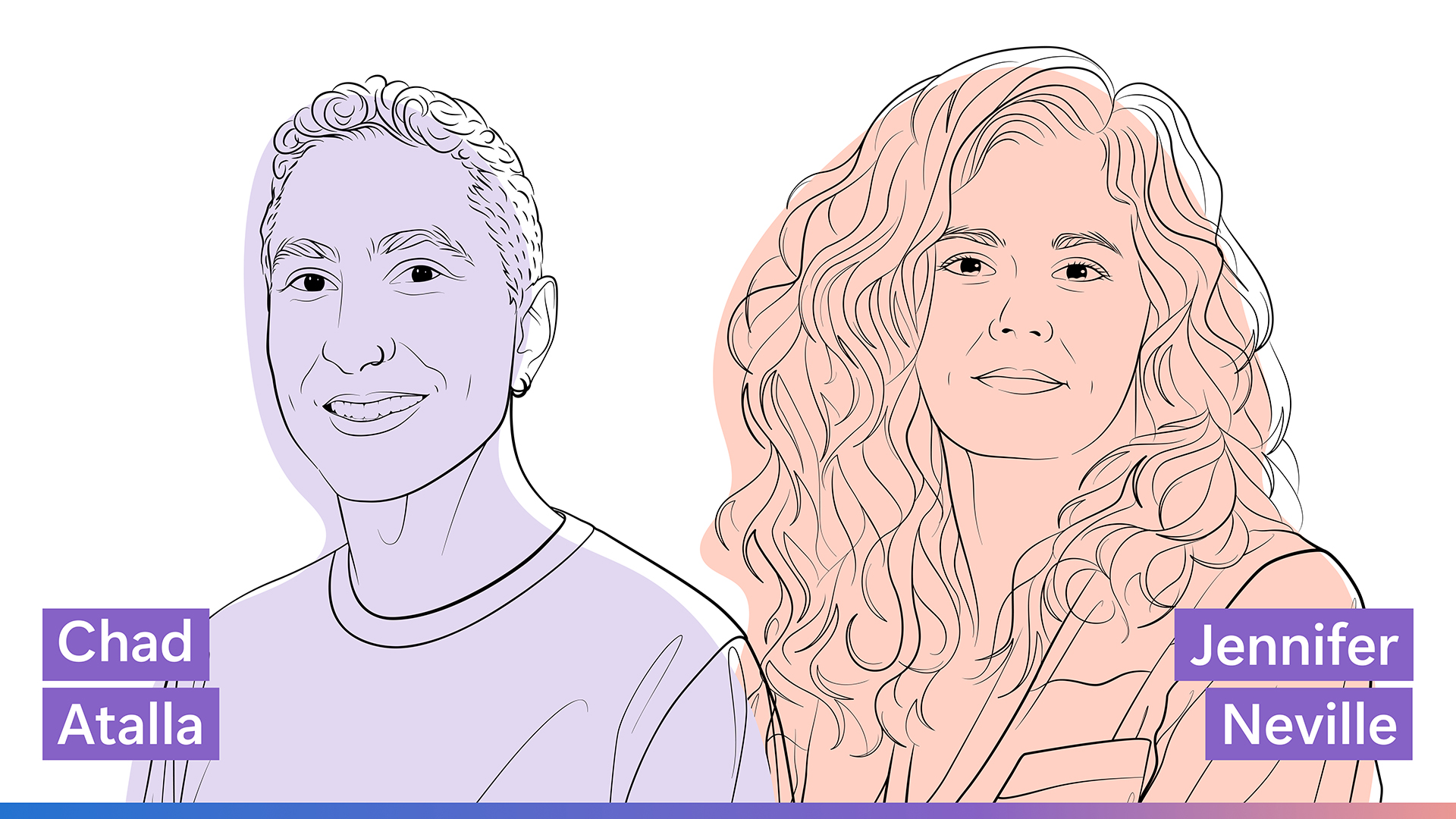
Jennifer Neville did not want to go into computer science—but that’s exactly where she landed. Neville discusses the starts and stops that led to her professional sweet spot and her work identifying “surprising failures” making it hard for AI to handle complexity. The post What AI gets wrong and what failure teaches us appeared first on Microsoft Research.
Computer scientist, entrepreneur, and philanthropist will collaborate with the MIT Schwarzman College of Computing to advance AI and scientific discovery.