In digital pathology, compact evidence is often used to explain or audit predictions made by whole-slide image multiple instance learning models. In hierarchical compact-evidence pipelines, candidate filtering introduces a strategy-specific candidate-conditioned prediction alongside the original full-bag prediction. If...
Hyun Do Jung, Jungwon Choi, Soojung Choi et al.· 0 citations
Multi-reference image generation requires preserving the appearance of multiple subjects while composing them into a coherent scene. However, existing diffusion transformers commonly encode references as dense visual token grids and jointly process them with global attention, making conditioning increasingly expensive...
We propose a scalable roto-reflection-group-equivariant vision transformer based on windowed group-convolutional self-attention and a hierarchical feature architecture. We demonstrate that our approach can be scaled to group-equivariant vision transformers (ViTs) with millions of parameters and large datasets with prac...
Sheir A. Zaheer, Jihwan Moon, Chan Y. Park· 0 citations
Cassini synthetic aperture radar (SAR) images reveal the dunes, plains, and lake basins of Titan, providing an instance of representations learned from Earth imagery for planetary terrain classification. Cross-domain Evaluation of Earth-to-Titan Transfer Using SAR (CETUS) compares features from DINOv2, DOFA and CROMA w...
Kevin Lee· 0 citations
Reach audiences
Advertise in front of researchers, engineers, and readers.
In-context learning (ICL) adapts frozen large multimodal models (LMMs) to new tasks from a few demonstrations (demos), but re-encodes them at every query, where each demo image adds up to hundreds of visual tokens. Demo-free methods remove this cost with a compact task state. However, they add it at locations searched...
Mobile manipulators such as humanoid robots are increasingly deployed in dynamic, unstructured environments to perform dexterous manipulation tasks. However, end-to-end manipulation policies trained to imitate demonstration data collected from a single robot pose are brittle: even centimeter-scale deviations in robot p...
Suzannah Wistreich, Stephen Tian, Isabella Huang et al.· 0 citations
Robust person re-identification often combines complementary cues such as face, gait, and body shape. While adaptive fusion typically targets query quality, model strength also varies across identities. We introduce identity-conditioned score fusion, a framework that tailors weights to each gallery identity without tra...
Manyi Yao, Jurijs Nazarovs, Eunji Chong et al.· 0 citations
Cross-view geo-localization is commonly solved as an image retrieval problem, matching a ground-level image against a database of satellite tiles through a jointly trained embedding. Such models are accurate, but they need large paired supervision and cannot show what evidence supports a match. In this paper, we study...
Ayesh Abu Lehyeh, Jay Hwasung Jung, Safwan Wshah· 0 citations
Breast cancer is the leading cause of cancer-related mortality among women in Sub-Saharan Africa, where delayed diagnosis results from limited radiology expertise and fragmented clinical data systems. Although deep learning models have demonstrated strong performance in mammographic analysis, most rely solely on imagin...
Simon Hadush Nrea (Mekelle University, Mekelle, Ethiopia) et al.· 0 citations
Variational autoencoders (VAEs) are a key part of modern text-to-image models, which generate images within their latent space. VAEs are known to disentangle the main factors of variation in the data, and color is known to be one of the most structured of these in natural images: decorrelating it yields one luminance a...
Julian D. Santamaria, Kai Wang, Jes\'us Malo et al.· 0 citations
Gaussian Belief Propagation (GBP) is a distributed inference algorithm that passes messages in graphical models, making it attractive for scalable spatial intelligence. However, we find GBP most effective locally: it rapidly smooths message errors that vary sharply between neighbor variables, but corrects global errors...
Yuzhou Cheng, Tom Yates, Ignacio Alzugaray et al.· 0 citations
This paper concerns how semantic context determines geometry in learned vector representations. Similarity is typically measured using cosine similarity, which provides a single fixed geometry. Semantic similarity, however, is inherently context dependent: two images may be similar because they depict the same object,...
Akash Kannan, Kiho Park, Victor Veitch· 0 citations
Exploring how generative AI could make machine vision more accessible to businesses. The post GenEye in a Box: Making Machine Vision Something You Can Just Ask For appeared first on GPT-Lab.
Jennifer Neville did not want to go into computer science—but that’s exactly where she landed. Neville discusses the starts and stops that led to her professional sweet spot and her work identifying “surprising failures” making it hard for AI to handle complexity. The post What AI gets wrong and what failure teaches us appeared first on Microsoft Research.
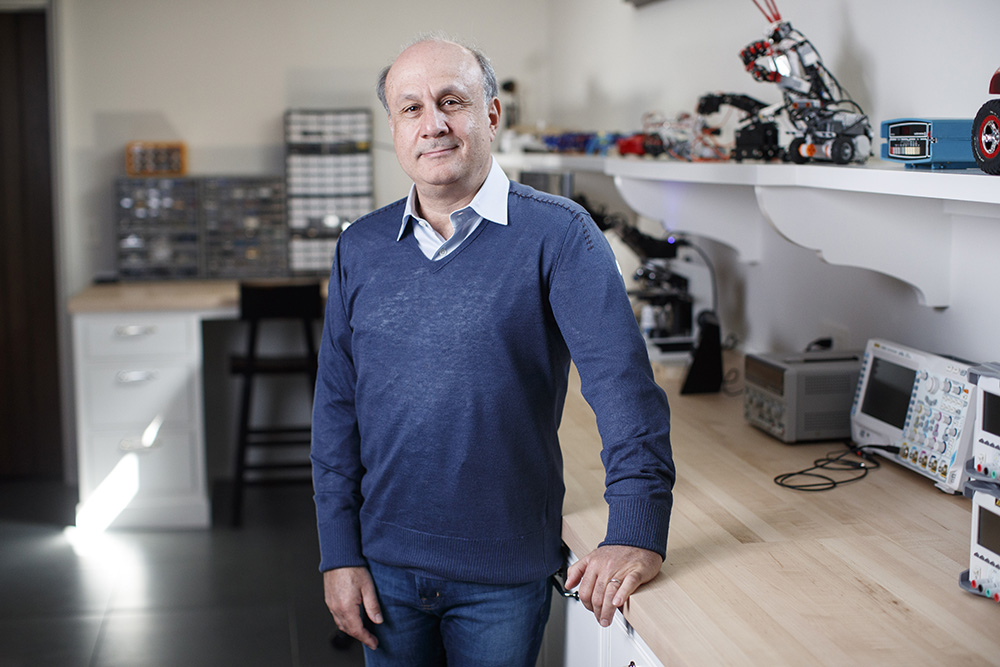
Computer scientist, entrepreneur, and philanthropist will collaborate with the MIT Schwarzman College of Computing to advance AI and scientific discovery.