Fast-tracking genetic leads to reverse cellular aging
Biologists use Co-Scientist to find novel factors that successfully rejuvenate human cells.
More from the blog

Paving the way for greener ammonia production
New MIT research could lead to better materials for a fossil-fuel-free process for making the chemical that's essential to fertilizer and other products.
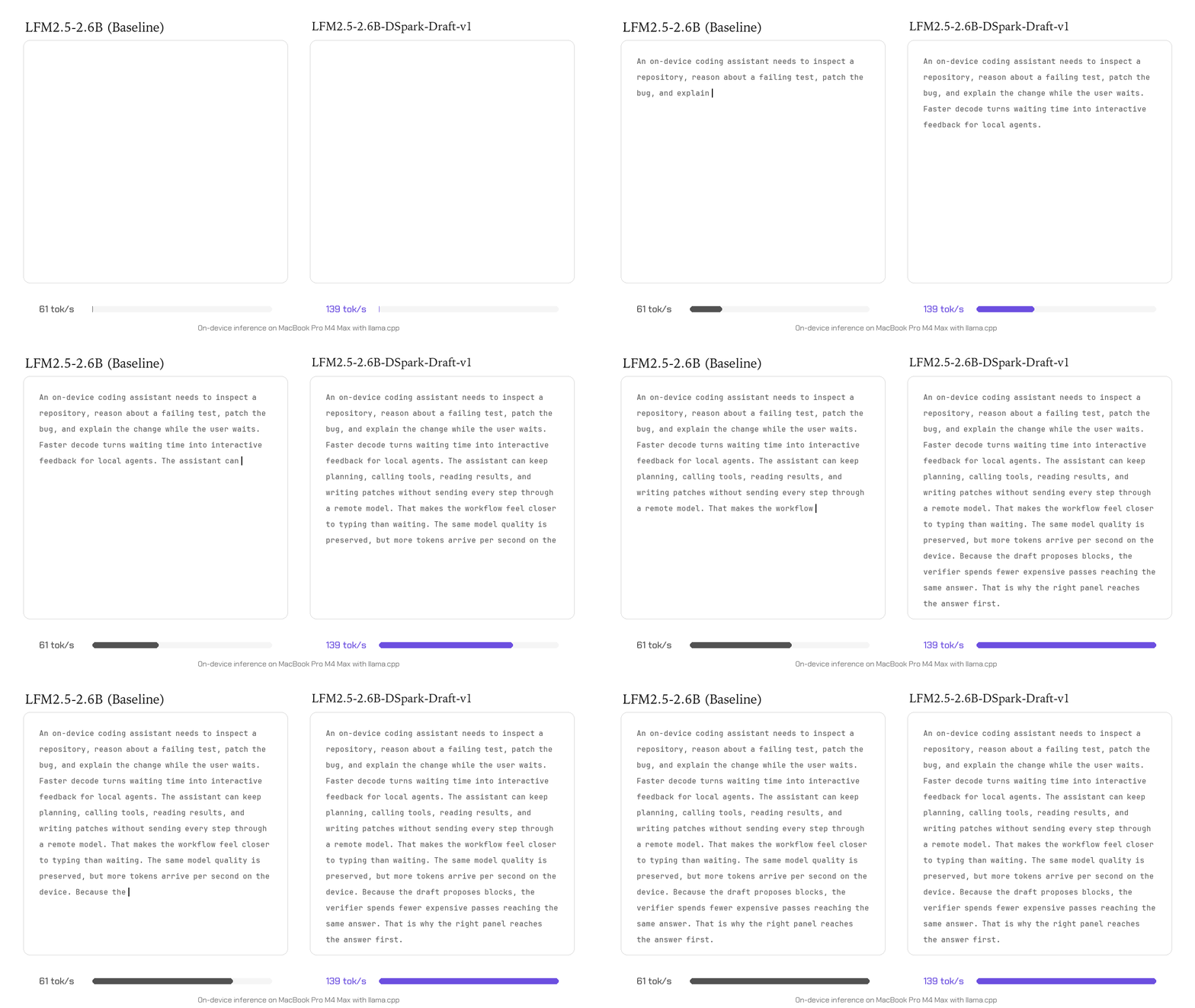
Up to 3.2x Faster Inference with LFM2.5-DSpark
A Blog post by Liquid AI on Hugging Face

We’re launching Lyria 3.5 in Google Flow Music, with advances across musicality, lyrics, vocals, and creative control
Our newest music generation model, Lyria 3.5, delivers significant advancements across musicality, lyrics, and vocal quality, empowering you to craft richer tracks. We’r…
Following the questions where they lead
Assistant Professor Bailey Flanigan has arrived at complex computational methods for helping democracy thrive.
Related papers
Professional Software Developers Don't Vibe, They Control: AI Agent Use for Coding in 2025
Investigating how experienced developers use agents in building software, including their motivations, strategies, task suitability, and sentiments finds that while experienced developers value agents as a productivity boost, they retain their agency in software design and implementation out of insistence on fundamental software quality attributes.
Mutation-induced phenotypic plasticity drives formation of a pro-metastatic tumour-intrinsic niche
It is argued that formation of a tumour-intrinsic niche is a prerequisite for BRAF-mutant CRC seeding to distant organs and that interference with niche formation may help avoid metastatic relapse.
Unlocking non-model organisms with CRISPR-Cas: A roadmap for sustainable biotechnology.
It is concluded that bridging the gap between foundational CRISPR research and its real-world applications is imperative and future efforts should focus on democratizing tools via open-source platforms, advancing delivery systems, and fostering sustainable innovation through synthetic biology integration to fully realize the transformative potential of genome editing in organisms beyond model organisms.
Same Facts, Different Updates: Inference Setup Shapes LLM Behavior in Medical Allocation
This work studies a medical example in which a model is asked to assign resource-allocation probabilities to two people given brief clinical context, and then sees the same scenario with a single extra sentence containing contrasting patient information, showing the context-dependent effect of patient information in a sensitive medical use case.