Skip to content

Equilibrium Forcing: Adaptive Video Generation Without Noise Conditioning

Aug 2026 · 0 citations · 44 references
Computer Science

TL;DR

Equilibrium Forcing is introduced, a simplified framework for video denoising generative models without noise level conditioning that pioneers modular training- and inference-time designs for noise-unconditional generation that decouple learning the denoising field from sampling.

Abstract

Standard autoregressive video generation algorithms based on Diffusion and Flow Matching rely on rigid training objectives and static sampling schedules, limiting inference procedures from adapting to the data. We introduce Equilibrium Forcing (EqF), a simplified framework for video denoising generative models without noise level conditioning. EqF pioneers modular training- and inference-time designs for noise-unconditional generation that decouple learning the denoising field from sampling. This flexibility allows for inference-time algorithms that operate in a closed loop by adapting to feedback from the sample, improving video quality and consistency on challenging autoregressive video generation benchmarks. Extensive analysis elucidates exactly how removing the noise level conditioning enables EqF's data-dependent inference properties to surpass the performance of standard noise level-conditional denoising video methods.


View source

Similar papers

#artificial intelligence Preprint Sep 2026

From Scores to Samples: Elastic Forcing for Autoregressive Video Generation

This framework minimizes maximum mean discrepancy in frozen self-supervised video representation spaces in frozen self-supervised video representation spaces, using a hybrid Nystr\"om--Monte Carlo estimator to balance approximation bias and sampling variance.

Chi Zhang, Yue-Yi Liu, Hao-Yan Shi et al. · 3 citations · ⚡2
Preprint Aug 2026

Stream Forcing: Constructing Unified Training Trajectory for Robust Streaming Video Generation

This work reformulates the video diffusion sampling as a frame-indexed stochastic process over noise levels, and constructs a continuous training trajectory along which the sampling schedule progressively evolves from independent sampling to inference-consistent sampling.

Yue-Ting Zhu, Yue-Hao Song, Kai-Chen Zhang et al. · 2 citations
Preprint Aug 2026

In-Context Forcing: Uncovering Context Effects in Autoregressive Video Diffusion

In-Context Forcing is introduced, a progressive autoregressive paradigm that utilizes contexts with decreasing noise levels that enables cross-frame parallel denoising, achieving substantial inference acceleration without sacrificing performance.

Lingxiao Yang, Liu Liu, Mo-Ran Li et al. · 2 citations
Preprint Sep 2026

Mask Forcing: Improving Autoregressive Video Diffusion Distillation via Dual-Noise Masking Rollout

Mask Forcing, a Dual-Noise Masking Rollout strategy that perturbs the AR student self-rollout to mitigate mode collapse induced by reverse-KL mode seeking, improves multiple AR video diffusion distillation methods with higher visual quality efficiently, without incorporating real video data or additional post-training...

Zhuo-Ran Zhao, Sheng-Ju Qian, Tong-Tong Liang et al. · 2 citations
Preprint Sep 2026

Self-Aligned Forcing: Streaming Video Diffusion with Differentiable Noisy History

Autoregressive video diffusion enables interactive streaming generation, but suffers from error accumulation over long rollouts. Self-rollout training reduces exposure bias, yet finite rollouts leave long-range drift unresolved. We observe that the noise level of the history key-value (K/V) representations trades visua...

Weiqiang Wang, Zhuo-Kun Chen, Yu-Sheng Dai et al. · 0 citations

FlowLong: Training-free Long Audio-Video Generation via Manifold-constrained Tweedie Matching

FlowLong is presented, a training-free, architecture-agnostic, inference-time framework that harmonizes overlapping windows sampled in parallel via Tweedie matching, a manifold-constrained blend of predicted clean samples on overlaps, and stochastic early-phase sampling that yields arbitrarily long, phase-locked audio-...

Jangho Park, G. Park, Gihyun Kwon et al. · 0 citations

Related blog posts

MIT News · Artificial Intelligence Oct 28, 2026

Making machines that can listen

Professor Paris Smaragdis develops computers with superhuman hearing for applications like speech recognition, music understanding, and environmental monitoring.

Microsoft Research Blog Aug 11, 2026

Introducing CARE-X: Towards Clinically Useful Radiology VLMs with Auxiliary Supervision, Reward-Aligned Learning, and Tool-Augmented Measurement

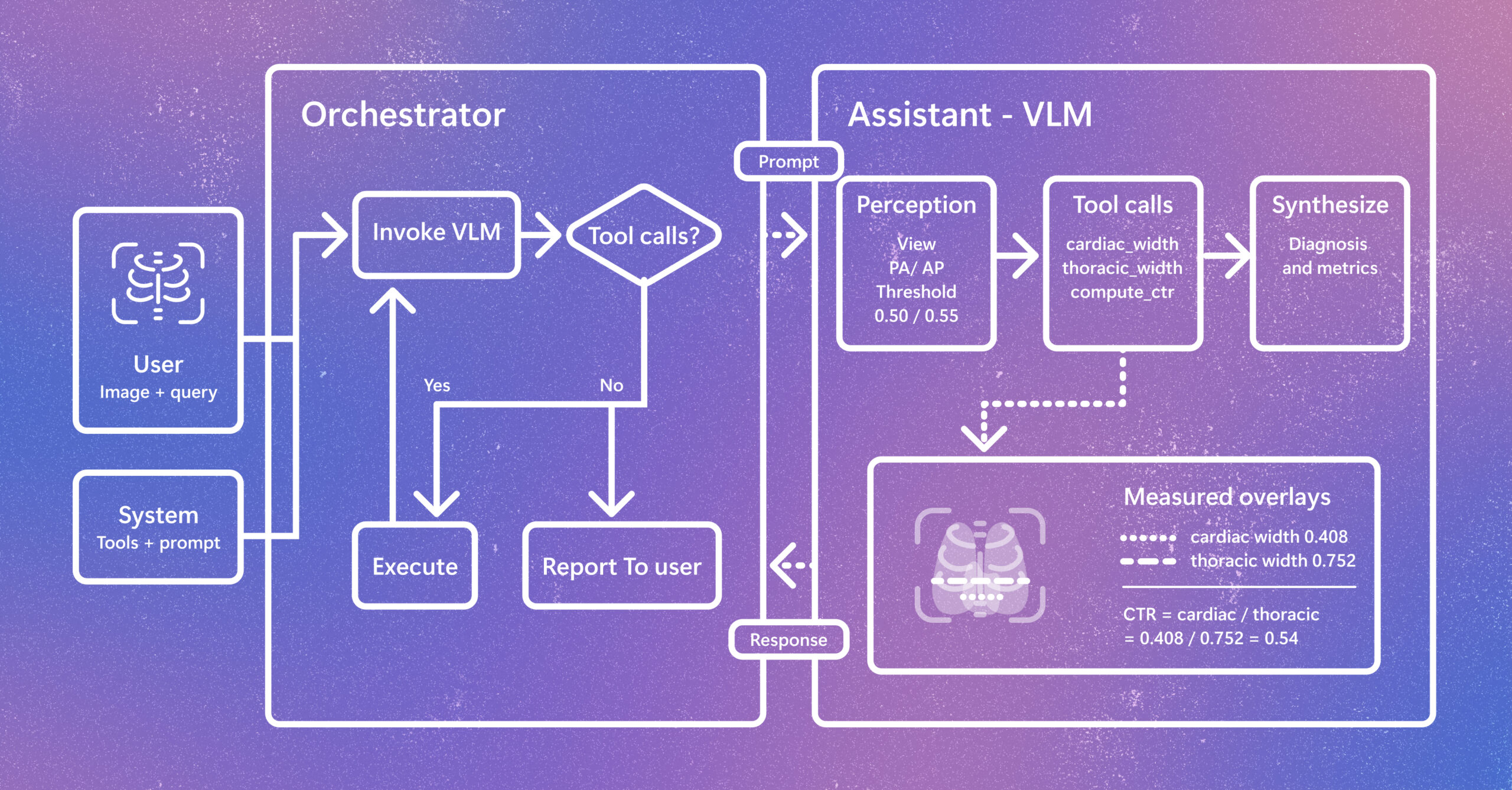
Radiology AI is evolving beyond report generation. CARE-X explores a unified approach that combines flexible reasoning, calibrated predictions, and measurement-based tools for chest X-ray interpretation. The post Introducing CARE-X: Towards Clinically Useful Radiology VLMs with Auxiliary Supervision, Reward-Aligned Learning, and Tool-Augmented Measurement appeared first on Microsoft Research.

We use cookies to run the site and, with your consent, for analytics and to show ads. See our Cookie Policy.