Skip to content

Separating Capability from Confidence: Grounded Dual-State Calibration for GRPO-Trained Medical Vision-Language Models

Sep 2026 · 0 citations · 25 references
Computer Science

TL;DR

DualRead builds on the insight that reliability can be read from the actor's internal states at critical moments in the answering process and improves correctness discrimination and calibration over verbalized confidence while preserving answer accuracy.

Abstract

Medical vision-language models (VLMs) require confidence that reflects both answer correctness and patient-specific visual evidence. Recent GRPO-based methods optimize verbalized confidence together with answer generation. However, this joint optimization may interfere with answer learning and drive confidence toward near-binary values. Verbalized confidence also provides no explicit assessment of visual support. We therefore separate capability learning from confidence estimation and propose \textbf{DualRead}. DualRead builds on the insight that reliability can be read from the actor's internal states at critical moments in the answering process. It freezes the GRPO-trained actor and combines pre-answer solvability with a post-answer assessment of the generated answer and its visual support. To further assess whether confidence reflects visual grounding, we introduce \textbf{Counterfactual Confidence Grounding AUC} (CCG-AUC). It measures whether confidence decreases when real-image substitution changes the actor from correct to incorrect. Across two VLM backbones and both in- and out-of-distribution medical VQA benchmarks, DualRead improves correctness discrimination and calibration over verbalized confidence while preserving answer accuracy. CCG-AUC reveals whether confidence responds to answer-relevant visual evidence rather than primarily to non-visual cues.


View source

Similar papers

Aug 2026

CARE: Confidence-Aware Reasoning for Reliable Medical VQA

Reinforcement Fine-Tuning (RFT) has enabled medical Multimodal Large Language Models (MLLMs) to produce Chain-of-Thought (CoT) reasoning for visual question answering, yet these models suffer from $\textit{confidence miscalibration}$---a systematic gap between expressed certainty and actual diagnostic accuracy that und...

Yuetian Du, Yu-Cheng Wang, Zhenyuan Chen et al. · 0 citations
#natural language process... Preprint Sep 2026

MedProb: Probing Internal Representations of Vision-Language Models for Medical Question Answering

This work presents MedProb, a lightweight probing framework that predicts multiple-choice Med-VQA answers from frozen VLM representations without free-text generation, and shows the probe can be extended to open-ended generation via a rejection-sampling scoring procedure.

E. Nourbakhsh, Ke Yang, Anthony Rios · 0 citations
#artificial intelligence Preprint Sep 2026

ViSTA: A Simple Bridge Extends Visual Alignment to Clinical Time-Series Understanding in Multimodal LLMs

ViSTA is introduced, a compact adapter that incorporates irregular numerical measurements into a pretrained vision-language model's chart representations and extends pretrained language models to numerical prediction and temporal questions.

Jun-Yi Gao, Yu Shi, Ping-Zhao Hu et al. · 0 citations
#artificial intelligence Preprint Sep 2026

The Mirage of Calibrated Confidence: Trajectory-Independence of Verbalized Confidence in Vision-Language Models

It is shown that confidence is insufficiently sensitive to what the reasoning trajectory actually contains, and that calibration training can paradoxically worsen this disconnect, and proposed TGS-Bench is a model-agnostic suite spanning 10 benchmarks with controlled good/bad trajectory pairs.

Jisoo Yang, Jaeho Han, T. Pham et al. · 0 citations

Related blog posts

MIT News · Artificial Intelligence Oct 28, 2026

Making machines that can listen

Professor Paris Smaragdis develops computers with superhuman hearing for applications like speech recognition, music understanding, and environmental monitoring.

Microsoft Research Blog Aug 11, 2026

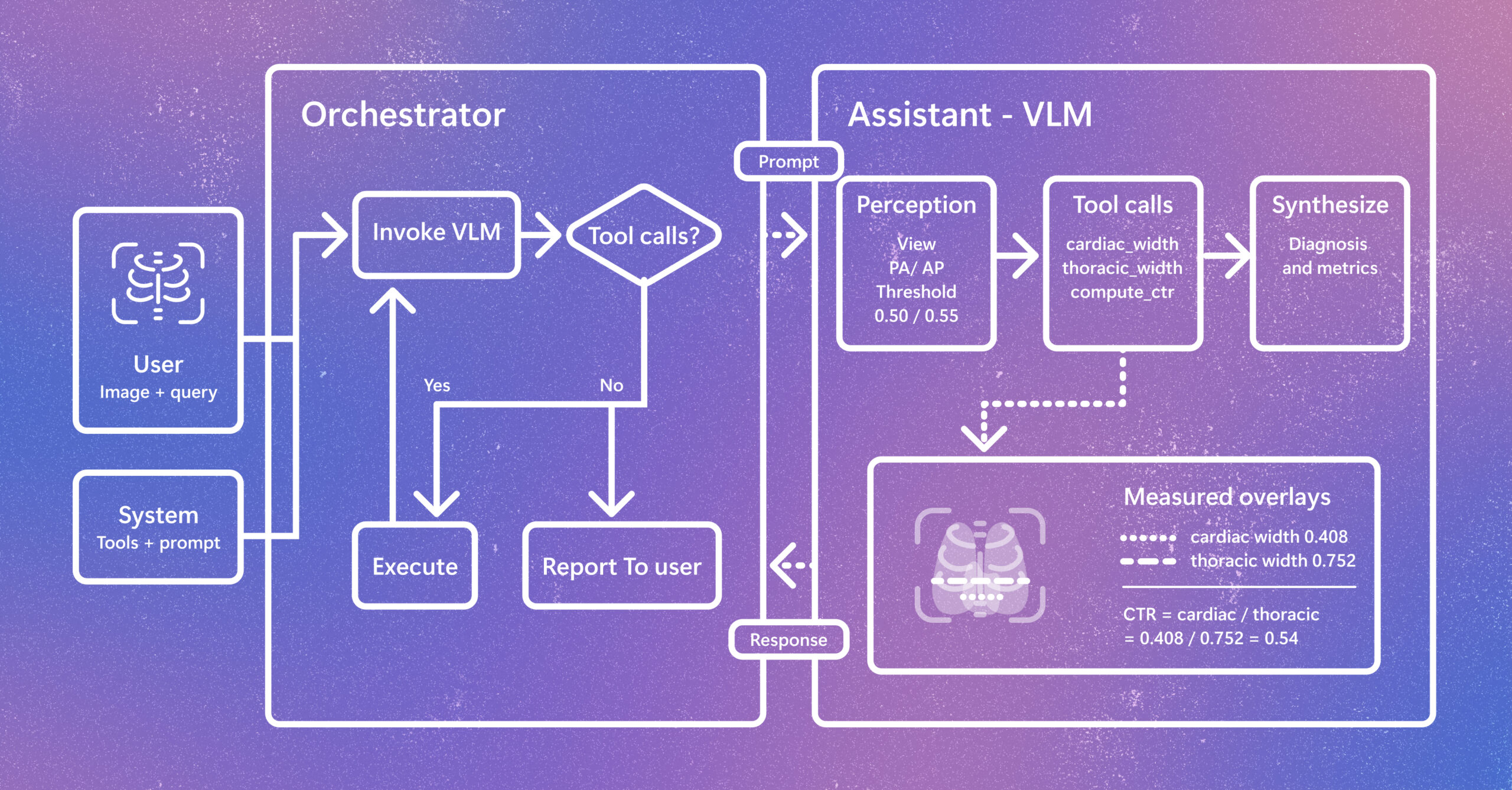
Introducing CARE-X: Towards Clinically Useful Radiology VLMs with Auxiliary Supervision, Reward-Aligned Learning, and Tool-Augmented Measurement

Radiology AI is evolving beyond report generation. CARE-X explores a unified approach that combines flexible reasoning, calibrated predictions, and measurement-based tools for chest X-ray interpretation. The post Introducing CARE-X: Towards Clinically Useful Radiology VLMs with Auxiliary Supervision, Reward-Aligned Learning, and Tool-Augmented Measurement appeared first on Microsoft Research.

We use cookies to run the site and, with your consent, for analytics and to show ads. See our Cookie Policy.