This work introduces Wide Encoded Extended Connectivity Fingerprints with Substructure Rotary Graph-distance Encoding (SuRGE), a tokenized hierarchical Morgan representation in which graph-distance-dependent rotations are applied at the input and within transformer self-attention.
Abstract
Computational molecular property prediction requires representations that capture local chemistry, long-range interactions, and molecular topology. Conventional fingerprints provide efficient local substructure features, whereas learned graph and sequence models can represent broader context but often rely on pretraining or three-dimensional conformers. We introduce Wide Encoded Extended Connectivity Fingerprints (WEECFP) with Substructure Rotary Graph-distance Encoding (SuRGE), a tokenized hierarchical Morgan representation in which graph-distance-dependent rotations are applied at the input and within transformer self-attention. Across MoleculeNet and the Therapeutic Data Commons ADMET benchmarks, WEECFP-SuRGE is competitive with recent pretrained and geometry-aware methods without external pretraining or conformer generation. We also show that the rotated token representation remains structurally informative. A guided confirmed-handshake overlap procedure reconstructs the correct constitutional isomer for 92.6% of a 4,200-molecule self-library evaluation. Together, the predictive and reconstruction results indicate that WEECFP-SuRGE preserves local substructure identity while making relative topology available to the model.
Analysis of HiFi-Mol reveals that fragment-aware masking improves graph representation quality, and classification results demonstrate dataset-dependent strengths of the individual graph and fingerprint variants, confirming that the two views provide complementary predictive signals.
Gwang-Hyeon Yun, Jong-Hoon Park, Bing Hu et al.· 0 citations
Visualization and prototype preference analyses indicate that PACL separates structurally similar molecules with different functional properties more clearly in task-aligned representation spaces, supporting adaptive substructure contrastive learning and task-specific semantic alignment as an effective strategy for mul...
Jie-Zhou Chen, Ping-Yu Wang, Lin-Bo Qing et al.· Journal of Computer-Aided Mo...· 0 citations
MoTIF-X, a motif-centered framework that uses graph-grounded chemical motifs as shared anchors for multimodal integration and interpretation, is introduced, achieving the best average classification performance across the evaluated benchmarks and generalizing to an external drug-cold-start dataset without additional fi...
Lin-Qing Mo, Jia-Yu Zhou, Bin Chen· arXiv.org· 0 citations
CAMF (Chirality- and Activity-cliff-aware Multimodal Framework), a task-adaptive framework that models SSPs through selective integration of complementary molecular evidence, reveals that modality relevance is strongly task-dependent, with descriptors and 3D geometry becoming especially important in non-smooth property...
Shaolong Lin, Si-Long Zhai, Shi-Hang Wang et al.· Chemical Science· 0 citations
OmniScore is introduced, a universal structure-based framework that learns a shared geometry-aware representation of complexes once and then adapts it to downstream scoring through lightweight task-specific heads, suggesting that geometry-aware pretraining can provide a reusable scoring backbone for tasks that depend o...
Protein binding prediction is central to target identification, therapeutic binder design, and large scale screening, yet remains challenging because binding depends on sequence, three dimensional geometry, and global structural organization. Recent folding models such as AlphaFold3 and Boltz-2 have substantially impro...
J. Choi, Ryoonki Hong, Alan Liang et al.· 0 citations
Related blog posts
Microsoft Research Blog· microsoft.comNov 16, 2026
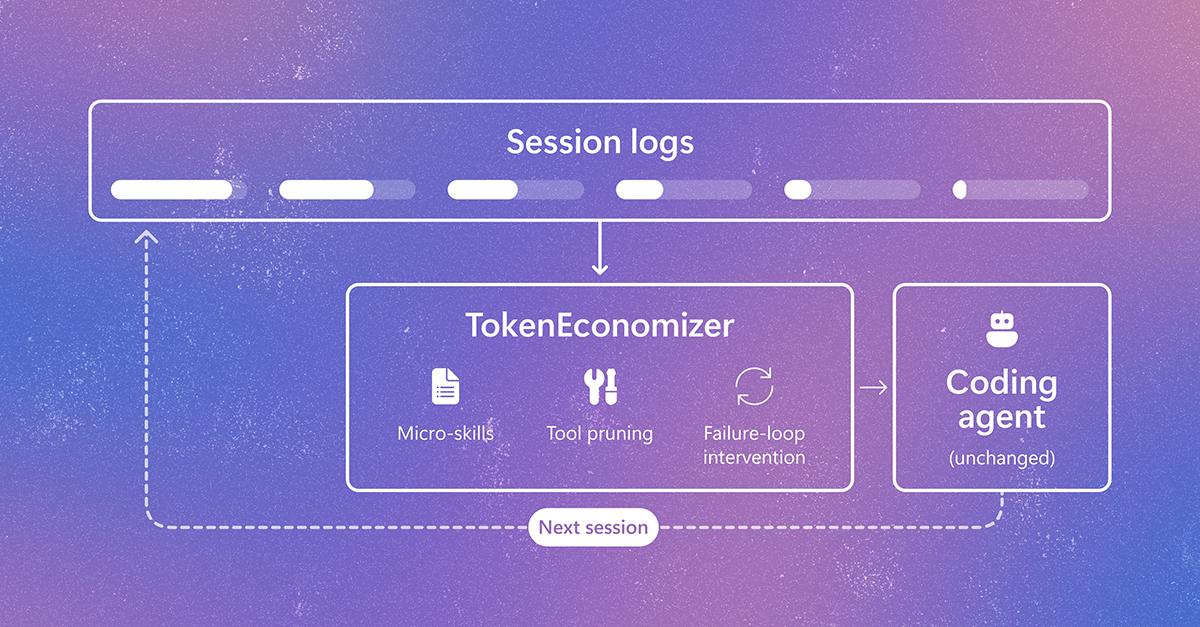
AI coding agents are increasingly help developers fix bugs and build features largely on their own, but every interaction with their models consumes tokens. In each session, an agent sends instructions, tool descriptions, and session history to its model. Most efforts to reduce this cost focus on individual tasks. Yet developers return to the same […] The post TokenEconomizer: Learning from Experience to Make AI Coding Agents More Efficient appeared first on Microsoft Research.
MIT News · Artificial Intelligence· news.mit.eduNov 13, 2026