Skip to content

Operation-aware Multimodal Clinical Decision Support System for ICU Discharge Risk Assessment

Nov 2026 · 0 citations · 27 references
Computer Science

Abstract

Unplanned 30-day intensive care unit (ICU) readmission is a critical benchmark for evaluating healthcare quality. Most predictive models assume readmission risk depends solely on a patient's individual pathophysiological state, ignoring hospital operational context and resource capacity. In practice, discharge decisions are dynamic trade-offs between patient stability and bed turnover pressures. To address this gap, we develop an Operation-aware Multimodal Clinical Decision Support System (CDSS) for ICU discharge risk assessment. The system combines multi-agent collaborative extraction with self-evolving retrieval-augmented generation (RAG) to eliminate template noise from progress notes, while constructing departmental workload indicators alongside admission flow features, continuous vital signs, and sparse medical codes (ICD/DRG). Addressing severe class imbalance (about 10.5% readmissions) and alarm fatigue, we implement data normalization, class reweighting, and decision-threshold calibration. In 20 independent runs across 20,000 ICU stays from MIMIC-III, empirical findings demonstrate that: vital signs alone have limited predictive capacity under real-world class imbalance (PR-AUC of 0.1387 +/- 0.0086); directly concatenating raw text embeddings degrades decision tree performance (XGBoost and LightGBM PR-AUC drop to 0.3893 and 0.4030); whereas an end-to-end multimodal fine-tuning architecture (Transformer E2E FineTune) utilizing layer-wise parameter freezing and differential learning rates reverses text negative transfer, achieving the highest AUROC of 0.8288 +/- 0.0110, PR-AUC of 0.4373 +/- 0.0310, and F1-Score of 0.4757 +/- 0.0196. Operational indicators supply independent risk signals, laying an engineering foundation for high-utility clinical decision support tools.

View source

Similar papers

#artificial intelligence Preprint Jul 2024

The Llama 3 Herd of Models

It is found that Llama 3 delivers comparable quality to leading language models such as GPT-4 on a plethora of tasks, and performs competitively with the state-of-the-art on image, video, and speech recognition tasks.

Aaron Grattafiori, Abhimanyu Dubey, Abhinav Jauhri et al. · 21,082 citations · ⚡3,832
#artificial intelligence Conference Open access Jun 2018

Gibson Env: Real-World Perception for Embodied Agents

This paper investigates developing real-world perception for active agents, proposes Gibson Environment for this purpose, and showcases a set of perceptual tasks learned therein.

F. Xia, Amir Zamir, Zhi-Yang He et al. · 1,069 citations · ⚡112
#machine learning Review Open access Oct 2014

Software development in startup companies: A systematic mapping study

The results indicate that software engineering work practices are chosen opportunistically, adapted and configured to provide value under the constrains imposed by the startup context.

Nicolò Paternoster, Carmine Giardino, M. Unterkalmsteiner et al. · 394 citations · ⚡54

Diffusion models as plug-and-play priors

The possibility of inferring high-dimensional data inference in a model that consists of a prior and an auxiliary differentiable constraint given some additional information is considered, thereby allowing a range of potential applications in adapting models to new domains and tasks.

Alexandros Graikos, Esmeralda S. Whitammer, N. Jojic et al. · 316 citations · ⚡15

Trajectory Balance: Improved Credit Assignment in GFlowNets

It is proved that any global minimizer of the trajectory balance objective can define a policy that samples exactly from the target distribution, and empirically demonstrate the benefits of the trajectories balance objective for GFlowNet convergence, diversity of generated samples, and robustness to long action sequenc...

Esmeralda S. Whitammer, Moksh Jain, Emmanuel Bengio et al. · 302 citations · ⚡60

Related blog posts

Microsoft Research Blog Nov 16, 2026

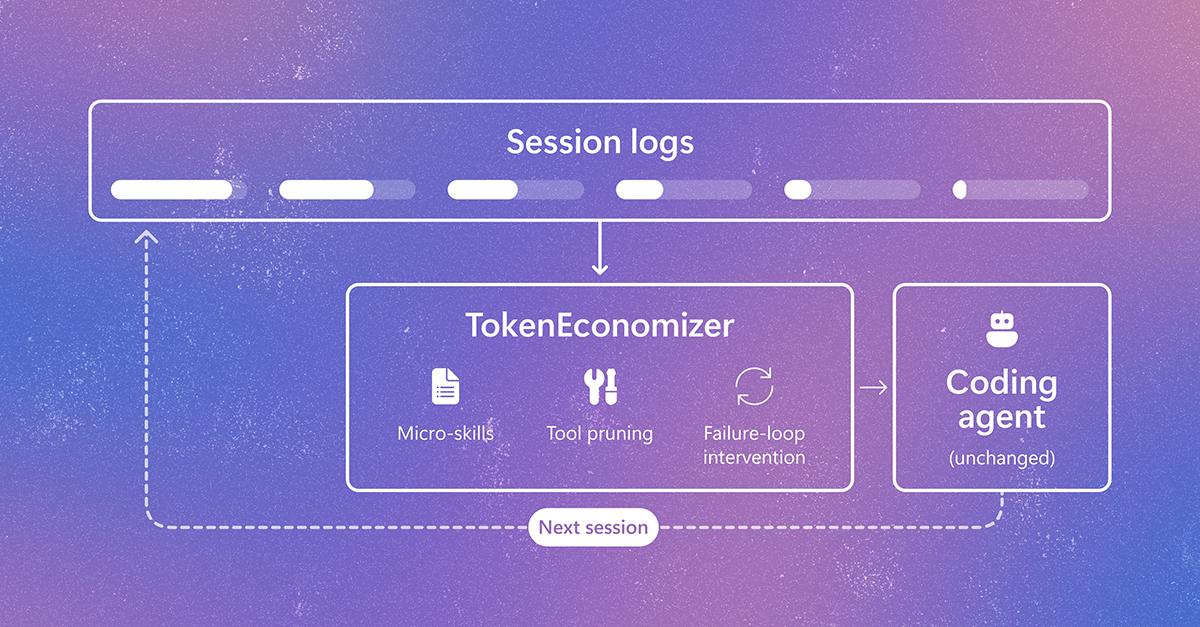
TokenEconomizer: Learning from Experience to Make AI Coding Agents More Efficient

AI coding agents are increasingly help developers fix bugs and build features largely on their own, but every interaction with their models consumes tokens. In each session, an agent sends instructions, tool descriptions, and session history to its model. Most efforts to reduce this cost focus on individual tasks. Yet developers return to the same […] The post TokenEconomizer: Learning from Experience to Make AI Coding Agents More Efficient appeared first on Microsoft Research.

We use cookies to run the site and, with your consent, for analytics and to show ads. See our Cookie Policy.