Skip to content
#federated learning Open access

Communication-Efficient Satellite-Ground Federated Learning Over Intermittent LEO Satellite Networks

Dec 2026 · IEEE Transactions on Mobile Computing · Vol 25, pp. 22835-22848 · 5 citations · 51 references

TL;DR

A UDP-based SGFL framework is proposed that strategically discards lost parameters to improve network throughput and an Overlapped Block-wise Scheduling framework is designed that allows on-satellite training to run in parallel with model downloading, greatly reducing the total completion time of each FL round.

Abstract

Artificial intelligence (AI) has significantly advanced satellite imagery applications, but it confronts critical communication limitations from LEO satellites’ high mobility. Satellite-ground federated learning (SGFL) provides a promising approach to enabling satellites to collaboratively train shared models, with ground stations orchestrating global aggregation. However, LEO satellite networks exhibit fundamentally distinct packet loss patterns compared to terrestrial networks, characterized by: (i) significant asymmetry, (ii) high burstiness, and (iii) heavy-tailed distribution, which largely degrades SGFL’s communication efficiency. In this work, we propose a UDP-based SGFL framework that strategically discards lost parameters to improve network throughput. To overcome the above challenges, we introduce the Zero-inflated Beta Regression model to fit the uplink (ground-to-satellite) packet loss distribution in satellite-ground communications. Then, we transform the end-to-end FL workflow into a time-minimization task scheduling problem. Finally, We design an Overlapped Block-wise Scheduling framework that allows on-satellite training to run in parallel with model downloading, greatly reducing the total completion time of each FL round. Extensive evaluations demonstrate a 20.5× speedup in end-to-end SGFL training with negligible accuracy loss.

Read PDF

Similar papers

#machine learning Review Open access Oct 2014

Software development in startup companies: A systematic mapping study

The results indicate that software engineering work practices are chosen opportunistically, adapted and configured to provide value under the constrains imposed by the startup context.

Nicolò Paternoster, Carmine Giardino, M. Unterkalmsteiner et al. · 394 citations · ⚡54
#machine learning Review Open access Jun 2014

Why Early-Stage Software Startups Fail: A Behavioral Framework

This state-of-practice investigation was performed using a literature review followed by a multiple-case study approach and presents how inconsistency between managerial strategies and execution can lead to failure by means of a behavioral framework.

Carmine Giardino, Xiaofeng Wang, P. Abrahamsson · 175 citations · ⚡19
#machine learning Review Open access Oct 2016

“Failures” to be celebrated: an analysis of major pivots of software startups

This study conducts a case survey study based on the secondary data of the major pivots happened in 49 software startups, and demonstrates that customer need pivot is the most common among all pivot types.

Sohaib Shahid Bajwa, Xiaofeng Wang, Anh Nguyen-Duc et al. · 127 citations · ⚡15
#machine learning Review Open access May 2016

Key Challenges in Software Startups Across Life Cycle Stages

It is found that what perceived as biggest challenges by software startups do vary across different life cycle stages, even though its significance decreases when the learning focuses of the startups move from problem to solution and their products mature.

Xiaofeng Wang, Henry Edison, Sohaib Shahid Bajwa et al. · 62 citations · ⚡6

Related blog posts

Microsoft Research Blog Nov 16, 2026

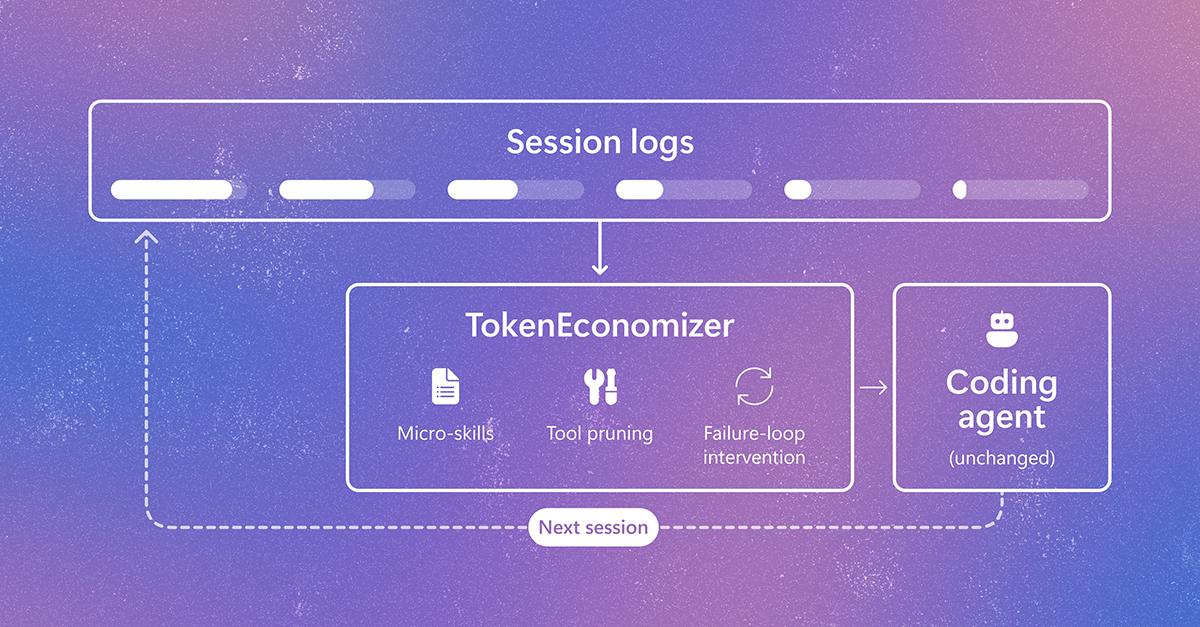
TokenEconomizer: Learning from Experience to Make AI Coding Agents More Efficient

AI coding agents are increasingly help developers fix bugs and build features largely on their own, but every interaction with their models consumes tokens. In each session, an agent sends instructions, tool descriptions, and session history to its model. Most efforts to reduce this cost focus on individual tasks. Yet developers return to the same […] The post TokenEconomizer: Learning from Experience to Make AI Coding Agents More Efficient appeared first on Microsoft Research.

We use cookies to run the site and, with your consent, for analytics and to show ads. See our Cookie Policy.