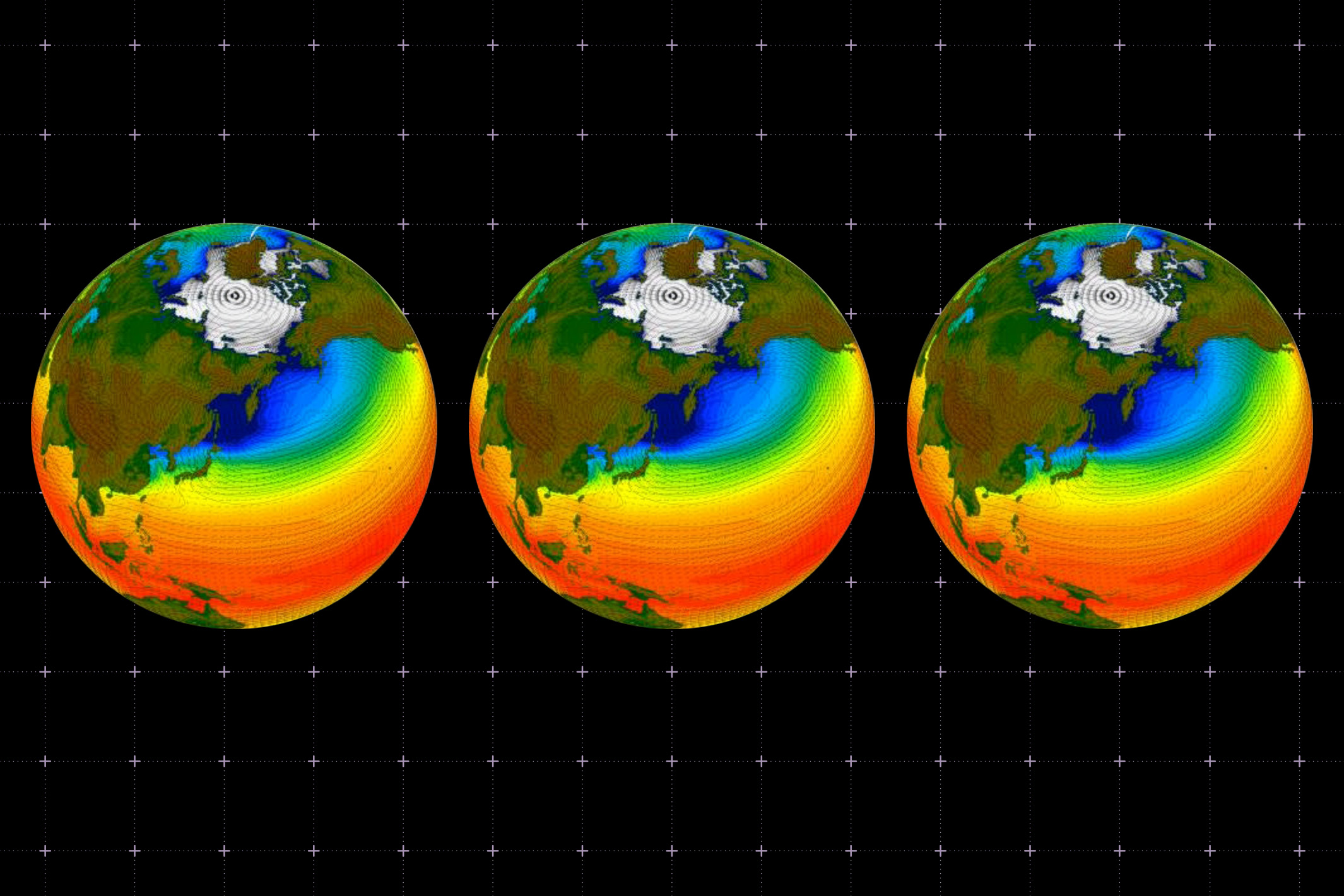
GNN-VIEW exposes the graph's information pathways, allowing model developers to debug the graph structure before training and after training, GNN-VIEW uses attribution-based explainability to reveal which input features are used by the trained model for a given forecast.
Abstract
Machine learning Earth-system models are becoming increasingly important, and so is their development. Graph-based models, one of the most prominent approaches, allow developers to constrain the learning process before training via graph connectivity. Yet, developing these models remains challenging: the graph is built algorithmically with little intuition about the final result beyond static plotting, which requires extra work and is often not detailed enough. Even after successful training, how the model arrives at forecasts remains obscure. We present GNN-VIEW, an interactive browser-based tool that supports the development of such systems. GNN-VIEW exposes the graph's information pathways, allowing model developers to debug the graph structure before training. After training, GNN-VIEW uses attribution-based explainability to reveal which input features are used by the trained model for a given forecast. This helps developers understand why a model fails. We showcase the usefulness of GNN-VIEW in the construction stage of a graph for an ocean forecasting model, and in explaining poorly predicted precipitation of a trained weather forecasting model during Hurricane Laura.

It is found that Llama 3 delivers comparable quality to leading language models such as GPT-4 on a plethora of tasks, and performs competitively with the state-of-the-art on image, video, and speech recognition tasks.
This paper investigates developing real-world perception for active agents, proposes Gibson Environment for this purpose, and showcases a set of perceptual tasks learned therein.
F. Xia, Amir Zamir, Zhi-Yang He et al.· 2018 IEEE/CVF Conference on...· 1,069 citations· ⚡112
This publication proposes a definition and a classification of agile software development approaches and analyses ten software development methods that can be characterized as being "agile" against the defined criterion.
P. Abrahamsson, O. Salo, Jussi Ronkainen et al.· arXiv.org· 727 citations· ⚡54
The study shows that agile practices improve both informal and formal communication, but indicates that, in larger development situations involving multiple external stakeholders, a mismatch of adequate communication mechanisms can sometimes even hinder the communication.
M. Pikkarainen, Jukka Haikara, O. Salo et al.· Empirical Software Engineeri...· 401 citations· ⚡48
The results indicate that software engineering work practices are chosen opportunistically, adapted and configured to provide value under the constrains imposed by the startup context.
Nicolò Paternoster, Carmine Giardino, M. Unterkalmsteiner et al.· Information and Software Tec...· 394 citations· ⚡54
Related blog posts
MIT News · Artificial Intelligence· news.mit.eduNov 17, 2026
By studying the computational foundations of language learning, Associate Professor Jacob Andreas builds intelligent systems that can communicate effectively with humans.
Microsoft Research Blog· microsoft.comNov 16, 2026
AI coding agents are increasingly help developers fix bugs and build features largely on their own, but every interaction with their models consumes tokens. In each session, an agent sends instructions, tool descriptions, and session history to its model. Most efforts to reduce this cost focus on individual tasks. Yet developers return to the same […] The post TokenEconomizer: Learning from Experience to Make AI Coding Agents More Efficient appeared first on Microsoft Research.
MIT News · Artificial Intelligence· news.mit.eduNov 13, 2026
MIT scientists developed a training method to generate models that simulate the effects of human activities on climate much more quickly than other approaches.
We use cookies to run the site and, with your consent, for analytics and to show ads.
See our Cookie Policy.