A comprehensive comparative analysis of four state-of-the-art model compression techniques applied to a high-performance convolutional neural network for predictive maintenance using a real-world dataset of rotating machinery, equipment typically used in industry.
Abstract
To enable Industry 5.0, where autonomous systems are widely adopted and integrated with people to promote sustainable development in industries, it is imperative to adapt complex deep learning models to operate efficiently on resource-constrained hardware for edge inference. However, adapting these models remains challenging due to the hardware heterogeneity of edge computing in industrial settings, performance degradation caused by model compression, and the lack of clear guidance on which compression techniques are practical and effective for applications such as predictive maintenance. To address these challenges, this paper presents a comprehensive comparative analysis of four state-of-the-art model compression techniques applied to a high-performance convolutional neural network for predictive maintenance using a real-world dataset of rotating machinery, equipment typically used in industry. The compressed models were evaluated across a heterogeneous set of nine computing platforms, ranging from highly constrained edge computing devices to general purpose and high-performance processors, reflecting the diversity and fragmentation typical of industrial edge environments. By jointly prioritizing classification performance, inference speed, and compression ratio, we found that compression using knowledge distillation emerged as the most effective approach. The model had more than 90% speedup across all devices while maintaining a 91.22% balanced F-score, with a very small drop in predictive performance relative to the uncompressed model, along with a 98.9% size reduction. Through successful deployment across multiple edge platforms and a systematic comparison of compression strategies, we demonstrated a clear path to achieving Industry 5.0 targets, drastically cutting computational costs and, consequently, energy consumption without sacrificing predictive performance.
It is found that Llama 3 delivers comparable quality to leading language models such as GPT-4 on a plethora of tasks, and performs competitively with the state-of-the-art on image, video, and speech recognition tasks.
This paper investigates developing real-world perception for active agents, proposes Gibson Environment for this purpose, and showcases a set of perceptual tasks learned therein.
F. Xia, Amir Zamir, Zhi-Yang He et al.· 2018 IEEE/CVF Conference on...· 1,069 citations· ⚡112
The results indicate that software engineering work practices are chosen opportunistically, adapted and configured to provide value under the constrains imposed by the startup context.
Nicolò Paternoster, Carmine Giardino, M. Unterkalmsteiner et al.· Information and Software Tec...· 394 citations· ⚡54
The possibility of inferring high-dimensional data inference in a model that consists of a prior and an auxiliary differentiable constraint given some additional information is considered, thereby allowing a range of potential applications in adapting models to new domains and tasks.
Alexandros Graikos, Esmeralda S. Whitammer, N. Jojic et al.· Neural Information Processin...· 316 citations· ⚡15
It is proved that any global minimizer of the trajectory balance objective can define a policy that samples exactly from the target distribution, and empirically demonstrate the benefits of the trajectories balance objective for GFlowNet convergence, diversity of generated samples, and robustness to long action sequenc...
Esmeralda S. Whitammer, Moksh Jain, Emmanuel Bengio et al.· Neural Information Processin...· 302 citations· ⚡60
An algorithm is proposed which leverages disentangled semantic factors to generate adversarial perturbation by altering controlled semantic attributes to fool the learner towards various "adversarial" targets.
Haonan Qiu, Chaowei Xiao, Lei Yang et al.· arXiv.org· 208 citations· ⚡17
Related blog posts
Microsoft Research Blog· microsoft.comNov 16, 2026
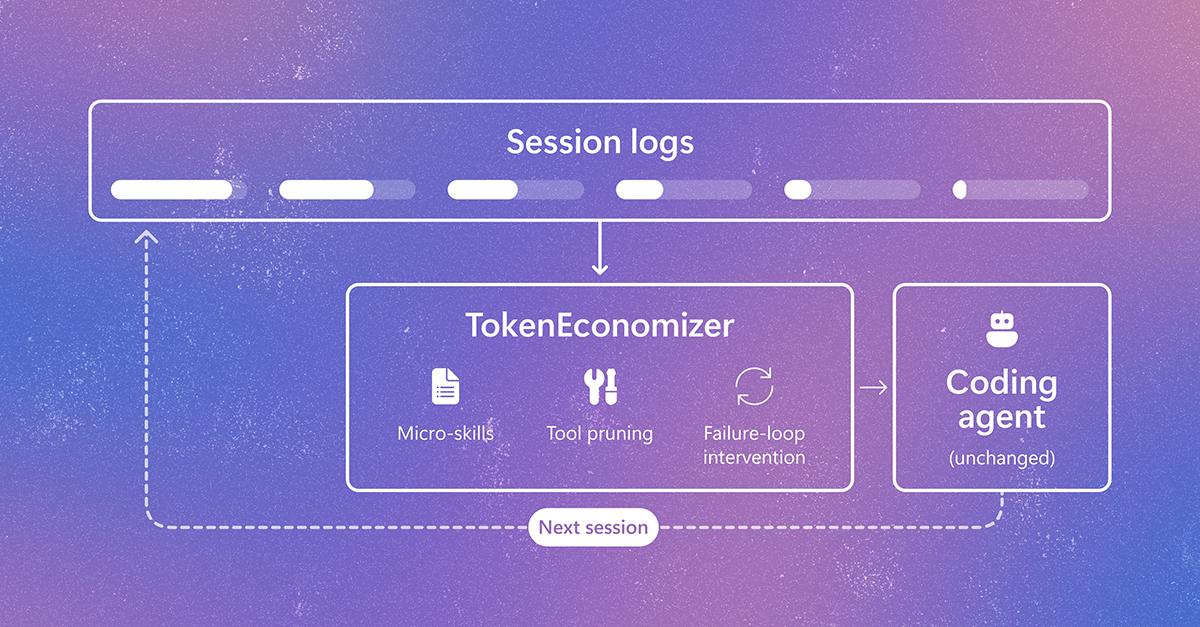
AI coding agents are increasingly help developers fix bugs and build features largely on their own, but every interaction with their models consumes tokens. In each session, an agent sends instructions, tool descriptions, and session history to its model. Most efforts to reduce this cost focus on individual tasks. Yet developers return to the same […] The post TokenEconomizer: Learning from Experience to Make AI Coding Agents More Efficient appeared first on Microsoft Research.
MIT News · Artificial Intelligence· news.mit.eduNov 13, 2026