Skip to content

Honesty is the Best Policy ... or is it? Demand Management for Probabilistic Service Options

Oct 2026 · 0 citations · 42 references
Computer Science Mathematics

Abstract

To enable well-informed customer choices and redistribute demand across service options, providers can display probabilities regarding predicted service levels at the time of booking, effectively offering probabilistic service options. In many service settings, the underlying truthful probabilities endogenously depend on the system state, rather than being static product attributes controlled by the provider. While customers rely on this information when making decisions, they cannot readily verify its accuracy. Consequently, providers may be tempted to manipulate the displayed probabilities to guide customers'choices in their favor, creating a novel lever for demand management. In this work, we model the resulting problem as a sequential decision process, define truthful probabilities recursively, and introduce transparency constraints that limit their distortion. Because the exact computation of truthful probabilities is intractable for realistic settings, we develop an adapted reinforcement learning algorithm to approximate them. Furthermore, we propose a sampling-based mixed-integer program to optimize the information communicated by the provider in each state. Our framework enables providers to gauge the benefits of dynamically disclosing probabilistic information at the time of booking and sheds light on incentives for manipulation. Our computational study is motivated by out-of-home delivery, i.e., the delivery to parcel lockers or shops, and reveals a trade-off between individual-level transparency and aggregate customer utilities.

View source

Similar papers

#artificial intelligence Preprint Jul 2024

The Llama 3 Herd of Models

It is found that Llama 3 delivers comparable quality to leading language models such as GPT-4 on a plethora of tasks, and performs competitively with the state-of-the-art on image, video, and speech recognition tasks.

Aaron Grattafiori, Abhimanyu Dubey, Abhinav Jauhri et al. · 21,082 citations · ⚡3,832
#artificial intelligence Conference Open access Jun 2018

Gibson Env: Real-World Perception for Embodied Agents

This paper investigates developing real-world perception for active agents, proposes Gibson Environment for this purpose, and showcases a set of perceptual tasks learned therein.

F. Xia, Amir Zamir, Zhi-Yang He et al. · 1,069 citations · ⚡112
#machine learning Review Open access Oct 2014

Software development in startup companies: A systematic mapping study

The results indicate that software engineering work practices are chosen opportunistically, adapted and configured to provide value under the constrains imposed by the startup context.

Nicolò Paternoster, Carmine Giardino, M. Unterkalmsteiner et al. · 394 citations · ⚡54

Diffusion models as plug-and-play priors

The possibility of inferring high-dimensional data inference in a model that consists of a prior and an auxiliary differentiable constraint given some additional information is considered, thereby allowing a range of potential applications in adapting models to new domains and tasks.

Alexandros Graikos, Esmeralda S. Whitammer, N. Jojic et al. · 316 citations · ⚡15

Trajectory Balance: Improved Credit Assignment in GFlowNets

It is proved that any global minimizer of the trajectory balance objective can define a policy that samples exactly from the target distribution, and empirically demonstrate the benefits of the trajectories balance objective for GFlowNet convergence, diversity of generated samples, and robustness to long action sequenc...

Esmeralda S. Whitammer, Moksh Jain, Emmanuel Bengio et al. · 302 citations · ⚡60

Related blog posts

Microsoft Research Blog Nov 16, 2026

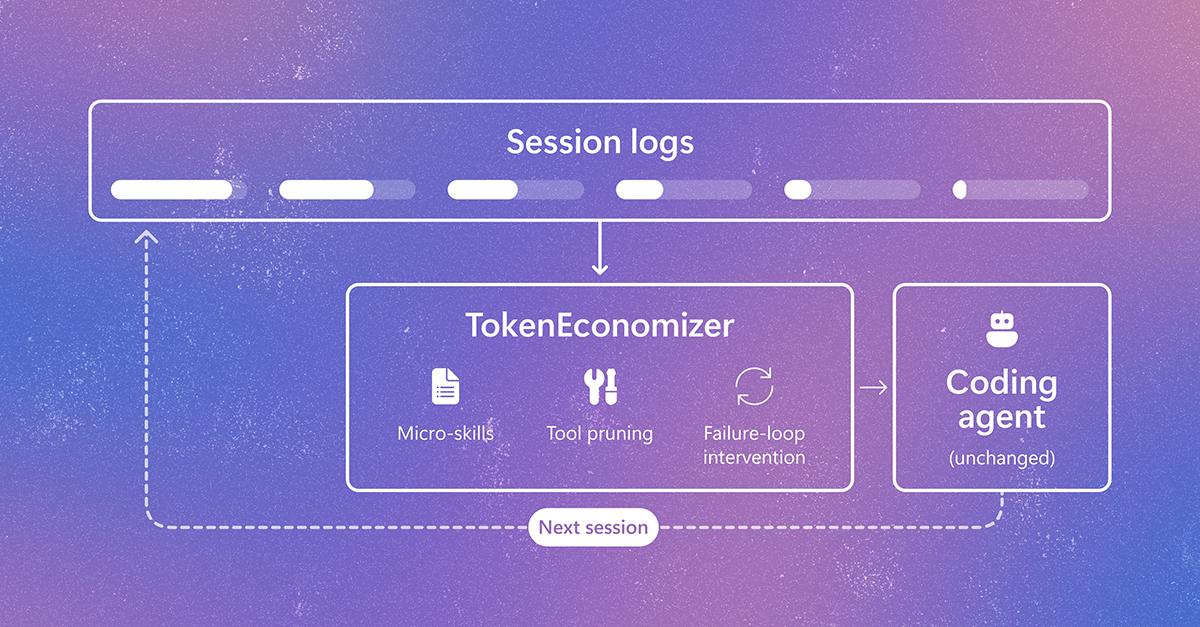
TokenEconomizer: Learning from Experience to Make AI Coding Agents More Efficient

AI coding agents are increasingly help developers fix bugs and build features largely on their own, but every interaction with their models consumes tokens. In each session, an agent sends instructions, tool descriptions, and session history to its model. Most efforts to reduce this cost focus on individual tasks. Yet developers return to the same […] The post TokenEconomizer: Learning from Experience to Make AI Coding Agents More Efficient appeared first on Microsoft Research.

We use cookies to run the site and, with your consent, for analytics and to show ads. See our Cookie Policy.