Speculative Decoding (SD) has demonstrated its efficacy in accelerating large language model inference, but for Vision-Language Models (VLMs), the diverse input modalities make it difficult for a small trained drafter to achieve consistently high throughput. Self-speculative decoding reuses parts of the target model as a drafter which retains the multi-modal capability of the VLMs, yet its efficiency depends on choosing a suitable draft configuration for each prompt. We propose Single-Peak SPeculative decoding (SP$^2$ec), a training-free bandit algorithm that adapts the draft configuration during generation. SP$^2$ec exploits the single-peak throughput pattern observed in existing self-speculative methods, including SWIFT, KnapSpec, SpecVLM, and our simple cosSim. Our algorithmic design explicitly minimizes a novel notion of wall-time regret for each given query, corresponding to the empirical wall-time latency. Theoretical guarantees on the wall-time regret show that SP$^2$ec can exploit the optimal draft configuration, with negligible exploration cost. Extensive experiments on Qwen2.5-VL-7B-Instruct and LLaVA-NeXT-Mistral-7B across visual and textual tasks show consistent improvements of up to 11\% over the original self-speculative methods, demonstrating the wide applicability of the proposed SP$^2$ec algorithm.
It is found that Llama 3 delivers comparable quality to leading language models such as GPT-4 on a plethora of tasks, and performs competitively with the state-of-the-art on image, video, and speech recognition tasks.
This paper investigates developing real-world perception for active agents, proposes Gibson Environment for this purpose, and showcases a set of perceptual tasks learned therein.
F. Xia, Amir Zamir, Zhi-Yang He et al.· 2018 IEEE/CVF Conference on...· 1,069 citations· ⚡112
Supporting data, adapters, predictions and code for the article *Low-Cost LoRA Fine-Tuning of Small Language Models for Multi-Step Arithmetic Reasoning* by Jake O'Grady, Asena Isik Gürhan, Chee Fong Ting and Effirul Ramlan (University of Galway). We generated 20,000 GSM8K-derived arithmetic problems with step-by-step s...
O'Grady, Jake, Gürhan, Asena Isik, Chee, Fong Ting et al.· Zenodo (CERN European Organi...· 465 citations
The results indicate that software engineering work practices are chosen opportunistically, adapted and configured to provide value under the constrains imposed by the startup context.
Nicolò Paternoster, Carmine Giardino, M. Unterkalmsteiner et al.· Information and Software Tec...· 394 citations· ⚡54
The possibility of inferring high-dimensional data inference in a model that consists of a prior and an auxiliary differentiable constraint given some additional information is considered, thereby allowing a range of potential applications in adapting models to new domains and tasks.
Alexandros Graikos, Esmeralda S. Whitammer, N. Jojic et al.· Neural Information Processin...· 316 citations· ⚡15
It is proved that any global minimizer of the trajectory balance objective can define a policy that samples exactly from the target distribution, and empirically demonstrate the benefits of the trajectories balance objective for GFlowNet convergence, diversity of generated samples, and robustness to long action sequenc...
Esmeralda S. Whitammer, Moksh Jain, Emmanuel Bengio et al.· Neural Information Processin...· 302 citations· ⚡60
Related blog posts
MIT News · Artificial Intelligence· news.mit.eduNov 17, 2026
By studying the computational foundations of language learning, Associate Professor Jacob Andreas builds intelligent systems that can communicate effectively with humans.
Microsoft Research Blog· microsoft.comNov 16, 2026
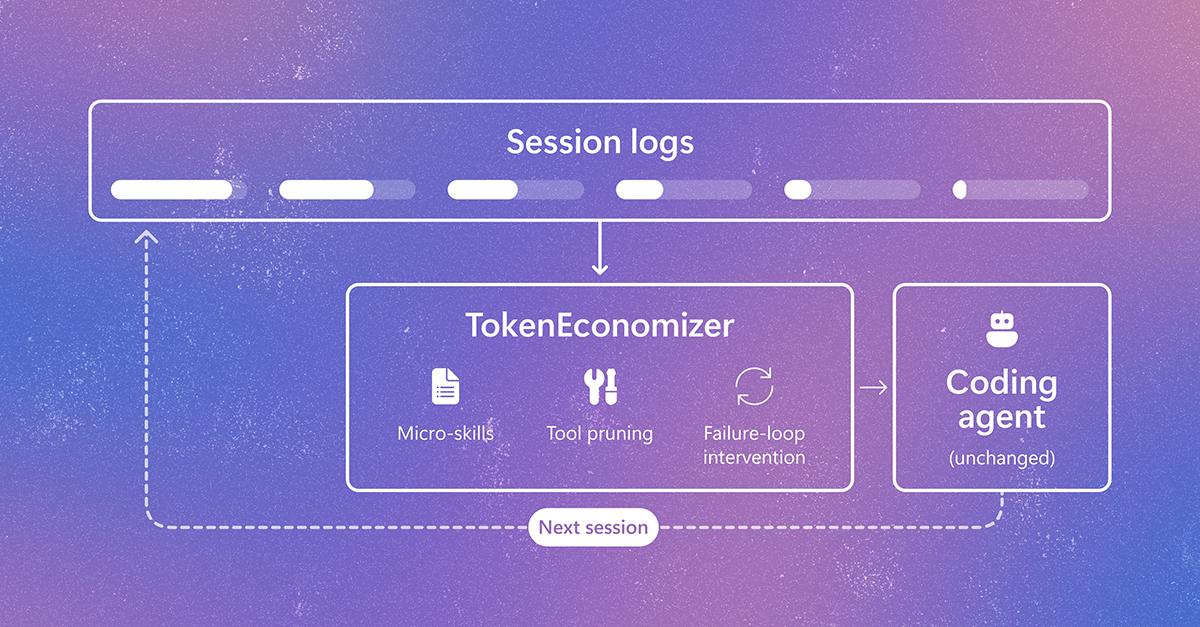
AI coding agents are increasingly help developers fix bugs and build features largely on their own, but every interaction with their models consumes tokens. In each session, an agent sends instructions, tool descriptions, and session history to its model. Most efforts to reduce this cost focus on individual tasks. Yet developers return to the same […] The post TokenEconomizer: Learning from Experience to Make AI Coding Agents More Efficient appeared first on Microsoft Research.
MIT News · Artificial Intelligence· news.mit.eduNov 9, 2026
Assistant Professor Benjamin Lindquist studies how engineers deliberately injected randomness into early AI, giving rise to deep-learning models that sometimes hallucinate.
We use cookies to run the site and, with your consent, for analytics and to show ads.
See our Cookie Policy.