Skip to content

When Variance Is Not an Error Map: Calibrated Uncertainty for Radiative Gaussian Splatting in Sparse-View CT

Jul 2026 · 0 citations · 33 references
Computer Science Engineering

TL;DR

A central lesson is to validate uncertainty in the region, and against the error target, for which it will be used, to validate uncertainty in the region, and against the error target, for which it will be used.

Abstract

Does an uncertainty map identify where a reconstruction is wrong? In sparse-view computed tomography (CT), we find a sharp gap between whole-volume evaluation and error localization inside the object. We derive clamp-aware analytic moments for factorized Gaussian-density distributions, with a variance pass through existing rendering interfaces that is $7.9\times$ faster than a 16-sample estimator. On a 15-scene benchmark, median variance--error Spearman correlation falls from $0.846$ over the whole volume to $0.108$ in foreground. The pattern recurs across representations and acquisition settings. Two analyses help explain the discrepancy: region contrast dominates global covariance, while $72$--$96\%$ of in-object squared error is shared across independently trained members. Spread is unchanged by a common error, although shared error alone does not determine ranking. Correcting the offset between the deployed reconstruction and predictive mean improves foreground correlation by only $0.0014$. The diagnosis separates two remedies. A log-normal control improves scale transfer without restoring localization; a supervised error predictor raises foreground correlation to $0.427$ on the benchmark and $0.566$ on eight held-out human subjects under simulated acquisition. A verified retrospective re-execution on eight additional subjects retains a median of $0.537$, with the same frozen predictors. The central lesson is to validate uncertainty in the region, and against the error target, for which it will be used.

View source

Similar papers

Sep 2026

Lightweight Cross-View Gradient Variance for Adaptive Density Control in 3D Gaussian Splatting

3D Gaussian Splatting has become an effective representation for real-time novel view synthesis by optimizing explicit 3D Gaussian primitives from a set of posed images. A key component of this framework is adaptive density control, where Gaussians are cloned, split, or pruned during training to improve scene coverage...

Javlon Tursunov, Gregor Rozinaj, Vivek Dwivedi et al. · 0 citations
#artificial intelligence Preprint Sep 2026

Depth Any Seen: Which Surfaces and How Far?

When several surfaces are visible along a ray, recovering visible 3D structure from one image requires jointly estimating their presence and metric depth. Depth Any Seen represents these surfaces as image-conditioned multi-Bernoulli depth sets, whose components each contribute one depth or remain absent. Its auxiliary-...

Xiao-Hao Xu, Xiao-Nan Huang · 0 citations
Preprint Sep 2026

Gauss What You Need: Compact Gaussian Splatting Across Scene Scales

3D Gaussian Splatting reconstructs a scene as a collection of Gaussian primitives from a set of posed photographs called the capture. The number of primitives used to represent the scene affects reconstruction quality, storage, and rendering cost. How to select this number automatically across capture scales remains un...

Afif Boudaoud, Jia-Yi Liu, A. Calotoiu et al. · 0 citations
Aug 2026

High-fidelity tomographic speckle imaging of scenes with spatially-varying point spread functions

We describe how a two-channel speckle imaging system can be effectively employed for high-fidelity imaging of objects observed under conditions where the point spread function varies spatially across the image. We show that this variation is present in images with fields-of-view as small as an isoplanatic patch, and th...

Fabien R. Baron, Daniel Johns, Stuart M. Jefferies et al. · 0 citations

Related blog posts

Microsoft Research Blog Aug 11, 2026

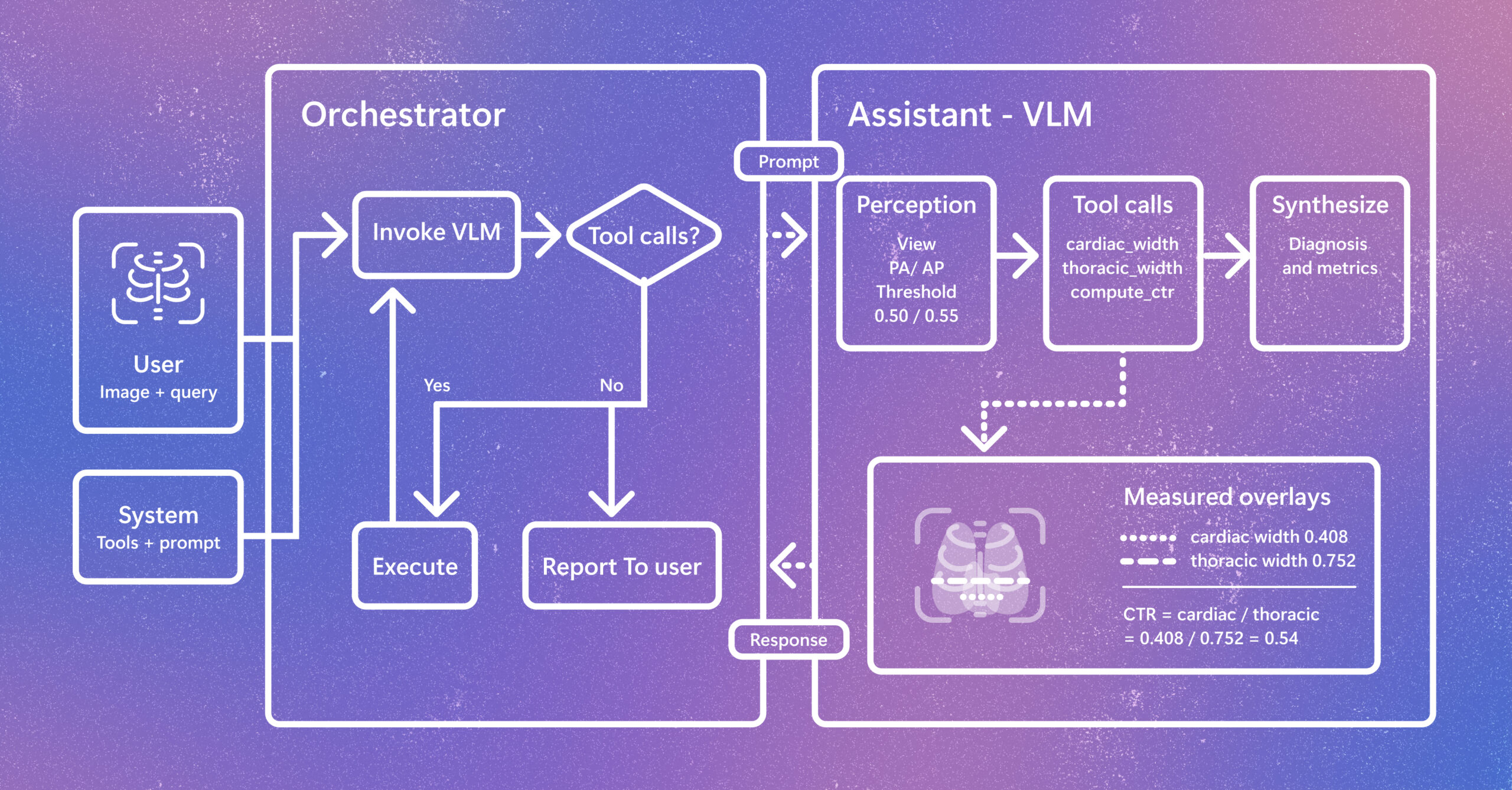
Introducing CARE-X: Towards Clinically Useful Radiology VLMs with Auxiliary Supervision, Reward-Aligned Learning, and Tool-Augmented Measurement

Radiology AI is evolving beyond report generation. CARE-X explores a unified approach that combines flexible reasoning, calibrated predictions, and measurement-based tools for chest X-ray interpretation. The post Introducing CARE-X: Towards Clinically Useful Radiology VLMs with Auxiliary Supervision, Reward-Aligned Learning, and Tool-Augmented Measurement appeared first on Microsoft Research.

We use cookies to run the site and, with your consent, for analytics and to show ads. See our Cookie Policy.