Jun 2017· International Conference on Software Business· pp. 146-160· 17 citations· ⚡ 2 influential· 32 references
Computer ScienceBusiness
TL;DR
This study explores how software firms interact with others in OSS ecosystems from a coopetition perspective, and finds that software firms emphasize the co-creation of common value and partly react to the potential competitiveness on O SS ecosystems.
Abstract
Software firms participate in an ecosystem as a part of their innovation strategy to extend value creation beyond the firm’s boundary. Participation in an open and independent environment also implies the competition among firms with similar business models and targeted markets. Hence, firms need to consider potential opportunities and challenges upfront. This study explores how software firms interact with others in OSS ecosystems from a coopetition perspective. We performed a quantitative and qualitative analysis of three OSS projects. Finding shows that software firms emphasize the co-creation of common value and partly react to the potential competitiveness on OSS ecosystems. Six themes about coopetition were identified, including spanning gatekeepers, securing communication, open-core sourcing and filtering shared code. Our work contributes to software engineering research with a rich description of coopetition in OSS ecosystems. Moreover, we also come up with several implications for software firms in pursing a harmony participation in OSS ecosystems.

This publication proposes a definition and a classification of agile software development approaches and analyses ten software development methods that can be characterized as being "agile" against the defined criterion.
P. Abrahamsson, O. Salo, Jussi Ronkainen et al.· arXiv.org· 727 citations· ⚡54
The study shows that agile practices improve both informal and formal communication, but indicates that, in larger development situations involving multiple external stakeholders, a mismatch of adequate communication mechanisms can sometimes even hinder the communication.
M. Pikkarainen, Jukka Haikara, O. Salo et al.· Empirical Software Engineeri...· 401 citations· ⚡48
The results indicate that software engineering work practices are chosen opportunistically, adapted and configured to provide value under the constrains imposed by the startup context.
Nicolò Paternoster, Carmine Giardino, M. Unterkalmsteiner et al.· Information and Software Tec...· 394 citations· ⚡54
The possibility of inferring high-dimensional data inference in a model that consists of a prior and an auxiliary differentiable constraint given some additional information is considered, thereby allowing a range of potential applications in adapting models to new domains and tasks.
Alexandros Graikos, Esmeralda S. Whitammer, N. Jojic et al.· Neural Information Processin...· 316 citations· ⚡15
It is proved that any global minimizer of the trajectory balance objective can define a policy that samples exactly from the target distribution, and empirically demonstrate the benefits of the trajectories balance objective for GFlowNet convergence, diversity of generated samples, and robustness to long action sequences and large action spaces.
Esmeralda S. Whitammer, Moksh Jain, Emmanuel Bengio et al.· Neural Information Processin...· 302 citations· ⚡60
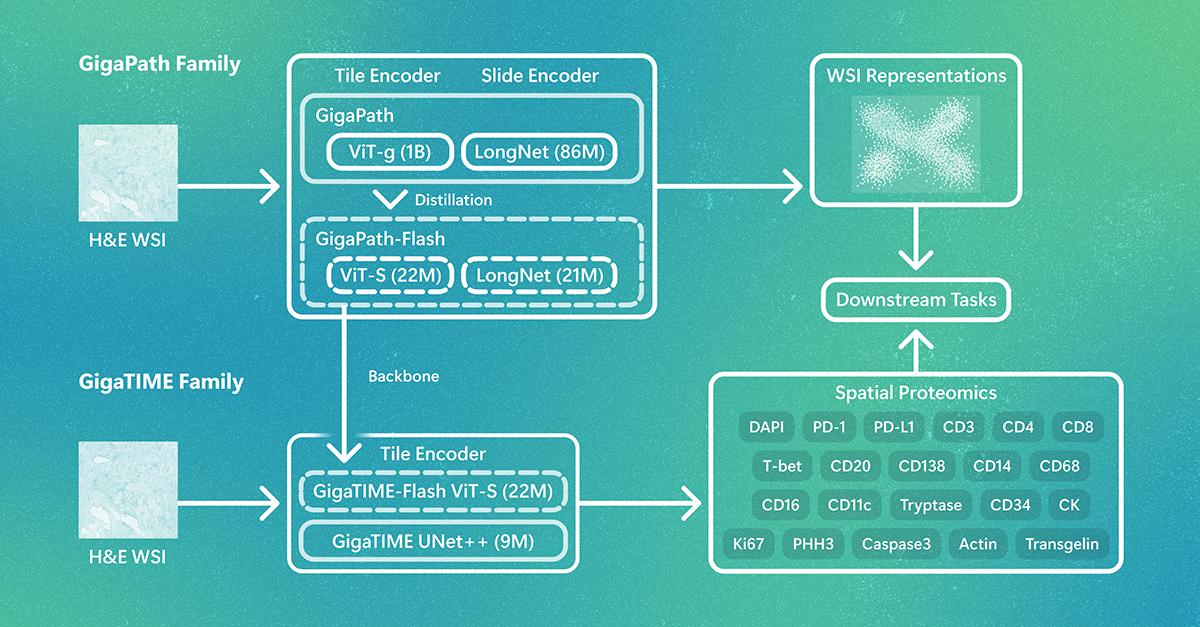
What if pathology foundation models could do more with less? GigaPath-Flash and GigaTIME-Flash cut computational demands while maintaining strong performance, opening the door to larger studies and broader exploration. The post GigaPath-Flash and GigaTIME-Flash: Toward population-scale discovery with efficient pathology foundation models appeared first on Microsoft Research.