It is shown in the paper that CodePori is able to generate running code for large-scale projects, completing the entire software development process in minutes rather than hours, and at a cost of a few dollars.
Large language model (LLM)-based multi-agent systems (MAS) have shown strong potential for solving complex tasks, yet their development forces a tradeoff: code frameworks are expressive but engineering-intensive, while no-code builders simplify authoring but constrain agent interactions to author-defined workflows. We present ChatDev 2.0: DevAll (hereafter DevAll), a no-code platform for building, executing, and inspecting heterogeneous MAS that delivers both high expressiveness and ease of use. In terms of expressiveness, DevAll pairs a declarative executable graph abstraction with a cycle-aware execution engine, so that heterogeneous agents and dynamic and cyclic interactions can be represented and executed within a single framework. For ease of use, an integrated visual interface lets users author, run, monitor, and inspect MAS, including human-in-the-loop steps, entirely without writing code. Experiments demonstrate that DevAll reproduces state-of-the-art MAS across three representative tasks at competitive performance and without task-specific orchestration code, highlighting its effectiveness as a general-purpose platform for LLM-based MAS. DevAll is available at https://github.com/OpenBMB/ChatDev.
Yu-Fan Dang, Shunyu Yao, Bo-Wen Lai et al.· 0 citations
A comprehensive overview of the existing tools and frameworks for implementing MAS in software engineering and a set of lessons learned and challenges that can help researchers and practitioners to select a suitable MAS framework according to their needs are provided.
Maria Sâmyla Serafim de Oliveira, M. Ibiyo, Marco Gianrusso et al.· 0 citations
This paper studies autonomous software development, in which LLM-based coding agents transform high-level requirements into complete, functional, and usable software systems without human intervention. We introduce Harness-of-Harness (HoH), a framework that enables coding agents to continually improve software during autonomous development. HoH operates on existing coding-agent harnesses, and organizes their executions into iterative planning-coding-testing loops. To sustain improvement across loops, HoH balances repair with capability growth, scopes development into small and verifiable increments, separates implementation-time testing from independent evaluation, and constrains verifiable outputs rather than prescribing agent workflows. It progressively exposes deliverables, role-specific tools, and skills, encourages reuse rather than recreation, and maintains versioned project histories. On GameCraft-Bench, FrontierSWE, and ProgramBench, three harness-model pairs (Codex with GPT-5.5, OpenCode with DeepSeek-V4-Pro, and Pi with MiniMax-M3), HoH consistently outperforms the corresponding standalone harnesses, achieving an average relative gain of 52.25 percent and a maximum gain of 82.86 percent after three iterations. In a multi-day deployment with more than 70 iterations, HoH autonomously develops a first-person-shooter game, featuring a coherent storyline, fully implemented core mechanics, human-playable experience, polished visuals and integrated audio. Github: https://github.com/Flesymeb/HarnessOfHarness Project Page: https://flesymeb.github.io/HarnessOfHarness/
Hao Yan, Min-Le Su, Hangfan Zhang et al.· 0 citations
MindForge is introduced, an automated pipeline that converts open-source command-line programs into source-free environments that expose only a compiled reference executable and its documentation that consistently improves over the base model across all seven unseen software engineering benchmarks, spanning long-horizon repository generation and translation.
Yihao Chen, Shi Chang, Khaled Chawa et al.· arXiv.org· 0 citations
TestAgent is proposed, an LLM-based test generation approach that addresses the above limitations by emulating human testing practices via a multi-agent collaboration mechanism and equips TestAgent with a set of tool APIs that can be invoked dynamically in an on-demand and adaptive manner.
Quanjun Zhang, Ye Shang, Siqi Gu et al.· arXiv.org· 0 citations
Real-world software systems are inherently multilingual, but current large language models are not equally consistent across programming languages. This mismatch limits code generation usefulness, especially for underrepresented languages. Existing approaches improve code generation through fine-tuning, multi-agent reasoning, or translation, but remain language-specific, assume existing source code, or rely on per-language test suites. We introduce XL-CoGen, a three-stage multilingual code-generation pipeline that starts from a natural-language specification and a shared test list to generate correct implementations across multiple target languages. XL-CoGen first validates direct generation by constructing and correcting the test harness; when it fails, it transfers through empirically selected intermediate languages and translates validated solutions; it then repairs the best candidate through diagnosis and minimal patching. This design requires neither target-language training nor language-specific test suites. Across two benchmarks and multiple LLMs, XL-CoGen consistently improves over direct generation, with the largest gains on low-performing languages. In our Rust fine-tuning case study, XL-CoGen outperforms the best fine-tuned baseline by 22 percentage points and improves challenging languages by up to 33 points on multilingual benchmarks. Ablation results show that transfer and repair are complementary: repair suffices on easier tasks, whereas transfer becomes more important as difficulty increases, especially for weak target languages.
Micheline Bénédicte Moumoula, Serge Lionel Nikiema, Albérick Euraste Djiré et al.· ACM Transactions on Software...· 0 citations
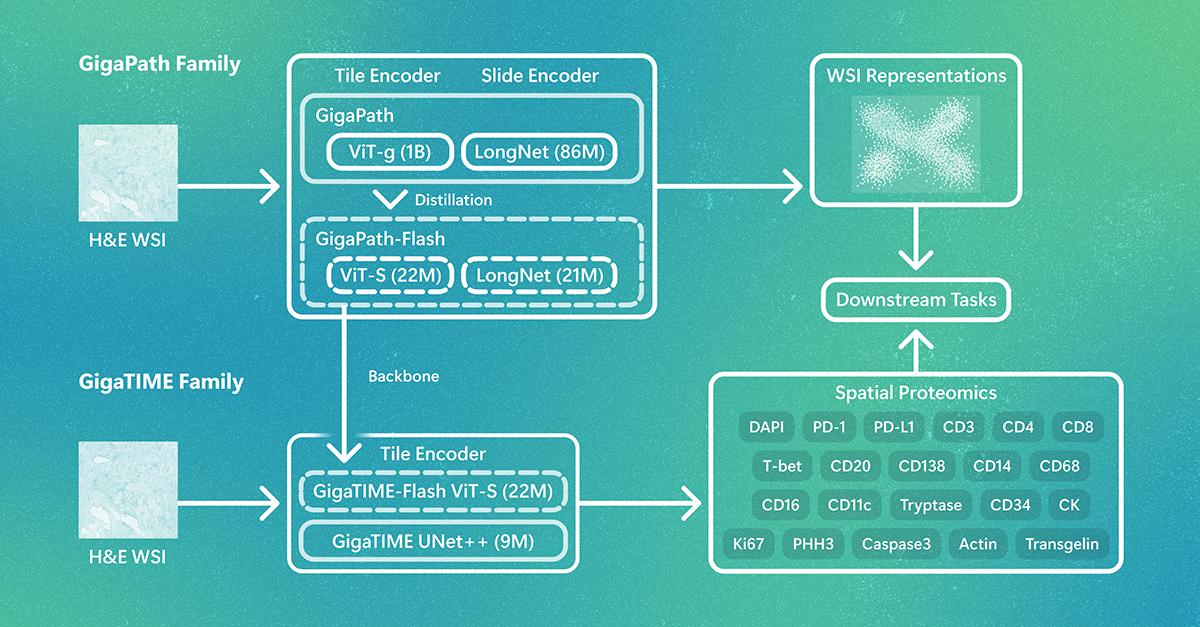
What if pathology foundation models could do more with less? GigaPath-Flash and GigaTIME-Flash cut computational demands while maintaining strong performance, opening the door to larger studies and broader exploration. The post GigaPath-Flash and GigaTIME-Flash: Toward population-scale discovery with efficient pathology foundation models appeared first on Microsoft Research.